
Most feedback tools are closed-source SaaS products. Your data lives on the vendor's servers, you pay per seat or per tracked user, and the vendor controls pricing. Canny moved from per-admin to tiered tracked-user billing in 2025. Productboard charges $15–19 per maker per month with AI limited to 250 credits per maker. UserVoice starts at $16,000 per year. With closed-source tools, pricing and feature availability can change at the vendor's discretion.
Open source feedback tools remove that risk. You get data ownership: your feedback lives in your database, on your infrastructure, under your control. No vendor lock-in: if the project's direction changes, you fork it. Predictable costs: self-hosting means you pay for compute, not per-seat licenses that scale with your team. And auditability: you can read every line of code, review every dependency, and verify exactly what the software does with your data.
The open source landscape for feedback tools has matured. There are now several viable options, each with different trade-offs in features, tech stack, and community activity. Here are the five most notable open source feedback tools in 2026, compared side by side.
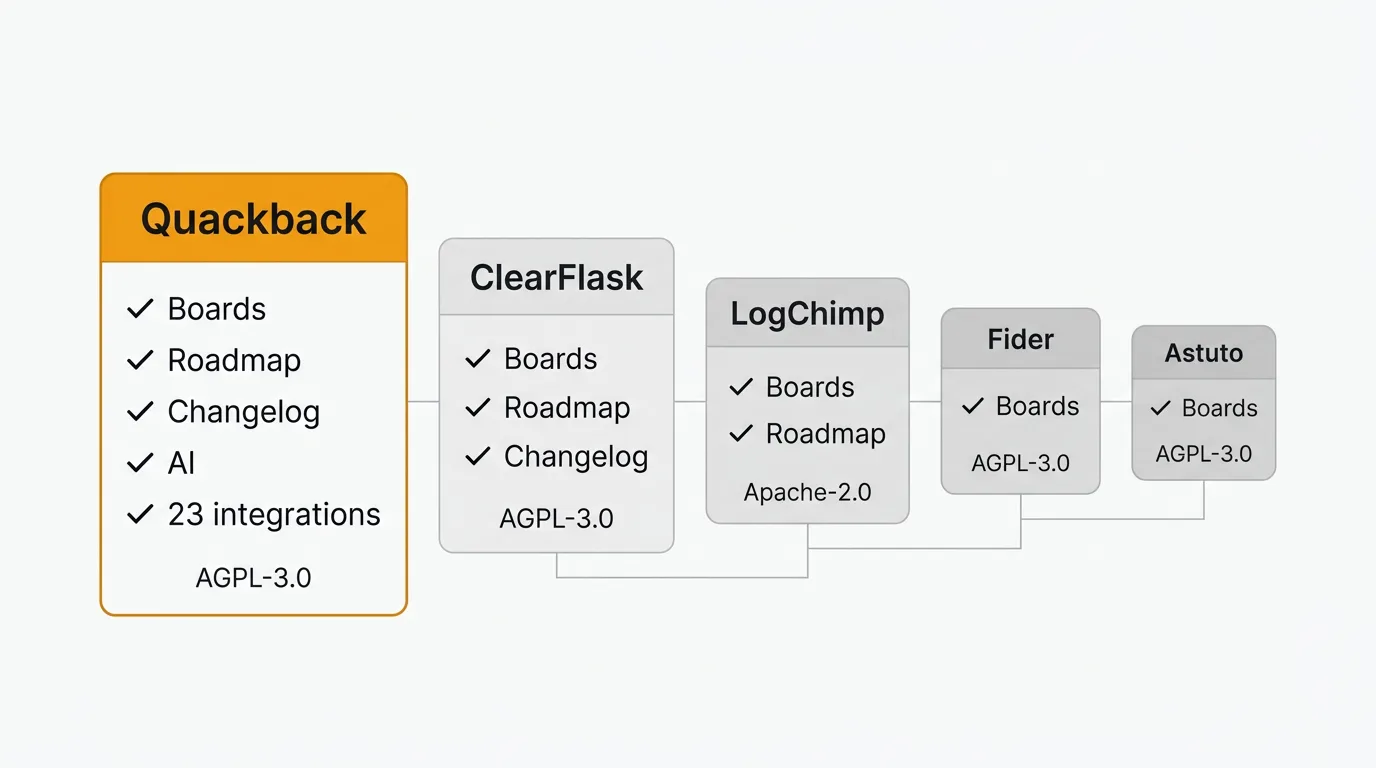
TLDR: The best open source feedback tools in 2026: Quackback (most complete — boards, roadmap, changelog, AI, 25 integrations), Fider (basic but proven), ClearFlask (feature-rich but complex), plus LogChimp and Astuto. All self-hostable with Docker.
Pricing last verified March 2026. Vendors may change plans and pricing without notice. Check each vendor's pricing page for the latest figures.
Quackback
Quackback is an open source customer feedback platform licensed under AGPL-3.0. It covers the full feedback workflow: feature voting boards, a public roadmap, changelogs, SSO/OIDC, a REST API, and 25 integrations including Slack, Linear, Jira, GitHub, Intercom, Zendesk, and Salesforce.
What separates Quackback from other open source options is scope. Most open source feedback tools handle the basics: collect votes, show a board. Quackback matches the feature set of commercial tools like Canny and UserVoice, then adds capabilities they don't offer.
The AI features are built in. Duplicate detection catches redundant posts before they pile up. Merge suggestions identify related requests with reasoning your team can accept or dismiss in one click. Sentiment analysis runs on every post automatically. Summaries pull out key quotes and next steps. The AI features work with OpenAI-compatible providers (OpenAI, Azure OpenAI, Cloudflare AI Gateway, or any compatible provider).
The MCP server is unique among feedback tools, open source or otherwise. It implements the Model Context Protocol, the same standard that Claude, Cursor, and Windsurf support. Connect an AI agent and it gets full access to your feedback data: search posts, triage requests, write responses, create changelog entries, and merge duplicates. Every action is attributed and auditable. This means your existing AI agents can participate in your feedback loop without custom integrations.
Deploy with Docker on any infrastructure. Your data stays in your PostgreSQL database. Self-hosting has no license fees. You can also see how Quackback stacks up against specific tools: compared to Canny and compared to Fider.
Key features:
- Feature voting boards with status tracking, nested comments, and official responses
- Public roadmap with planned, in progress, and shipped views
- Changelog with automatic voter notifications
- AI: duplicate detection, merge suggestions, sentiment analysis, post summaries
- MCP server for AI agents (search, triage, respond, create, merge)
- 25 integrations: Slack, Linear, Jira, GitHub, Intercom, Zendesk, Salesforce, and more
- SSO/OIDC, webhooks, full REST API
- Custom branding with themes, custom CSS, and your own domain
- User segments and admin inbox with bulk actions
License: AGPL-3.0
Tech stack: TypeScript, PostgreSQL, Docker
Deployment: Docker Compose or one-click deploy on Railway. See the self-hosting docs for setup instructions.
Pros:
- Full-featured: covers boards, roadmap, changelog, integrations, and AI in a single product
- AI features built in, working with OpenAI-compatible providers
- MCP server enables AI agent access, a capability no other feedback tool offers
- Free to self-host with full data ownership
- Managed Cloud takes the ops off your plate — backups, updates, and uptime handled
- Active development with frequent releases
Cons:
- Self-hosting requires running your own infrastructure (or a one-click Railway deploy)
- Newer project compared to some alternatives on this list
Fider
Fider is an open source feedback tool licensed under AGPL-3.0. It's built with Go and React, backed by PostgreSQL, and deploys with Docker. Fider handles the core feedback collection workflow: users submit ideas, vote on them, and leave comments. Admins manage posts with tags, custom statuses, and filters.
Fider has been around since 2017 and has a stable codebase. If you need a straightforward voting board and nothing more, it does the job well. The interface is clean, the setup is simple, and the Go binary runs with minimal overhead — 256MB of RAM is typically sufficient.
Where Fider falls short is everything beyond the basics. There's no changelog. No roadmap view. No AI features. Integrations are limited to webhook-based connections with Slack, Discord, and Microsoft Teams. There's no native Jira, Linear, or GitHub integration. The project moved to an open-core model in v0.33.0, which put content moderation and SEO indexing behind the paid cloud tier.
Key features:
- Feedback boards with voting, comments, and rich text editor
- Tags, filters, and customizable statuses
- REST API and webhooks (4 event types)
- Multi-language support (10+ languages, including RTL)
- SSO with OAuth providers
- Markdown support in posts and comments
License: AGPL-3.0
Tech stack: Go, React, PostgreSQL
Deployment: Docker on any cloud provider or on-premises. Also available as a managed cloud service.
Pros:
- Mature and stable codebase (since 2017)
- Lightweight and resource-efficient thanks to Go
- Simple to set up and operate
- Multi-language support included (10+ languages)
Cons:
- No changelog, no roadmap view, no AI features
- Limited integrations (webhooks only, no native issue tracker connections)
- Open-core model means some features are paywalled on the cloud version
- Development pace has slowed in recent years
- No duplicate detection, no post merging
LogChimp
LogChimp is an open source feedback board and roadmap tool. It's built with Node.js and Vue.js. The project aims to give teams a simple way to collect feature requests and display a public roadmap.
LogChimp covers the essentials: users can submit feedback, vote on posts, and view a roadmap. The interface is minimal and clean. Setup requires Node.js 14+ and a PostgreSQL database. There is no official Docker image, so you run it directly or build your own container.
The concern with LogChimp in 2026 is development activity. Commits have become infrequent. The community is small, and the feature set has not expanded significantly. Open issues and pull requests on GitHub suggest limited maintainer bandwidth. If you adopt LogChimp, you should be comfortable maintaining a fork if the project stalls further.
Key features:
- Feedback boards with voting
- Public roadmap view
- Post statuses and categorization
- REST API
- Email notifications
License: MIT
Tech stack: Node.js, Vue.js, PostgreSQL
Deployment: Manual Node.js deployment or Docker.
Pros:
- Simple and lightweight
- MIT license (permissive, no copyleft restrictions)
- Clean interface
Cons:
- Development has slowed significantly
- Small community with limited support
- No AI features, no changelog, no SSO
- Limited integrations
- Documentation is sparse
- No duplicate detection or post merging
Astuto
Astuto is an open source feedback tool licensed under GPL-3.0. It's built with Ruby on Rails and React, and it deploys with Docker. Astuto provides feedback boards where users can submit ideas, vote, and comment.
Astuto is deliberately minimal. The scope is limited to boards, voting, comments, statuses, and basic customization. It runs on a single Rails process with PostgreSQL, so resource requirements are low — 512MB of RAM is sufficient for small deployments.
The trade-off is feature ceiling. There is no public roadmap view, no changelog, no AI features, no integrations with issue trackers like Jira or Linear, and no SSO. If you start with Astuto and later need these capabilities, you will need to migrate to a different tool.
Key features:
- Feedback boards with voting and comments
- Custom statuses and board categories
- Custom branding (logo, colors)
- Multi-language support
- Webhooks for basic automation
- User roles and moderation
License: GPL-3.0
Tech stack: Ruby on Rails, React, PostgreSQL
Deployment: Docker Compose. Official Docker images available.
Pros:
- Genuinely simple to deploy and run
- Lightweight resource requirements
- Clean, focused interface
- Active maintainer responsive to issues
Cons:
- No roadmap view, no changelog
- No AI features
- No integrations with issue trackers (Jira, Linear, GitHub)
- No SSO/OIDC
- Limited to basic feedback collection
- Small community
ClearFlask
ClearFlask is an open source feedback platform licensed under AGPL-3.0. It was originally a commercial SaaS product that later released its source code. The platform includes feature voting, a public roadmap, a changelog, and user segmentation.
ClearFlask is the most feature-rich option on this list after Quackback. It supports idea boards with voting, a roadmap with multiple views, a changelog with subscriber notifications, and basic analytics. The platform also includes features like credit-based voting (where users have a limited number of votes to distribute) and single sign-on.
The trade-off is operational complexity. ClearFlask is built with Java (Spring Boot) and React. The JVM requires at least 2GB of RAM for the application server alone. Setup involves multiple services (application server, database, search index), and the documentation for self-hosting assumes familiarity with Java ecosystems. Development has slowed since the open source release, and the community is small.
Key features:
- Feature voting boards with multiple vote types (including credit-based voting)
- Public roadmap with timeline and column views
- Changelog with subscriber notifications
- User segmentation and analytics
- SSO support
- REST API
- White-labeling and custom domains
License: AGPL-3.0
Tech stack: Java (Spring Boot), React, MySQL/DynamoDB
Deployment: Docker, though setup is more involved than other tools on this list. Requires multiple services.
Pros:
- Feature-rich for an open source tool (roadmap, changelog, analytics, SSO)
- Multiple voting mechanisms including credit-based voting
- White-labeling support
- Originally battle-tested as a commercial product
Cons:
- Complex setup compared to alternatives
- Heavier infrastructure requirements (Java, multiple services)
- Development has slowed since going open source
- Small community and limited documentation for self-hosting
- No AI features, no MCP server
- No native integrations with issue trackers
Comparison table
| Feature | Quackback | Fider | LogChimp | Astuto | ClearFlask |
|---|---|---|---|---|---|
| License | AGPL-3.0 | AGPL-3.0 | MIT | GPL-3.0 | AGPL-3.0 |
| Feedback Boards | Yes | Yes | Yes | Yes | Yes |
| Public Roadmap | Yes | No | Yes | No | Yes |
| Changelog | Yes | No | No | No | Yes |
| AI Features | Yes (duplicate detection, sentiment, merge suggestions, summaries) | No | No | No | No |
| MCP Server | Yes | No | No | No | No |
| SSO | Yes (OIDC/SAML) | Yes (OAuth) | No | No | Yes |
| Integrations | 23 (Slack, Jira, Linear, GitHub, Intercom, Zendesk, Salesforce, etc.) | 3 (Slack, Discord, Teams via webhooks) | None | Webhooks only | None |
| Docker Deploy | Yes | Yes | Yes | Yes | Yes (complex) |
| Active Development | Yes | Slowed | Minimal | Moderate | Slowed |
How to choose
Start with what you actually need today and what you'll need in six months.
If you just need a voting board: Fider or Astuto will get you running in minutes. Fider is more mature and has multi-language support. Astuto is simpler and lighter. Both handle the basics well. The limitation is that "the basics" is all they handle. When you need a roadmap, changelog, or integrations, you'll hit a wall.
If you need the full feedback workflow: Quackback and ClearFlask are the two options that cover boards, roadmap, and changelog. Quackback adds 25 integrations, AI features, and an MCP server. ClearFlask offers credit-based voting and analytics but has a more complex setup and slower recent development. Evaluate both against your specific requirements.
If you want the simplest possible setup: Astuto is the lightest option. A single Docker Compose command gets you a working feedback board. Good for side projects, internal tools, or early-stage products where you just need a place for users to submit ideas.
If permissive licensing matters: LogChimp is the only MIT-licensed option. The others use copyleft licenses (AGPL-3.0 or GPL-3.0). If your organization has restrictions on copyleft software, LogChimp may be the only option, though the slow development pace is a real risk.
If AI and automation matter: Quackback is the only open source feedback tool with built-in AI. Duplicate detection, sentiment analysis, merge suggestions, and post summaries are included. The MCP server means your AI agents in Claude, Cursor, or Windsurf can search, triage, and respond to feedback without custom code. No other open source tool on this list offers AI features of any kind.
If you're migrating from a commercial tool: If you're moving from Canny, UserVoice, or another paid platform, evaluate whether the open source option covers the features you actually use. Quackback and ClearFlask are the most feature-complete options on this list (boards, roadmap, changelog). For a broader comparison that includes commercial tools, see feedback tools compared.
Frequently asked questions
What is an open source feedback tool?
An open source feedback tool is software for collecting and managing customer feedback where the source code is publicly available. You can read, modify, and redistribute the code under the terms of its license. This means you can self-host the tool on your own infrastructure, audit what it does with your data, and customize it for your specific needs. The alternative is closed-source SaaS tools like Canny or UserVoice, where you rely on the vendor to host, maintain, and control the software.
Can I self-host these tools?
Yes. All five tools on this list support self-hosting with Docker. The complexity varies. Astuto and Fider are the simplest to deploy: a single Docker Compose file with a PostgreSQL database. Quackback is similarly straightforward with Docker Compose or a one-click Railway deploy. Check the Quackback self-hosting docs for a step-by-step guide. LogChimp requires a Node.js setup. ClearFlask has the most involved deployment, requiring multiple services and familiarity with Java infrastructure.
Are open source feedback tools really free?
The software itself is free. You don't pay license fees, per-seat charges, or subscription costs. You do pay for the infrastructure to run it: a server, a database, and whatever compute resources the tool needs. For most of these tools, a small VPS ($5-20/month) is sufficient. That's a fixed, predictable cost, unlike SaaS pricing that scales with users or seats. Some tools (Fider and Quackback) also offer managed cloud versions if you'd rather not run your own infrastructure.
How do open source feedback tools compare to Canny or UserVoice?
The core workflow is the same: collect feature requests, let users vote, show a roadmap, publish a changelog. The difference is in control and cost. Canny uses tiered pricing with tracked user limits and auto-upgrades you if you exceed your tier. UserVoice starts at $16,000/year. Neither offers self-hosting or source code access. Open source tools like Quackback give you the same features with full data ownership and the ability to audit and modify the code. The trade-off historically was that open source tools had fewer features. That gap has closed. Quackback now offers feature voting, roadmaps, changelogs, 25 integrations, and AI features that match or exceed what commercial tools provide.
What is the best open source alternative to Canny?
Quackback is the closest open source equivalent to Canny. It covers the same core features: feature voting boards, public roadmap, changelog, SSO, and integrations with tools like Slack, Jira, Linear, and GitHub. It also includes AI features (duplicate detection, sentiment analysis, merge suggestions) and an MCP server for AI agent access, neither of which Canny offers. Self-hosting is free. For a detailed comparison, see Quackback vs Canny.

Authored by James Morton
Founder of Quackback. Building open-source feedback tools.
Try Quackback
The open-source feedback platform. Boards, voting, and roadmaps.
Get startedStar on GitHub305