Feedback tool pricing is confusing. One vendor charges per tracked user. Another charges per "maker." A third won't even show you a price without a sales call. Some bill per board, some per seat, some per resolution. A few are free. Figuring out what you'll actually pay, especially as your team and user base grow, requires reading fine print, running estimates, and sometimes just asking.
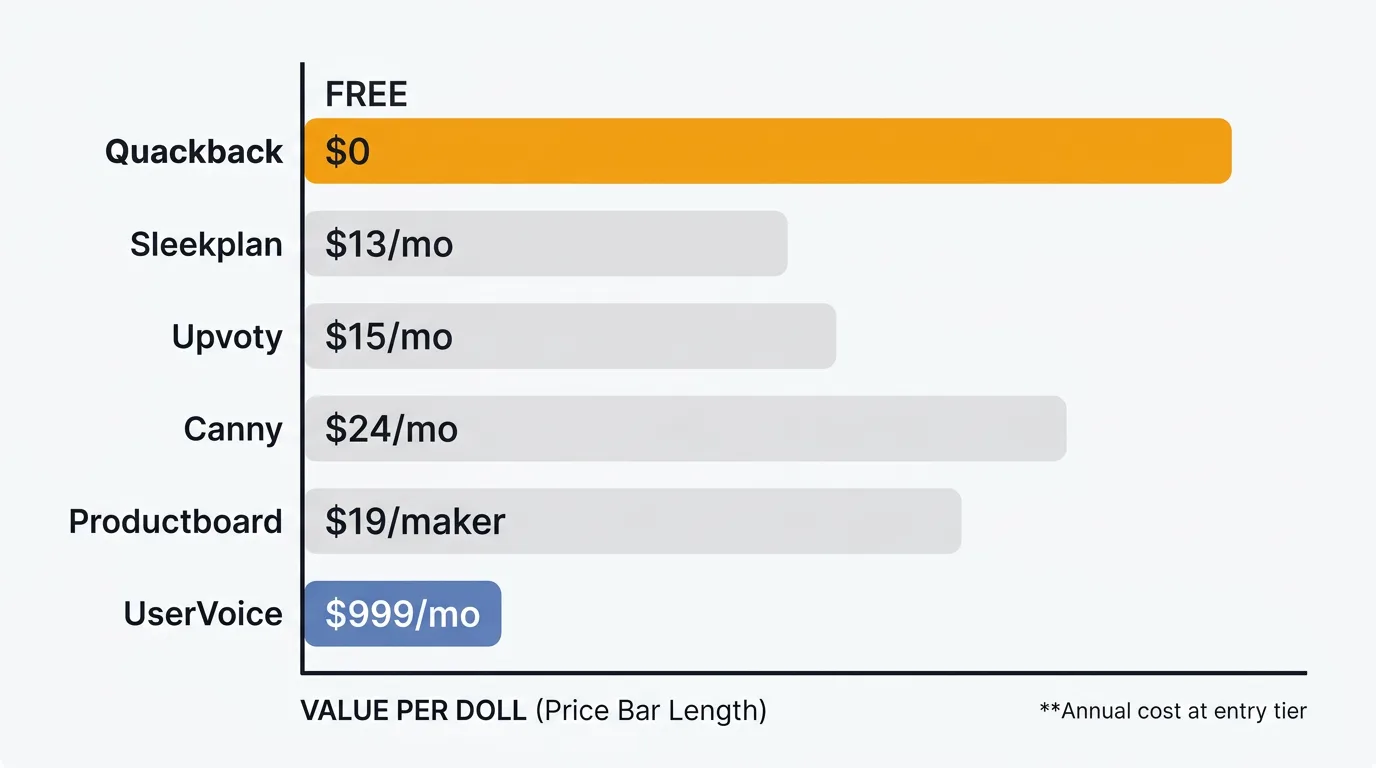
Feedback tool pricing ranges from free (Quackback, Fider) to $16,000+/year (UserVoice). Billing models vary: tiered by tracked users (Canny), per maker (Productboard), per seat, or enterprise quotes. Quackback is open source — free to self-host, or run it on a managed Quackback Cloud plan when you want zero infrastructure to maintain.
Pricing last verified March 2026. Vendors may change plans and pricing without notice. Check each vendor's pricing page for the latest figures.
This guide compares the pricing of the most popular customer feedback tools in 2026. No vague ranges where exact numbers exist. No "contact sales" where public pricing is available. The goal is a clear picture of what each tool costs at every scale, so you can make a decision based on numbers rather than marketing pages.
Pricing models explained
Before comparing specific tools, it helps to understand the billing models the market has settled on. There are six distinct approaches.
Tiered by tracked users (Canny)
Canny uses tiered pricing based on "tracked users" — anyone who has a post, vote, or comment attributed to them in your workspace. Each plan tier includes a set number of tracked users. If you exceed your limit, Canny auto-upgrades you to the next tier (you can set spend caps to prevent this). A five-person startup with 2,000 active feedback users pays more than a fifty-person company with 50 internal users. The risk is crossing tier thresholds unexpectedly. A viral feature request or a support tool integration that attributes feedback to customers can push your tracked-user count past a tier limit, triggering an auto-upgrade. See the full Canny pricing breakdown for details.
Per maker (Productboard)
Productboard charges per "maker" — anyone who creates or manages product content. Viewers and contributors who only submit feedback don't count toward your bill. This model scales with team size rather than user engagement. Under the new Spark plan, a team of 5 makers pays $75/mo (annual) or $95/mo (monthly). A team of 20 pays $300/mo (annual). AI is included via 250 credits per maker per month. See the full Productboard pricing breakdown.
Per user (Aha!)
Aha! Ideas charges a flat per-user rate. Ideas Essentials is $39/user/month. Ideas Advanced is $59/user/month. If you also use Aha! Roadmaps (which most Ideas customers do), that's another $59/user/month. For a team of 10, you're looking at $590–1,180/mo on Ideas alone, or $1,180–1,780/mo with Roadmaps included.
Enterprise quote (UserVoice, Pendo)
UserVoice and Pendo don't offer self-service pricing. UserVoice starts at $16,000/year (~$1,333/mo) with annual billing. Pendo doesn't publish prices at all — customers report annual contracts starting at $20,000–50,000+ depending on MAUs and modules. Both require a sales process before you can evaluate the product. See the full UserVoice pricing breakdown.
Flat rate (Nolt, Upvoty)
Nolt and Upvoty use flat-rate pricing that doesn't scale with users or team size. Nolt charges $29/mo for one board (Essential, billed annually) or $69/mo for five boards (Pro). Upvoty charges $15/mo for one board (Power) or $39/mo for unlimited boards (Superpower). The trade-off is a narrower feature set — neither offers AI, and both are limited in integrations compared to more expensive tools.
Free and open source (Quackback, Fider)
Quackback and Fider are both open source and free to self-host. There are no feature gates tied to pricing tiers. Your only cost is infrastructure — typically $5–20/mo for a small VPS. Quackback includes the full feature set (feedback boards, voting, public roadmap, changelogs, 25 integrations, SSO/OIDC, and AI features) at no cost. Fider covers the basics (voting boards, comments, tags) but has no changelog, no roadmap view, and no AI.
Pricing comparison table
Here's every major feedback tool compared across the dimensions that affect your bill.
| Tool | Starting Price | Billing Model | Free Tier | SSO Plan | AI Features | Self-Hosting |
|---|---|---|---|---|---|---|
| Canny | Free (25 tracked users) | Tiered by tracked users | Yes (25 tracked users) | Business (custom pricing) | Autopilot (all plans) | No |
| UserVoice | $16,000/yr (~$1,333/mo) | Enterprise quote (annual) | 30-day trial | Included | Included | No |
| Productboard | $15/maker/mo (annual) | Per maker | No | Enterprise only | Included via credits (250/maker/mo) | No |
| Aha! Ideas | $39/user/mo | Per user | No | Enterprise only | Included on higher tiers | No |
| Pendo | ~$20,000+/yr | Enterprise quote (MAU-based) | No | Included | Included | No |
| Featurebase | $29/seat/mo | Per seat | Yes (1 seat) | Professional ($59/seat/mo) | Fibi ($0.49/resolution) | No |
| Nolt | $29/mo | Per board | No | All paid plans | No | No |
| Upvoty | $15/mo | Per board | No | No | No | No |
| Sleekplan | $13/mo | Flat rate (tiered) | Yes (1 seat, limited) | Business ($38/mo) | 1,000 credits on Starter | No |
| Quackback | Free self-hosted / $29/mo Cloud | Self-hosted or workspace | Self-hosting (full features) · Cloud Free (1 seat) | Free self-hosted · Enterprise ($99/mo) on Cloud | Quinn on paid Cloud · BYOK self-host | Yes |
| Fider | Free | Free / self-hosted | Yes (basic features) | OAuth included | No | Yes |
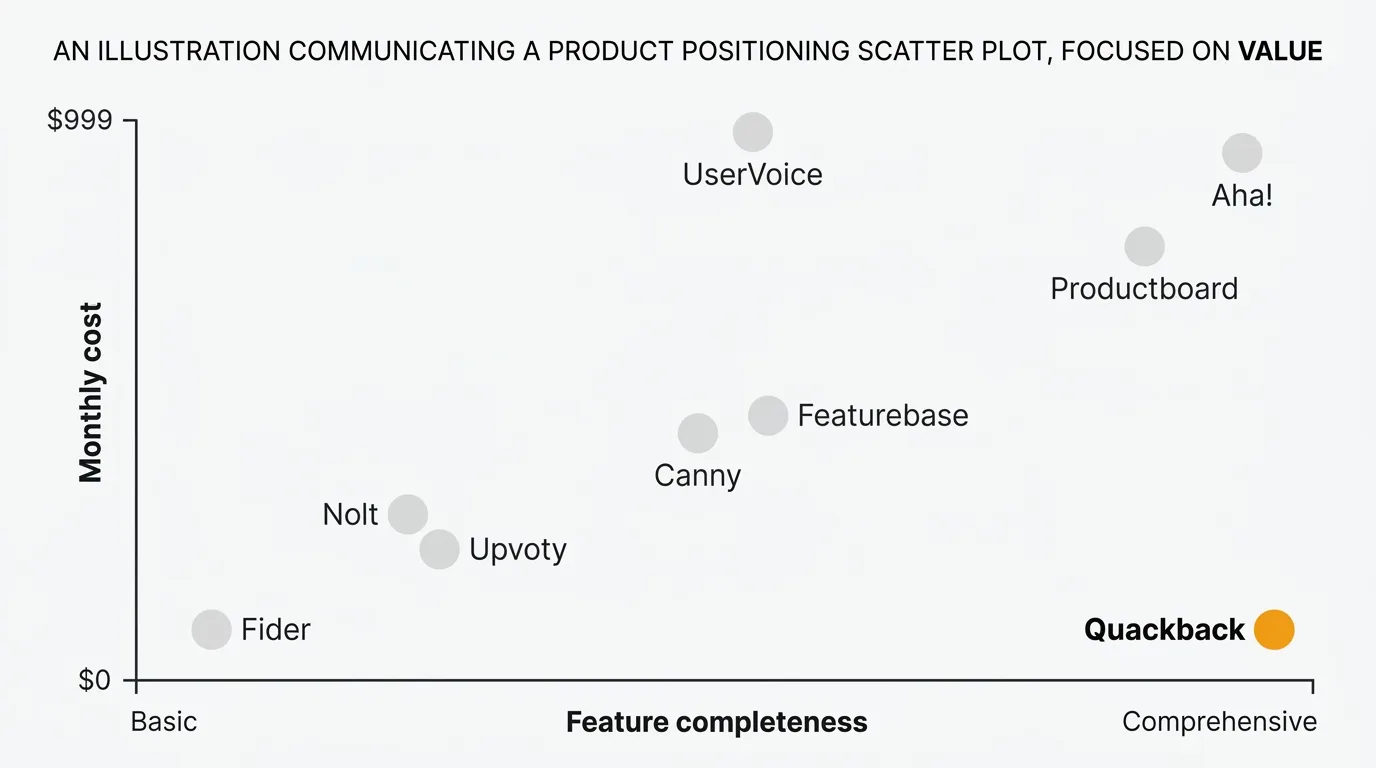
A few things stand out. SSO is consistently locked behind expensive plans across closed-source tools. Canny requires the Business plan (custom pricing). Featurebase requires $59/seat/mo Professional. Productboard and Aha! gate it to Enterprise tiers. Self-hosted Quackback and Fider include SSO at no extra cost. On Quackback Cloud, SSO sits on the Enterprise plan ($99/mo), but it is self-serve with no seat minimums and no sales call, unlike the custom-priced enterprise gates elsewhere in this table.
AI features follow a similar pattern. Productboard includes AI via credits (250 per maker per month on the Spark plan), which may limit heavy users. Featurebase charges $0.49 per AI resolution. Canny includes Autopilot AI on all plans, including the free tier. Self-hosted Quackback includes all AI features with your own model key. Quackback Cloud includes Quinn on every paid plan, with Standard usage on Pro, Higher on Business, and Maximum on Enterprise, plus $10 top-up packs, and no per-resolution fee. It also ships an MCP server, so you can query and triage feedback from Claude or Cursor, a capability none of the closed-source tools here offer.
Cost at scale
The table above shows starting prices. What matters more is what you pay as your product and user base grow. Here's the estimated monthly cost at different scales for the four tools that teams most often compare.
| Users / Scale | Canny (Pro est.) | UserVoice | Productboard (Spark, 10 makers) | Quackback |
|---|---|---|---|---|
| 100 users | $19–79/mo (Core or Pro) | $1,333/mo | $150/mo | Self-host $0 · Cloud from $29/mo |
| 500 users | $79+/mo (higher tier) | $1,333/mo | $150/mo | Self-host $0 · Cloud from $29/mo |
| 1,000 users | Higher tier (est.) | $1,333/mo | $150/mo | Self-host $0 · Cloud from $29/mo |
| 5,000 users | Business (custom pricing) | $1,333/mo+ | $150/mo | Self-host $0 · Cloud from $29/mo |
| 10,000 users | Business (custom pricing) | Custom (higher volume) | $150/mo | Self-host $0 · Cloud from $29/mo |
A few notes on how to read this table.
Canny uses tiered pricing with tracked user limits. The free plan covers 25 tracked users. Core starts at $19/mo and Pro at $79/mo, each with 100+ tracked users at the base tier. As your tracked user count grows, you move into higher tiers within your plan. Business requires 5,000+ tracked users and uses custom pricing.
UserVoice has a flat entry point of $16,000/year (~$1,333/mo) with custom pricing based on feedback volume and integrations. There are no per-seat charges. Higher-volume organizations pay more based on their usage and integration needs.
Productboard scales with makers (team members), not end users. A team of 10 makers on the Spark plan pays $150/mo (annual) regardless of whether 100 or 10,000 users submit feedback. AI is included via credits (250 per maker per month). The cost grows when you add makers, not when your user base grows.
Quackback is free to self-host. The cost is your infrastructure: a VPS at $5–20/mo for small deployments, potentially more for high-traffic installations. Quackback Cloud has a Free plan with 1 seat, and paid plans start at $29/mo billed annually.
Each tool scales differently. Canny's costs increase as you cross tracked user tier thresholds. UserVoice has a high floor regardless of scale. Productboard scales with team size. Quackback Cloud is a flat workspace price with included seats, not a per-end-user meter. Self-hosting keeps the software subscription at zero but requires infrastructure management.
Hidden costs to watch for
Every feedback tool has costs that don't appear on the pricing page. These are common across the category.
SSO tax. If your organization requires SAML or OIDC single sign-on for compliance, expect to pay a premium. Canny gates SSO to the Business plan (custom pricing). Featurebase gates end-user SSO to the $59/seat/mo Professional plan and admin SAML/SCIM to Enterprise at $99/seat with a 5-seat minimum. Productboard reserves it for Enterprise tiers with custom pricing. UserVoice includes security and compliance features but requires a $16,000+/year contract. For a 10-person team that needs SSO, the "SSO tax" alone can add $200–400/mo to your bill. Quackback includes SSO/OIDC free on every self-hosted installation, and on Cloud it is a listed self-serve price (Enterprise, $99/mo) rather than a sales conversation.
AI credit and usage limits. Productboard includes AI via credits (250 per maker per month on the Spark plan). Teams with heavy AI usage may find this constraining. Featurebase charges $0.49 per AI resolution: at 500 resolutions per month, that's $245/mo. Quackback Cloud includes Quinn on every paid plan with $10 top-up packs, so there is no per-resolution line item. Canny includes Autopilot AI on all plans, including the free tier. These charges and limits are easy to miss during evaluation.
Tracked-user accumulation. Canny's tracked users accumulate over time. Once someone votes, comments, or submits a post, they count toward your limit indefinitely. Over time, your tracked-user count only goes up. A product with years of feedback history accumulates thousands of tracked users, even if most are no longer active. This can push you into higher tiers based on historical engagement you no longer benefit from.
Integration limits. Canny's Core plan includes custom domains and translations. PM integrations like Jira, ClickUp, and Linear require the Pro plan at $79/mo. Nolt locks several integrations behind the Pro plan at $69/mo. Evaluate whether the integrations you need are included in the tier you're considering, not just the tier above it.
Branding removal fees. Removing "Powered by [tool name]" branding from your feedback portal often requires an expensive plan upgrade. Canny requires the Business plan (custom pricing) to remove branding. This is a cost that matters if your feedback portal is customer-facing and you want a professional appearance.
Onboarding and implementation time. Enterprise tools like UserVoice and Pendo require weeks of setup: sales demos, contract negotiation, CRM integration, team training. During this time, you're paying for the subscription but not yet collecting feedback at full capacity. Simpler tools (Nolt, Sleekplan, Quackback) let you start collecting feedback in minutes or hours.
The cheapest options by category
Not every team needs the same thing. Here's the cheapest option for four common scenarios.
Best free option
Quackback is free, open source (AGPL-3.0), and self-hosted, with a managed Cloud from $29/mo. Self-hosted, it includes feedback boards, voting, a public roadmap, changelogs, a status page, support inbox, help center, integrations, SSO/OIDC, and AI features; your only cost is infrastructure. Fider is another free, open-source option with a lighter feature set (voting boards, comments, tags). Both require self-hosting.
Best under $50/mo
Sleekplan at $13/mo (Starter) gives you feedback boards, a roadmap, changelog, CSAT/NPS surveys, and 1,000 AI credits. It's the cheapest hosted option that covers the full feedback workflow. Upvoty at $15/mo is another option if you want boards, roadmap, and changelog without AI. Nolt at $29/mo is simpler but includes SSO on all paid plans, which is notable given how many tools gate SSO to expensive tiers.
Best open source
Quackback covers the full feedback workflow (boards, voting, roadmap, changelog, AI, integrations). Fider is lighter and simpler, covering voting boards, comments, and tags. Both are free to self-host. For a deeper comparison, see Open Source Feedback Tools.
Best enterprise value
If your organization requires enterprise features (SSO, advanced analytics, CRM integration) but wants to avoid UserVoice or Pendo pricing, there are several paths.
Self-hosted or managed: self-hosted Quackback includes SSO/OIDC, all integrations, AI features, and a REST API at infrastructure cost only. Quackback Cloud starts at $29/mo billed annually. Quinn is included on paid plans, with $10 top-up packs if you need more, plus a bundled status page. Portal users are free.
Mid-range hosted: Canny's Pro plan ($79+/mo depending on tracked user tier) or Featurebase's Growth plan ($29/seat/mo) offer solid features at a fraction of UserVoice's entry point. Both scale with usage over time. Quackback Cloud's Pro plan starts at $29/mo and includes tickets, a status page, and API access that Featurebase reserves for higher tiers.
Enterprise hosted with CRM integration: If you need revenue-linked prioritization with Salesforce data, UserVoice and Productboard are the established options. The cost is higher, but the capability is unique.
For detailed breakdowns, see Canny pricing, UserVoice pricing, and Productboard pricing.
Try Quackback — open source with a managed cloud option. Start free. Get started | View on GitHub
Frequently asked questions
What is the cheapest customer feedback tool?
For self-hosted: Quackback is free with no user or feature limits. Your only cost is a server ($5–20/mo for most teams). For cloud-hosted: Sleekplan starts at $13/mo, Upvoty at $15/mo, and Canny has a free plan (25 tracked users) and Core starts at $19/mo. Sleekplan and Upvoty include flat-rate pricing that doesn't scale with users. Canny's tiered tracked-user model means costs increase when you cross tier thresholds.
Why do feedback tools charge per seat or per user?
Per-seat and per-user pricing lets vendors scale revenue with customer growth. The logic is that larger teams get more value, so they should pay more. The problem is that it creates friction: teams hesitate to add new members because each seat costs money. Tiered tracked-user pricing (Canny's model) can be unpredictable because crossing tier thresholds triggers auto-upgrades, and your tracked user count is driven by external engagement you don't fully control. Open source tools like Quackback, which you self-host, sidestep that dynamic.
Is it worth paying for a feedback tool or should I use a free one?
It depends on your team's needs and capacity. Free, open-source tools like Quackback and Fider cover the core feedback workflow when self-hosted, and Quackback Cloud offers a managed plan if you want zero infrastructure responsibility without giving up the full feature set. Paid hosted tools like Sleekplan ($13/mo) or Nolt ($29/mo) also remove that overhead at a modest cost. Enterprise tools like UserVoice ($16,000+/year) and Pendo ($20,000+/yr) are harder to justify on price alone, but they offer unique capabilities (revenue-linked prioritization, product analytics) that cheaper tools don't replicate.
How do I estimate my total cost of ownership for a feedback tool?
Start with the base subscription price, then add: the SSO plan upgrade if you need it, AI add-on costs, the number of seats or tracked users you expect in 12 months (not just today), integration costs if key integrations are locked to higher tiers, and the time cost of onboarding and setup. For enterprise tools like UserVoice or Pendo, add the implementation timeline (2–6 weeks where you're paying but not fully operational). For self-hosted tools like Quackback, your total cost is your server bill. For a broader view of the tools available, see Best Customer Feedback Tools in 2026.

Authored by James Morton
Founder of Quackback. Building open-source feedback tools.
Try Quackback
The open-source feedback platform. Boards, voting, and roadmaps.
Get startedStar on GitHub262