
Amplitude's free tier tracks 50,000 monthly users. That is generous for a startup. The problem starts when you grow past it and discover what enterprise product analytics actually costs.
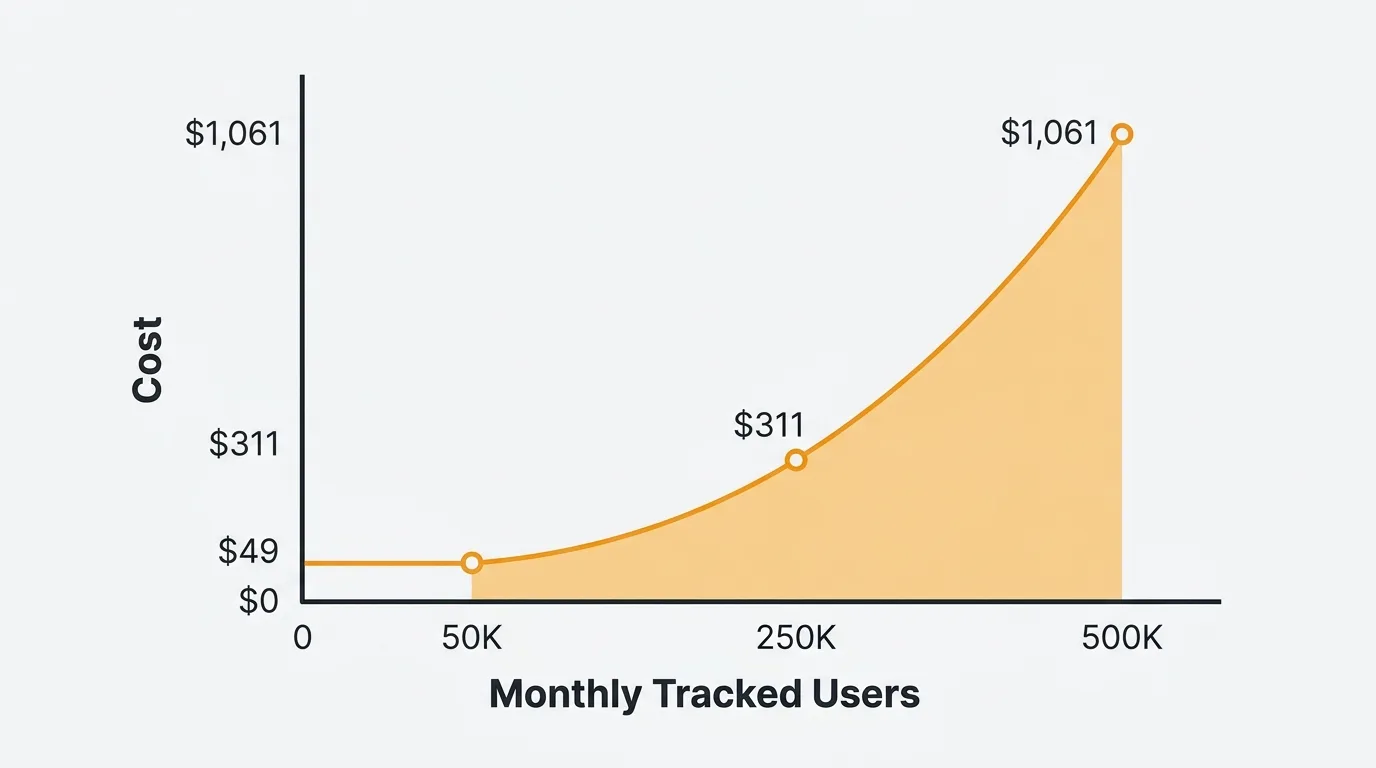
Amplitude offers four plans: a free Starter tier (50,000 MTUs), Plus from $49/month, and custom Growth and Enterprise contracts. It bills on a dual model — monthly tracked users (MTUs) and events per MTU — so you can exceed either limit independently and pay 1.2x your rate on the overage. Mixpanel and the open-source PostHog are usually cheaper and easier to budget at scale.
Pricing last verified March 2026. Vendors may change plans and pricing without notice.
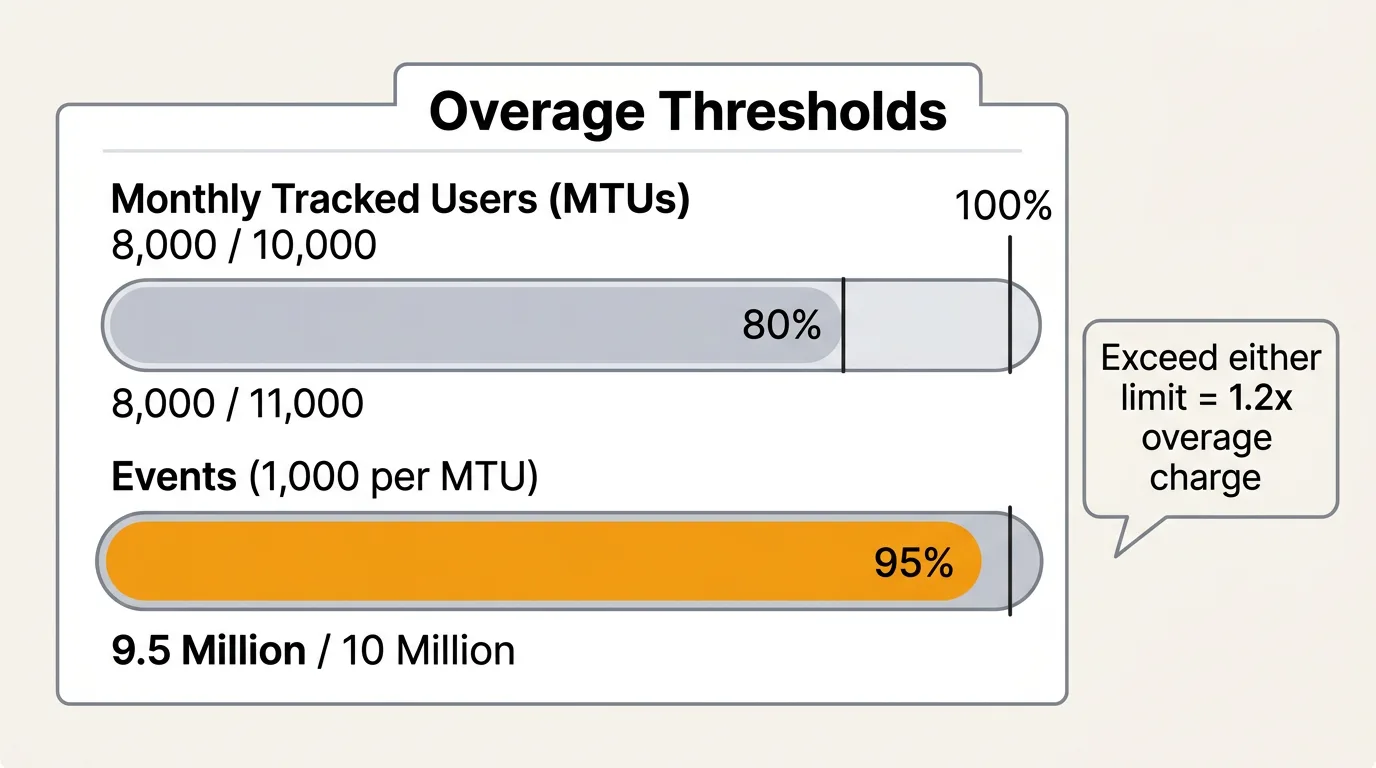
Amplitude uses a dual billing model: monthly tracked users (MTUs) and events per MTU. You can be under your user limit but over on events, or vice versa. Both trigger overage charges at 1.2x your contracted rate. This makes budgeting difficult for products with unpredictable growth or power-user-heavy engagement patterns.
Amplitude pricing plans
| Plan | Price | MTU limit | Data retention |
|---|---|---|---|
| Starter (Free) | $0 | 50,000 MTUs | 12 months |
| Plus | From $49/mo | 1,000-300,000 MTUs | Up to 2 years |
| Growth | Custom | 300,000+ MTUs | Custom |
| Enterprise | Custom | 500,000-1M+ MTUs | Custom |
Plus plan pricing by MTU volume
| MTUs | Monthly cost | Annual cost |
|---|---|---|
| 1,000 | ~$61 | ~$588 |
| 10,000 | ~$161 | ~$1,548 |
| 25,000 | ~$311 | ~$2,988 |
| 50,000 | ~$561 | ~$5,388 |
| 100,000 | ~$1,061 | ~$10,188 |
Annual billing saves approximately 20%. The Plus plan tops out around 300,000 MTUs — beyond that, you need a Growth or Enterprise contract.
Real-world contract costs
Based on verified contract data from Vendr's marketplace, the median Amplitude contract is roughly $63,720 per year. Companies tracking 100,000 to 500,000 MTUs commonly pay $30,000 to $150,000 annually. Deployments exceeding one million MTUs can exceed $200,000 per year.
How MTU and event billing works
Monthly Tracked Users (MTUs) are the primary billing unit. Any end user who triggers at least one event in a calendar month counts as one MTU.
Events are capped relative to MTUs. You get 1,000 events per MTU purchased. A plan with 10,000 MTUs allows 10 million events per month. Exceed either limit and Amplitude charges 1.2x your per-unit rate for the overage.
What counts as an event: Any tracked user action — page views, button clicks, form submissions, API calls, feature interactions. Each discrete action is one event.
The dual constraint: This is where costs get unpredictable. A product with 5,000 monthly users who each trigger 500 events is fine on a 10,000 MTU plan (5,000 MTUs used, 5 million events used out of 10 million). But a product with 5,000 power users who each trigger 3,000 events would exceed the event cap (15 million events vs 10 million allowed) while being under the MTU limit. Both users and events can trigger overages independently.
Monthly reset: MTU and event counts reset on the first of each calendar month. Overages are calculated on the last day of each month.
What each plan includes
Starter (free)
Foundational product analytics, session replay, unlimited feature flags, unlimited data sources and destinations, and starter templates. Limited chart saves and no custom events. Adequate for early-stage products that need basic analytics without advanced segmentation.
Plus ($49+/month)
Everything in Starter plus unlimited chart saves, custom events, dashboard filters and formulas, up to five behavioral cohorts, custom audiences and syncs, AI-powered data assistant, data quality monitoring, and online support.
Growth (custom pricing)
Everything in Plus plus advanced behavioral analysis, custom KPI metrics, causal insights monitoring, A/B and multivariate testing (Amplitude Experiment), real-time data streaming and syncs, and priority support.
Enterprise (custom pricing)
Everything in Growth plus advanced governance and security (SOC 2, HIPAA compliance), dedicated support and customer success manager, custom data retention, bundled Experiment and CDP capabilities, and SSO/SCIM provisioning.
Hidden costs and gotchas
Overage penalties
Exceeding your MTU or event cap triggers a 1.2x multiplier on your contracted rate. An unexpected traffic spike — a product going viral, a bot crawling your site, a marketing campaign outperforming projections — can generate significant overage charges before you can react.
Add-on products
Several capabilities that many teams consider core are sold as separate products:
- Amplitude Experiment (A/B testing): $20,000-$60,000+ per year
- Amplitude CDP (data streaming and audience syncing): $15,000-$50,000+ per year
- Professional services (implementation, training): $10,000-$50,000+ for enterprise
Contract lock-in
Growth and Enterprise plans are typically annual contracts. Cancellation means paying through the end of the term.
The event-per-MTU cap
This is the most common surprise. Teams budget for a certain number of MTUs without realizing that event volume per user can independently trigger overages. Products with power users (project management tools, analytics dashboards, collaboration platforms) hit this ceiling faster than expected.
Free and cheaper alternatives
| Tool | Free tier | Paid starting price | Billing model | Best for |
|---|---|---|---|---|
| Mixpanel | 1M events/mo | ~$0.28/1K events | Per event | Mid-market analytics, transparent pricing |
| PostHog | 1M events + 5K recordings/mo | ~$0.05/1K events | Per event, usage-based | Technical teams, self-hosting option |
| Heap | 10K sessions/mo, 6-month retention | ~$2,500/mo (Growth) | Per session | Auto-capture, low-engineering-effort teams |
| Google Analytics 4 | Unlimited (with sampling) | $50,000/yr (GA4 360) | Free / enterprise | Marketing analytics, basic product |
Mixpanel is the most direct competitor. One million free events per month is generous. Pricing is transparent and per-event, making it easier to budget than Amplitude's dual MTU+event model. At 10 million events per month, Mixpanel costs roughly $2,520/month compared to Amplitude's custom Growth pricing.
PostHog is the cheapest at scale — 30-50% less than SaaS competitors. Open source with a self-hosting option. One million free events per month with volume discounts up to 82%. Best for technical teams willing to invest in setup.
Heap captures everything automatically without manual event instrumentation. The trade-off is cost — the Growth plan at approximately $100,000 per year for 5 million sessions is expensive. Heap was acquired by Contentsquare.
Google Analytics 4 is free and unlimited for basic web analytics, but it is not a product analytics tool. It lacks behavioral cohorts, funnel analysis, and the event-level granularity that Amplitude, Mixpanel, and PostHog provide.
Pairing quantitative analytics with qualitative feedback
Product analytics tools like Amplitude tell you what users do. They do not tell you why. A drop in feature adoption shows up in the data, but the reason — confusing UI, missing functionality, or a competitor doing it better — requires qualitative signal.
Pairing analytics with a customer feedback tool closes this gap. When Amplitude shows declining engagement with a feature, feedback from your feedback board explains what went wrong. When a feature request gets 200 votes, Amplitude data shows whether the requesting users are high-value or at-risk. The quantitative and qualitative signals reinforce each other.
This is where Quackback fits. Quackback is open source (AGPL-3.0) and self-hostable for free, with a managed Quackback Cloud for teams that do not want to run infrastructure. Its built-in AI triages and summarizes feedback, and an MCP server lets you query feedback directly from AI tools alongside your Amplitude data. The result is a single place where quantitative signal and qualitative "why" sit side by side.
Is Amplitude worth it?
Amplitude is a strong product analytics platform with deep behavioral analysis capabilities. For teams that need cohort analysis, funnel optimization, and experimentation, the feature set is competitive with Mixpanel and more advanced than PostHog for non-technical users.
The value breaks down at two points. First, the MTU+event dual billing model makes costs unpredictable for growing products. Second, the opaque pricing on Growth and Enterprise plans forces sales conversations that smaller teams want to avoid. If transparent pricing and predictable costs matter more than the most advanced feature set, Mixpanel or PostHog are better fits.
For teams under 50,000 MTUs, the free Starter plan is one of the most generous in product analytics. Use it until you outgrow it, then compare Amplitude Plus pricing against Mixpanel and PostHog before committing.
Try Quackback — open source with a managed cloud option. Start free. Get started | View on GitHub
Frequently asked questions
Does Amplitude have a free plan?
Yes. Amplitude Starter is free for up to 50,000 monthly tracked users with 12 months of data retention. It includes foundational analytics, session replay, and unlimited feature flags. The main limitations are restricted chart saves and no custom events.
How does Amplitude's MTU billing work?
A Monthly Tracked User (MTU) is any end user who triggers at least one event in a calendar month. You also get 1,000 events per MTU purchased. Exceed either your MTU cap or your total event cap and Amplitude charges 1.2x your contracted rate for the overage.
Is Amplitude cheaper than Mixpanel?
At low volumes, Amplitude's free tier (50K MTUs) is more generous than Mixpanel's (1M events but no MTU-based allocation). At mid-to-high volumes, Mixpanel's transparent per-event pricing is typically cheaper and more predictable than Amplitude's custom Growth and Enterprise quotes. The median Amplitude contract is roughly $63,720/year based on Vendr's verified deal data.
What is the cheapest product analytics tool?
PostHog is the cheapest at scale — open source, self-hostable, with usage-based pricing roughly 30-50% lower than Amplitude or Mixpanel. One million free events per month with volume discounts up to 82%. The trade-off is that it requires more technical setup and the UI is less polished for non-technical users.
Can I use Amplitude for free long-term?
Yes. The Starter plan has no time limit. As long as you stay under 50,000 MTUs, it is free indefinitely. The limitations (12-month data retention, limited chart saves, no custom events) are real but acceptable for early-stage products that need basic analytics.

Authored by James Morton
Founder of Quackback. Building open-source feedback tools.
Try Quackback
The open-source feedback platform. Boards, voting, and roadmaps.
Get startedStar on GitHub305