
Most IT roadmaps fail. Not because the technology decisions are wrong, but because the roadmap itself never leaves the slide deck it was born in. It gets presented once, filed somewhere in SharePoint, and ignored until the next planning cycle.
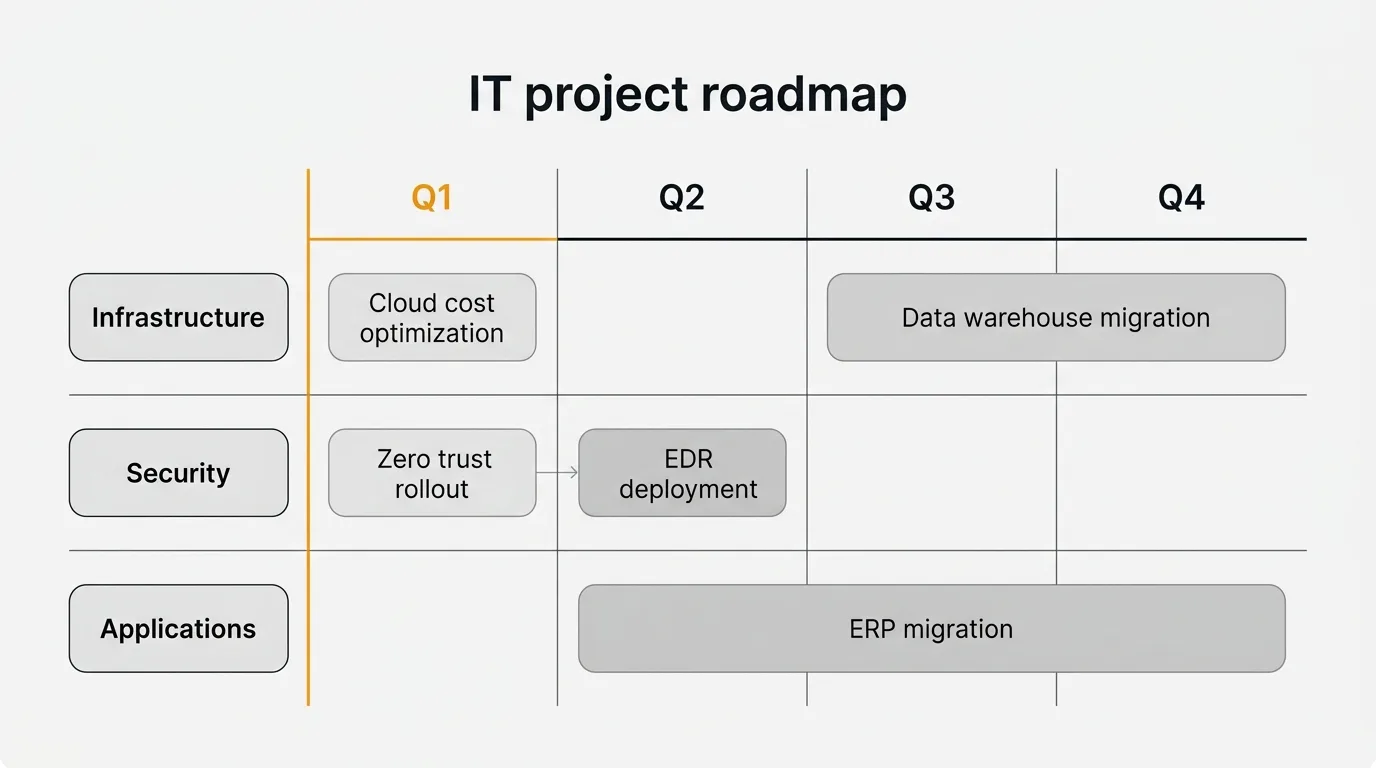
The failure modes are predictable. The roadmap is too vague to be actionable. It lists technologies instead of outcomes. It isn't connected to business goals, so leadership doesn't care. Or it's treated as a static document instead of a living plan, so it's outdated within weeks.
A good IT roadmap does three things: it communicates priorities to the business, it sequences work so the team knows what to build and when, and it evolves as conditions change. This guide covers how to build one that does all three.
What is an IT roadmap?
An IT roadmap is a strategic document that maps IT initiatives to business objectives over a defined time horizon. It shows what the IT organization plans to do, why each initiative matters, and roughly when it will happen.
It is not a project plan. A project plan details tasks, assignees, dependencies, and deadlines for a single initiative. A roadmap operates one level up. It shows the portfolio of initiatives and how they relate to each other and to the business.
Think of it this way: the roadmap answers "what are we investing in and why?" The project plan answers "how are we executing this specific investment?"
IT roadmaps serve multiple audiences. Engineering teams use them to understand priorities and plan capacity. Business leaders use them to see how IT spending connects to revenue, risk reduction, or operational efficiency. Finance uses them to forecast budgets. And the IT leadership team uses them to make trade-off decisions when new requests come in.
The best IT roadmaps are readable by non-technical stakeholders. If your roadmap requires a glossary to interpret, it's not doing its job.
Types of IT roadmaps
Not all IT roadmaps cover the same ground. The scope depends on what your organization needs to communicate and coordinate. Here are the most common types.
Infrastructure roadmap. Covers hardware, networking, data centers, and core systems. Typical initiatives include server refreshes, network upgrades, storage migrations, and disaster recovery improvements. Time horizons tend to be longer (12-36 months) because infrastructure changes are expensive and disruptive.
Security roadmap. Focuses on reducing risk and achieving compliance. Initiatives include zero trust architecture rollouts, endpoint detection and response deployments, SOC 2 or ISO 27001 certification, vulnerability management programs, and identity governance projects. Security roadmaps often have external deadlines (regulatory requirements, audit dates) that constrain sequencing.
Application modernization roadmap. Tracks the migration of legacy applications to modern architectures. This might mean moving monoliths to microservices, migrating from on-premises databases to managed services, or replacing end-of-life software. These roadmaps need to account for business continuity, since the systems being modernized are usually the ones the business depends on most.
Cloud migration roadmap. Specifically focused on moving workloads from on-premises to cloud infrastructure (or between cloud providers). Initiatives are typically grouped into waves based on complexity, risk, and dependency. A cloud migration roadmap needs to track cost implications, since cloud spending can surprise organizations that don't model it carefully.
Digital transformation roadmap. The broadest type. Covers organization-wide technology changes that affect how the business operates. This might combine elements of all the above types, plus initiatives around data analytics, automation, employee experience, and customer-facing technology. Digital transformation roadmaps require the most cross-functional alignment because they touch every department.
You don't need to pick just one. Many IT organizations maintain a high-level roadmap that spans all categories, with detailed sub-roadmaps for each domain.
How to build an IT roadmap in 5 steps
Step 1: Audit your current state
Start with an honest assessment of your current IT landscape. Most IT leaders overestimate how well they know their own environment until they try to write it down.
Document your existing systems, their age, their maintenance burden, and their alignment with current business needs. Identify technical debt. Map dependencies between systems. Note which systems have upcoming end-of-life dates or expiring vendor contracts.
Talk to the teams that operate these systems daily. They know where the pain is. They know which systems fail at 2 AM, which integrations are held together with scripts nobody understands, and which workarounds have become permanent fixtures.
The audit doesn't need to be exhaustive on day one. Focus on the systems that matter most to the business and the ones that carry the most risk. You can fill in gaps as you go.
Step 2: Define goals tied to business objectives
Every initiative on your roadmap should trace back to a business objective. "Upgrade to Kubernetes" is not a goal. "Reduce deployment time from 4 hours to 15 minutes to support faster product iteration" is.
Work with business leaders to understand their priorities for the next 12-18 months. Common business objectives that drive IT initiatives include:
- Revenue growth: Requires scalable infrastructure, faster feature delivery, better customer-facing systems.
- Cost reduction: Drives consolidation, license optimization, cloud cost management, automation of manual processes.
- Risk reduction: Motivates security investments, compliance programs, disaster recovery, and redundancy.
- Operational efficiency: Leads to workflow automation, system integrations, and self-service tooling.
- Market expansion: Demands multi-region infrastructure, localization support, and performance at scale.
Frame every initiative in terms of the business outcome it supports. This is how you get budget approval, and it's how you defend priorities when someone asks why their pet project isn't on the roadmap.
Step 3: Prioritize initiatives
IT teams typically face 3-4x more requests than they can deliver in a given quarter. The roadmap's job is to sequence them, not to promise everything at once.
Use a structured framework to prioritize. The RICE scoring framework works well for IT roadmaps:
- Reach: How many people or systems does this initiative affect?
- Impact: How significant is the improvement? (Scored on a scale, e.g., 0.25 to 3.)
- Confidence: How certain are you about the estimates? (Percentage.)
- Effort: How many person-months will this take?
RICE produces a numeric score for each initiative, which gives you a defensible starting point for prioritization conversations. It won't make the decisions for you, but it surfaces the trade-offs clearly.
Other factors that influence sequencing:
- Dependencies. Some initiatives unlock others. Network upgrades might need to precede cloud migration.
- External deadlines. Compliance requirements, vendor contract expirations, and end-of-life dates are non-negotiable.
- Quick wins. Small initiatives with disproportionate impact build momentum and credibility.
- Risk. High-risk initiatives might need earlier starts to allow for contingency.
Step 4: Set timelines and milestones
Convert your prioritized list into a time-based plan. Most IT roadmaps use quarterly granularity for the near term (next 2 quarters) and half-year or annual granularity for the outer horizon.
Don't over-specify. Initiatives planned for Q3 next year don't need week-by-week breakdowns. You'll replan them when they get closer. The further out the timeline, the less precise it should be.
Define milestones for each initiative. Milestones are checkpoints that let you and your stakeholders know whether things are on track. Good milestones are:
- Observable. You can tell whether they've been reached without asking the project lead.
- Meaningful. They represent actual progress, not just activity.
- Time-bound. They have a target date.
Examples: "Production traffic migrated to new load balancers by end of Q2." "SOC 2 Type II audit completed by September." "Legacy CRM decommissioned after data migration verification."
Build in buffer. IT projects routinely take longer than estimated. If your roadmap has zero slack, a single delay cascades through everything. Plan at 70-80% capacity and you'll have room to absorb surprises.
Step 5: Communicate and iterate
An IT roadmap that only your team sees is just a backlog with dates. The value comes from shared visibility.
Present it to business leadership quarterly. Post it on an internal wiki or portal where anyone affected by IT decisions can reference it. When a department head asks "when is the SSO rollout happening?" they should be able to check the roadmap instead of pinging you on Slack.
Collect feedback from stakeholders. Finance might flag budget constraints you missed. Operations might tell you that the ERP migration conflicts with their peak season. Product might reveal that their upcoming launch depends on infrastructure you planned for Q4. The best roadmap processes include a structured way for stakeholders to flag new needs and challenge priorities, rather than relying on hallway conversations.
Update the roadmap monthly with your leadership team, and share quarterly updates with the broader organization. When priorities shift, update the roadmap and communicate the change. A roadmap that doesn't change is either perfect (unlikely) or ignored (more likely).
IT roadmap template
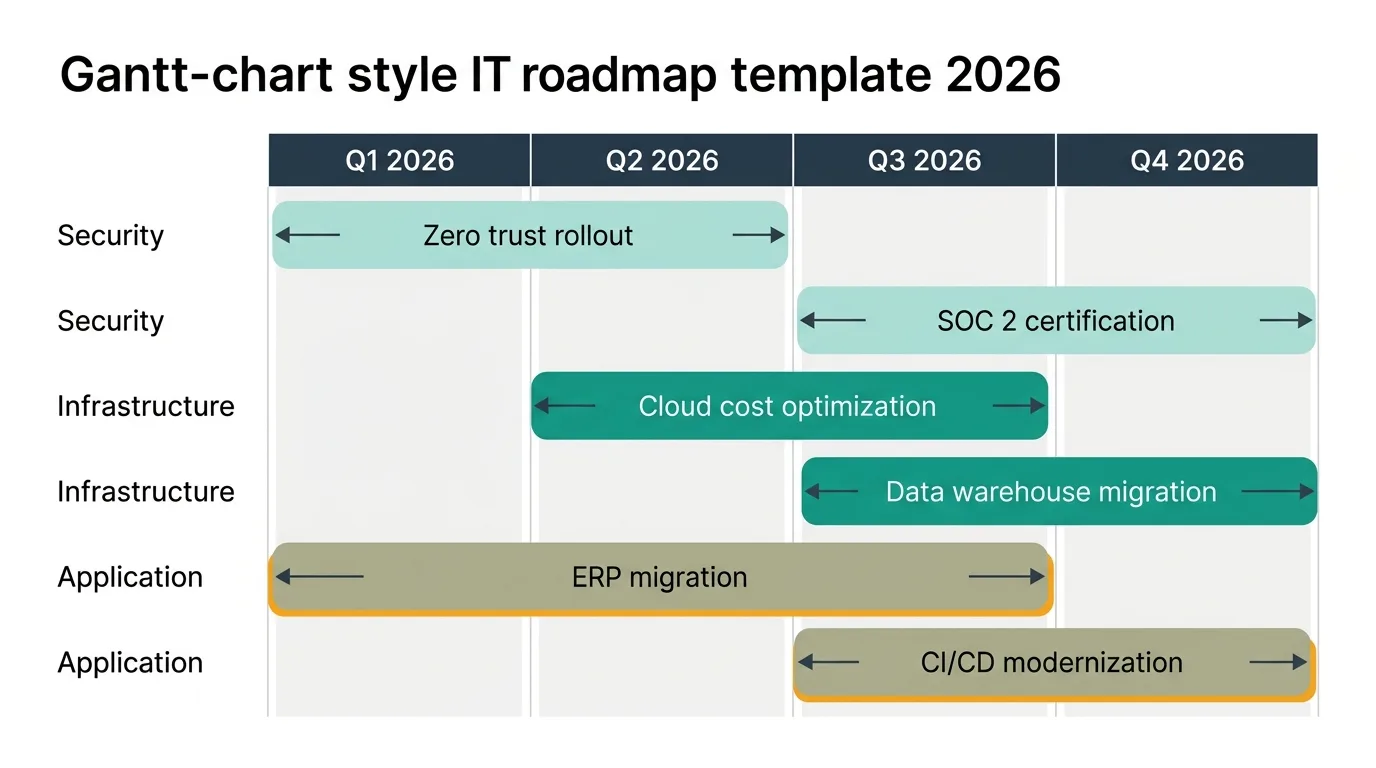
Here's a simple template you can adapt. Start with a spreadsheet or table, then graduate to specialized tooling as your roadmap matures.
| Initiative | Category | Priority | Timeline | Owner | Status |
|---|---|---|---|---|---|
| Zero trust network rollout | Security | P1 | Q1-Q2 2026 | Sarah Chen | In Progress |
| Legacy ERP migration | App Modernization | P1 | Q2-Q4 2026 | Mike Torres | Planning |
| Cloud cost optimization | Infrastructure | P2 | Q1 2026 | Priya Patel | In Progress |
| SOC 2 Type II certification | Security | P1 | Q1-Q3 2026 | Sarah Chen | In Progress |
| Data warehouse migration to Snowflake | Infrastructure | P2 | Q3-Q4 2026 | Alex Kim | Not Started |
| CI/CD pipeline modernization | App Modernization | P3 | Q4 2026 | Dev Platform Team | Not Started |
| Endpoint detection and response | Security | P2 | Q2 2026 | Sarah Chen | Planning |
| Customer portal performance overhaul | App Modernization | P2 | Q2-Q3 2026 | Frontend Team | Not Started |
Add columns as needed: estimated cost, business objective alignment, dependencies, risk level. But don't over-engineer it. A roadmap that's easy to read and maintain beats a complex one that's always out of date.
IT roadmap examples
Example 1: Cloud migration roadmap
A mid-size financial services company migrating from co-located data centers to AWS. The roadmap spans 18 months and is organized in waves:
Wave 1 (Q1-Q2): Non-critical internal tools. HR portal, internal wiki, dev/staging environments. Low risk, builds cloud operations muscle.
Wave 2 (Q3-Q4): Customer-facing applications. Trading dashboard, account management portal. Requires performance testing, failover planning, and regulatory review.
Wave 3 (Q1-Q2 next year): Core systems. Transaction processing, risk calculation engines, data warehouse. Highest complexity, requires parallel-run period before cutover.
Each wave includes milestones for architecture review, security assessment, migration execution, performance validation, and legacy decommission. The roadmap also tracks a parallel workstream for cloud operations readiness: training, runbook creation, monitoring setup, and incident response process updates.
Example 2: Security compliance roadmap
A healthcare SaaS company pursuing HITRUST certification while strengthening its security posture. The roadmap runs 12 months:
Q1: Gap assessment against HITRUST CSF. Deploy SIEM solution. Implement MFA across all systems. Begin vendor risk assessment program.
Q2: Remediate top-priority gaps from assessment. Deploy endpoint detection and response. Implement data loss prevention controls. Complete security awareness training for all employees.
Q3: Conduct internal audit. Remediate findings. Begin HITRUST assessor engagement. Implement automated compliance monitoring.
Q4: Complete HITRUST validated assessment. Establish continuous monitoring program. Build automated evidence collection for ongoing compliance.
Example 3: Infrastructure refresh roadmap
A retail company modernizing aging infrastructure to support e-commerce growth:
Q1-Q2: Replace end-of-life network switches and firewalls. Upgrade core database servers. Implement infrastructure-as-code for all new deployments.
Q3: Migrate from monolithic load balancers to distributed ingress controllers. Deploy container orchestration platform. Implement centralized logging and observability.
Q4-Q1 next year: Migrate primary workloads to containerized deployments. Implement auto-scaling for e-commerce platform ahead of peak season. Decommission legacy virtualization cluster.
Common mistakes
Treating the roadmap as a commitment, not a plan. Roadmaps are strategic communication tools, not contracts. When leadership treats every item as a promise, the IT team stops putting anything on the roadmap that carries uncertainty. The result is a roadmap full of safe, incremental work that doesn't move the needle. Set expectations that the roadmap will change. That's a feature, not a failure.
No connection to business outcomes. A roadmap full of technology names (Kubernetes, Terraform, Snowflake) without business context is meaningless to stakeholders. Every initiative should answer "so what?" in terms the business cares about: revenue, cost, risk, speed, or customer experience.
Planning too far out in too much detail. Detailed plans for work 12 months away are fiction. Use a "zoom lens" approach: high detail for the current quarter, moderate detail for the next quarter, directional themes for the rest of the year. This reduces the overhead of replanning when priorities shift.
Ignoring capacity constraints. A roadmap with 20 P1 initiatives and a team of 8 engineers is not a plan. It's a wish list. Be honest about capacity. If everything is a priority, nothing is. Force the hard conversations about what gets cut or deferred.
Never updating it. The number one reason IT roadmaps get ignored is that they're stale. If the roadmap doesn't reflect current reality, people stop looking at it. Schedule regular reviews and treat the roadmap as a living document.
Tools for IT roadmaps
The right tool depends on your audience and how you use the roadmap.
For sharing IT plans with stakeholders outside the IT organization, a dedicated roadmap tool works well. Tools like Quackback, Productboard, or Aha let you publish a roadmap that stakeholders can view and comment on, which is particularly useful when your IT roadmap includes initiatives that affect other departments.
For project execution within the IT team, tools like Jira, Asana, Linear, or Monday.com handle task-level tracking, sprints, and assignments. These are complementary to a roadmap tool. The roadmap shows the strategic view. The project management tool shows the execution detail.
For visualization, tools like Miro, Lucidchart, or even well-formatted Google Sheets can work for teams that want maximum flexibility in how they present the roadmap.
If you're building roadmaps for other functions, see the technology roadmap guide for product and engineering-focused roadmaps, or the marketing roadmap guide for go-to-market planning.
Frequently asked questions
How often should you update an IT roadmap?
Review it monthly with your IT leadership team. Update it quarterly for broader stakeholder communication. And revise it immediately when a major change happens: a budget cut, an acquisition, a security incident, or a significant shift in business priorities. The cadence matters less than the consistency. Pick a rhythm and stick to it.
What's the difference between an IT roadmap and a technology roadmap?
An IT roadmap focuses on the IT organization's plans: infrastructure, security, internal systems, compliance, and operational technology. A technology roadmap is broader and often product-focused: it covers the technology decisions that affect what you build for customers. In practice, the two overlap significantly, especially in software companies where the IT infrastructure and the product infrastructure are the same thing.
How far out should an IT roadmap plan?
12 to 18 months is the sweet spot for most organizations. Long enough to show strategic direction. Short enough that the plan is still credible. Infrastructure-heavy roadmaps sometimes extend to 24-36 months because hardware procurement and data center changes have long lead times. But even then, only the first 6 months should have detailed plans. Everything beyond that is directional.

Authored by James Morton
Founder of Quackback. Building open-source feedback tools.
Try Quackback
The open-source feedback platform. Boards, voting, and roadmaps.
Get startedStar on GitHub305