
Every product team needs a roadmap. Most confuse it with a project plan or a feature list. A roadmap is neither.
A project plan tracks tasks and deadlines. A feature list is a backlog waiting for prioritization. A roadmap is something more deliberate: a strategic document that communicates where your product is going, why those things matter, and in what order you plan to get there. Getting that distinction right changes how your team plans, how your stakeholders communicate, and how your users perceive your product.
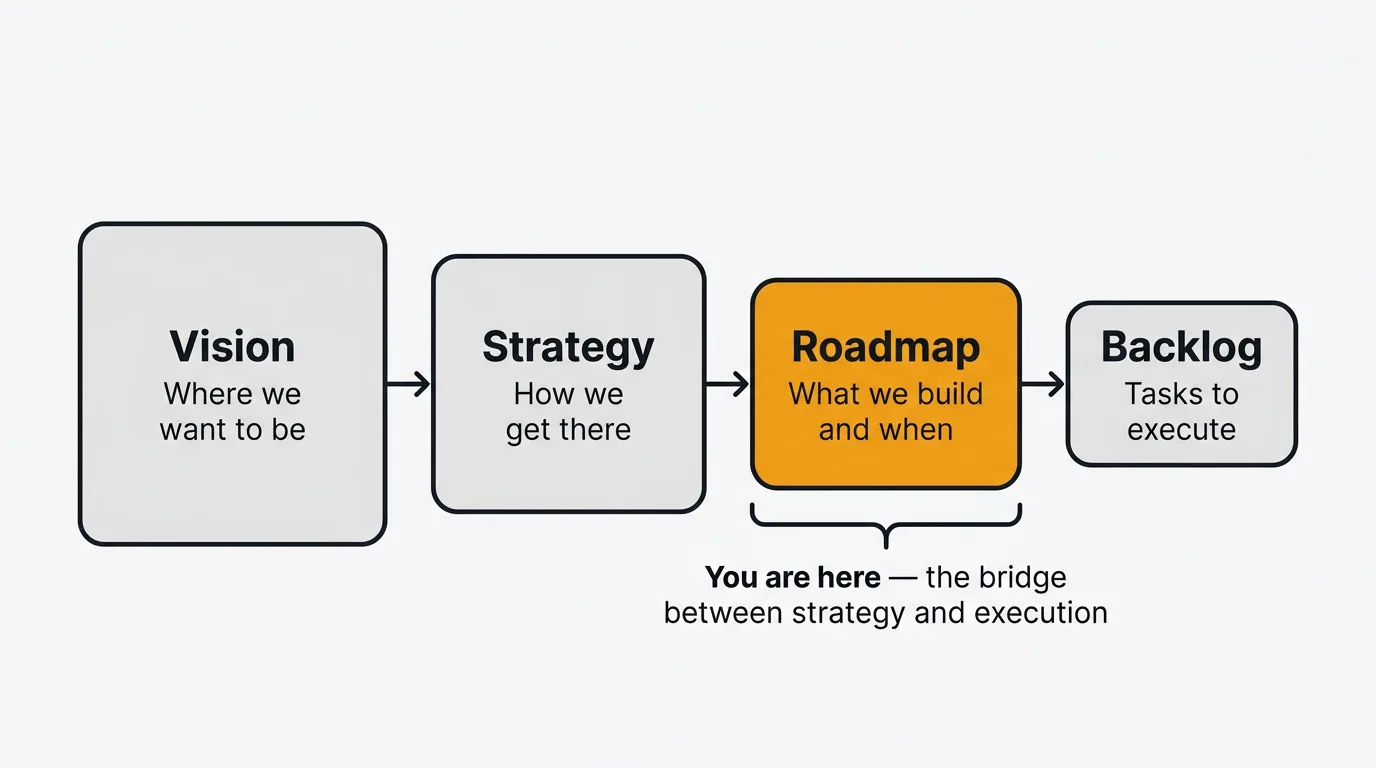
A product roadmap is a strategic document that communicates where your product is going, why those things matter, and roughly in what order you plan to build them. It is not a project plan (which tracks tasks and deadlines) or a feature list (an unprioritized backlog). The best roadmaps communicate intent and direction at the initiative level, not contractual ship dates.
What is a product roadmap
A product roadmap is a strategic document that communicates the direction and priorities of a product over time. It answers three questions: where are we going, why does that matter, and roughly when will we get there.
Notice what is missing from that definition. A roadmap is not a task list. It operates at the initiative or theme level, not the subtask level. It is not a contract. The best roadmaps communicate intent and direction — not deadlines or promises. And it is not a comprehensive feature list. A roadmap is a curated, prioritized view of what your team has decided to focus on, which means it includes decisions about what you are not building.
The difference between a roadmap and a backlog is worth emphasizing. A backlog is an unordered or lightly ordered collection of everything you might build. A roadmap is a curated subset of that list, organized by priority and time horizon, designed to communicate a coherent story. Showing your backlog to a stakeholder or a customer is almost never useful. Showing your roadmap is.
At its best, a roadmap functions as a single source of truth for product direction. Engineers know what they are building next. Sales can set accurate expectations with prospects. Customers understand where the product is heading. Leadership can evaluate whether the product strategy is on track.
Why product roadmaps matter
The practical value of a roadmap comes from five things it forces your team to do.
Align on priorities. Without a roadmap, every team member is working from their own mental model of what matters most. Those mental models diverge over time. A roadmap makes the prioritization explicit so the whole team rows in the same direction.
Communicate direction to stakeholders. Executives, investors, sales teams, and customer success managers all have questions about product direction. A roadmap gives them a single place to get answers without requiring the product team to run individual update meetings every week.
Force trade-off decisions. A roadmap with finite lanes forces you to choose. Every item you add to Now must displace something. That constraint is uncomfortable, but it produces better decisions than a prioritization-free list where everything is equally important.
Connect user feedback to product decisions. A roadmap grounded in real feedback demonstrates to your team — and to your users — that product decisions are evidence-based, not arbitrary. When engineers and designers can trace a roadmap item back to user requests and vote counts, they have better context for the work and more confidence in the direction.
Reduce "why are we building this?" questions. These questions are a tax on every planning meeting and engineering sprint. When your roadmap is clear and well-maintained, the answer is visible to everyone. That clarity compounds over time: teams with good roadmaps spend more time building and less time relitigating decisions.
Types of product roadmaps
There is no single correct roadmap format. The right format depends on your team's planning maturity, your audience, and how predictable your product development is. Here are the five most common formats.
Now / Next / Later
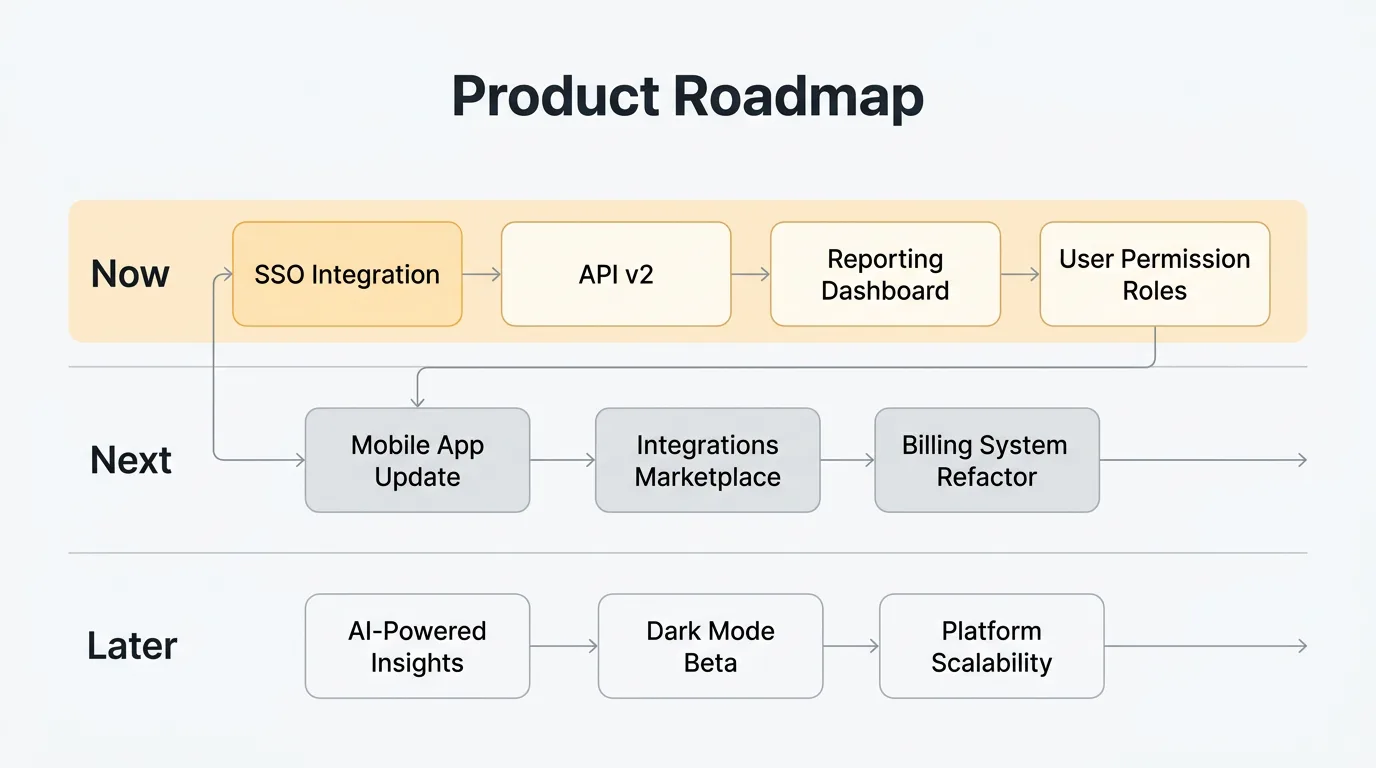
The Now/Next/Later format divides the roadmap into three columns: what the team is actively building, what they plan to build next, and what they intend to build eventually. There are no dates. No quarters. Just three buckets that reflect relative priority.
This is the most flexible format. It absorbs disruption well — when priorities shift, you move cards between columns rather than rebuilding the whole plan. It also forces genuine triage. A team that puts everything in the Now column quickly realizes the format has broken down.
Now/Next/Later works best for early-stage teams, fast-moving products, and situations where quarterly planning feels premature. It is also a good format for public-facing roadmaps because it communicates direction without creating date commitments you may not be able to keep. For a deeper look at applying this format in an agile context, see the guide on agile roadmaps.
The main limitation is that the format carries no time information. Teams that need to sequence work against external commitments — a product launch, a conference, an enterprise contract — will find it insufficient on its own.
Timeline-based
The timeline format lays initiatives across a calendar using monthly or quarterly date ranges. This is the closest relative to a traditional Gantt chart, but organized at the initiative level rather than the task level.
Timeline roadmaps are best for cross-functional coordination. When engineering, design, marketing, and infrastructure all need to deliver work simultaneously for a launch, a timeline makes dependencies visible at a glance. They are also useful when enterprise customers or partners need delivery windows for integration planning.
The significant drawback is maintenance overhead. Timeline roadmaps go stale faster than any other format. A bar on a calendar looks like a commitment even when it isn't, which creates false precision and mismatched expectations when dates slip.
Theme-based
The theme-based format groups work into named strategic goals rather than chronological buckets. Instead of a feature list, the roadmap communicates intent: "Q2 is about reducing time to first value" or "H2 is focused on enterprise readiness." Individual features appear inside themes, but the theme is the unit of communication.
This format is particularly effective for executive communication and board presentations. Themes translate naturally to business outcomes — retention, growth, platform stability — without requiring the audience to infer strategy from a list of features.
Theme-based roadmaps also survive scope changes better than feature lists. If one feature in a theme gets cut or delayed, the theme still communicates the right intent. Teams can adjust implementation without invalidating the roadmap.
Outcome-based
The outcome-based roadmap organizes work around metrics rather than features. Instead of "Build SSO," the roadmap says "Reduce enterprise deal friction: target 20% reduction in sales cycle length." The features that might deliver that outcome are listed as options, not commitments.
This format is most effective for product-led growth teams and organizations that have moved past the "build everything in the backlog" phase. It forces clarity on why each initiative exists. If you cannot articulate the outcome a feature is meant to drive, that is a signal to reconsider whether it belongs on the roadmap.
The challenge with outcome-based roadmaps is that they require a culture comfortable with uncertainty about implementation. Stakeholders who want to know exactly what will ship by when will find this format frustrating.
Kanban-style
The kanban format organizes items by status: Planned, In Progress, Done. This is the most common format for public-facing roadmaps because it communicates where things stand without requiring date commitments. Linear, Plausible, and dozens of other SaaS companies use this format for their public roadmaps.
For a full comparison of tools designed for public roadmaps, see the best public roadmap tools guide.
Format comparison
| Format | Best for | Flexibility | Audience |
|---|---|---|---|
| Now / Next / Later | Early-stage, agile teams | Very high | Team + customers |
| Timeline-based | Cross-functional coordination | Low | Internal, enterprise |
| Theme-based | Executive communication | Medium | Leadership, board |
| Outcome-based | Product-led growth teams | High | Internal |
| Kanban-style | Public-facing transparency | Medium | Customers |
What to include in a product roadmap
A roadmap should be opinionated about what it contains. The temptation is to add detail until the roadmap becomes a project plan. Resist it.
Include these elements:
- Goals and themes. One or two sentences explaining the strategic direction behind the roadmap. What problem are you solving at the business level?
- Initiatives. The units of meaningful work. Not tasks, not subtasks. "Redesign onboarding flow" is an initiative. "Write copy for onboarding step 3" is a task that belongs in a project management tool.
- Time horizons. Rough bucketing — Now/Next/Later, or quarterly groupings — that communicate relative priority and sequence without creating false precision.
- Status indicators. A simple signal — Planned, In Progress, Shipped — that tells anyone reading the roadmap where each item stands.
- Links to user feedback and evidence. If an item is on the roadmap because 200 users requested it, that context belongs on the roadmap. It validates the decision and helps engineers understand the user problem they are solving.
Exclude these elements:
- Task-level detail. Tasks belong in your project management tool, not your roadmap. Once a roadmap includes subtasks and assignees, it has become a project plan and loses its usefulness as a communication tool.
- Exact deadlines. Specific ship dates belong in sprint plans, not roadmaps. Deadlines on a roadmap create the impression of a contract that does not exist, and they become liabilities when timelines slip.
- Resource allocation. Who is working on what and how many hours it will take is not roadmap-level information. Keep it out.
How to build a product roadmap
Building a roadmap from scratch follows a consistent sequence. The format is the last decision, not the first.
Step 1: Define your product vision and goals
Before you can prioritize, you need a clear picture of where the product is going over the next 12 to 18 months. What does success look like? What are the two or three most important outcomes you are trying to drive? Write these down explicitly. They will serve as a filter for every prioritization decision that follows.
Without this foundation, a roadmap becomes an ordered list of whatever your loudest stakeholders requested most recently. That is not a strategy.
Step 2: Collect and synthesize feedback
A roadmap grounded in user feedback makes better bets than one built on internal assumptions. Collect feedback through a feedback board where users can submit requests and vote on existing ones. Supplement that with support ticket patterns, NPS survey responses, and qualitative interviews.
Look for signal in the aggregate. One feature request from one user is a data point. A hundred requests from users with similar profiles who are all running into the same friction is a direction. For a structured approach to this process, the guide to collecting customer feedback covers methods and tools in detail.
Step 3: Prioritize with a framework
With a list of candidates, apply a structured scoring method to reduce the influence of recency bias and internal politics. The RICE framework — Reach, Impact, Confidence, Effort — scores each initiative on four factors and produces a comparable ranking.
Alternatively, MoSCoW prioritization — Must have, Should have, Could have, Won't have — is faster to apply and works well for sprint-level planning or when you need to communicate priorities to stakeholders who are not familiar with quantitative scoring.
Use the output as a starting point for conversation, not a final answer. Scoring models are decision aids. The team still needs to make the final call, informed by context the model cannot capture.
Step 4: Group into themes or time horizons
Individual features are hard to communicate at the roadmap level. Group related items into themes that describe the user problem you are solving. "Improve team collaboration" is a better roadmap item than a list of seven small features. Themes also make the roadmap more resilient — if one feature in a theme gets cut, the theme still conveys the right intent.
If you are building a timeline or quarterly roadmap, assign grouped themes to time horizons at this stage. Be conservative. Under-promising and over-delivering is a better outcome than the reverse.
Step 5: Choose your format
Match the format to your audience and your planning maturity. If you are early-stage and moving fast, default to Now/Next/Later. If you have a quarterly planning cadence and multiple teams, use a theme-based format. If you are sharing a roadmap with customers, use a public kanban.
Avoid timeline formats unless you have the organizational maturity and coordination overhead that justifies the maintenance cost.
Step 6: Share and iterate
A roadmap nobody reads is a planning document that happened in a meeting. Publish it where your team and users can find it. Link it from your product, your docs, your support portal. When items ship, notify the users who requested them.
Set a review cadence and stick to it. Monthly reviews for the Now column. Quarterly reviews for Next and Later. Assign a specific person to own updates. A roadmap that drifts from reality is worse than no roadmap — it creates false expectations for everyone relying on it.
Product roadmap examples
The best way to understand what good roadmaps look like is to study real ones. Here are four format examples worth noting.
Linear's public kanban uses three columns — Planned, In Progress, Done — with minimal card detail. The Done column does most of the credibility work by showing a long history of shipped items. Linear commits only to what they can show without caveats. The restraint is intentional.
GitHub's repository-based roadmap is a GitHub project board built from GitHub Issues. The format meets developers where they already are. Users can react to issues, leave comments, and link their own issues to roadmap items. It turns the roadmap into a two-way communication channel.
A quarterly theme-based internal roadmap groups work into named strategic goals — Q1: onboarding, Q2: retention, Q3: enterprise readiness — with features nested inside each theme. This format aligns cross-functional teams around shared outcomes rather than individual features.
An outcome-based roadmap replaces feature names with metric targets. "Reduce activation drop-off" appears where a feature list would otherwise be. Features that might contribute to that outcome are listed as options, not commitments. This format works best for product-led growth teams where the connection between features and metrics is well understood.
For a detailed analysis of 15 real roadmap examples across all these formats, see the product roadmap examples guide.
Public vs internal roadmaps
Not all roadmaps serve the same audience. The distinction between public and internal roadmaps matters more than most teams realize.
An internal roadmap is a planning tool. It can include rough estimates, open questions, dependencies, and in-progress thinking. It is allowed to be messy because its audience — your team — has context to interpret it correctly.
A public roadmap is a communication tool. It represents your product to users who may be making purchasing decisions based on what they see. Every label and every status is a message to a customer who may be evaluating you against a competitor.
Benefits of a public roadmap:
- Reduces "when is this coming?" support volume by giving users a self-serve answer.
- Builds trust with users who can see their feedback reflected in product priorities.
- Creates accountability — teams with public roadmaps tend to keep them more current.
- Differentiates you from competitors who hide their direction entirely.
Risks to manage:
- Over-commitment. Items on a public roadmap create expectations. If items sit in "Planned" for 18 months without moving, that erodes trust faster than having no roadmap.
- Competitor visibility. Detailed public roadmaps reveal your strategic direction to competitors. Theme-level communication is usually safer than feature-level detail.
- Inflexibility. Users who see specific features on a public roadmap can become attached to those exact features, which makes pivoting harder.
How to share safely:
- Use themes and outcomes rather than specific feature names where possible.
- Show status, not estimates. "In progress" communicates something useful without creating a date commitment.
- Limit the "Planned" column to items you are genuinely committed to building in the near term. Move speculative items to a separate feedback board rather than a public roadmap lane.
- Link roadmap items back to their source feedback so users can see the demand behind each decision.
For a detailed comparison of tools that support public roadmaps, see the best public roadmap tools guide.
Common roadmap mistakes
Most roadmap failures follow a predictable pattern. These are the mistakes worth watching for.
Treating the roadmap as a contract. Sales teams sometimes share roadmaps with enterprise prospects as implicit commitments. Engineers sometimes treat timeline entries as deadlines. When the roadmap is treated as a contract, it stops being updated honestly, and teams start managing the roadmap appearance rather than the underlying product reality.
Adding too much detail. Once a roadmap includes subtasks, assignees, and story point estimates, it has become a project plan. The overhead of keeping it current increases dramatically, and the signal-to-noise ratio drops. Keep the roadmap at the initiative level.
Never saying no. A roadmap that says yes to everything is not a strategy. The value of a roadmap comes precisely from its constraints. If your Later column never gets reviewed and pruned, it becomes a graveyard for ideas that nobody will build — and its presence creates false expectations.
Building in isolation. A roadmap built entirely from internal assumptions rather than user feedback tends to prioritize the features that are loudest internally, not the ones that matter most to users. Grounding roadmap decisions in feedback — vote counts, support patterns, interview notes — produces better bets and creates a defensible rationale for every decision.
Not updating it. A roadmap reviewed once and never touched again is worse than no roadmap. It creates false expectations for anyone who checks it. Assign ownership and set a recurring review cadence. If no one is responsible for keeping it current, it will drift.
Confusing output with outcome. A roadmap that lists features is measuring output. A roadmap organized around outcomes — metrics, user problems, business goals — measures what actually matters. Teams that optimize for output can ship a lot and still miss their goals. Teams that optimize for outcomes stay connected to the work's purpose.
Roadmap tools
Your tool choice should follow your format choice, not precede it. Choosing a tool before deciding what kind of roadmap you need leads to over-engineering.
Spreadsheets are underrated for early-stage teams. A well-structured spreadsheet with columns for initiative, theme, time horizon, and status handles the Now/Next/Later format effectively. See the Google Sheets roadmap template for a ready-to-use starting point.
Dedicated roadmap tools — Productboard, Aha!, Jira Product Discovery — add structured views, integrations, and collaboration features that become valuable as team size and planning complexity grow. The overhead of setting them up and maintaining them is not worth it for teams of under ten people.
Feedback-connected roadmaps close a loop that dedicated roadmap tools often miss. When your roadmap is disconnected from your feedback board, you end up manually justifying prioritization decisions that should be self-evident from vote counts and user demand. Quackback's roadmap connects directly to the feedback board so every roadmap item links back to the requests and votes that drove it. When an item ships, users who voted for it are notified automatically via the changelog — no manual email required. Quackback is open source (AGPL-3.0) and self-hosted for free, with a managed Quackback Cloud option. The whole team can read and update the roadmap, and an MCP server lets you query roadmap and feedback data directly from your AI tools.
For teams managing different kinds of roadmaps across departments, the technology roadmap guide, IT roadmap guide, and marketing roadmap guide cover format and process considerations specific to those contexts.
Try Quackback — open source with a managed cloud option. Start free. Get started | View on GitHub
Frequently asked questions
How often should you update your roadmap?
The Now column — whatever the team is actively building — should reflect current reality at all times. Review the Next column monthly. Review the Later column quarterly. If your product is moving fast, monthly reviews across the full roadmap are appropriate. The key is a fixed cadence rather than reactive updates when someone notices the roadmap is wrong.
Should your roadmap have dates?
For internal roadmaps, rough quarterly buckets are useful for coordination without creating false precision. For public roadmaps, dates create commitments you may not be able to keep. Status labels — Planned, In Progress, Done — communicate progress without the liability of a specific date. If you do include dates, use ranges ("Q3 2025") rather than specific days.
What's the difference between a roadmap and a backlog?
A backlog is an unordered collection of everything you might build, often hundreds of items. A roadmap is a curated, prioritized subset, organized by theme and time horizon to communicate a coherent strategic story. The roadmap is a communication tool; the backlog is a planning artifact.
Should you make your roadmap public?
Most SaaS teams should publish some version of a public roadmap. It reduces support volume, builds trust, and differentiates you from competitors who hide their direction. The caveat is that you should only publish items you are reasonably confident you will build. A public roadmap full of items that never ship erodes trust faster than having no roadmap. Use themes rather than specific feature names to preserve flexibility while still communicating direction.
How do you handle stakeholder requests that don't fit the roadmap?
Acknowledge the request and explain the trade-off directly: "That is not in the current roadmap because we are focused on X this quarter." Log it in your feedback board for the next planning cycle. If the request recurs, that frequency is signal. A clear no with context beats vague reassurance.
What's the difference between a product roadmap and a project plan?
A project plan operates at the task level: assignees, deadlines, dependencies, and resources. It answers who is doing what, and when. A product roadmap operates at the initiative level. It answers what you are building, in what order, and why. A roadmap informs project plans but does not replace them.

Authored by James Morton
Founder of Quackback. Building open-source feedback tools.
Try Quackback
The open-source feedback platform. Boards, voting, and roadmaps.
Get startedStar on GitHub305