
Most marketing teams operate in a constant state of reaction. A product launch moves up two weeks, a competitor drops a new feature, a conference slot opens. Without a roadmap, every shift creates chaos. With one, it creates a conversation.
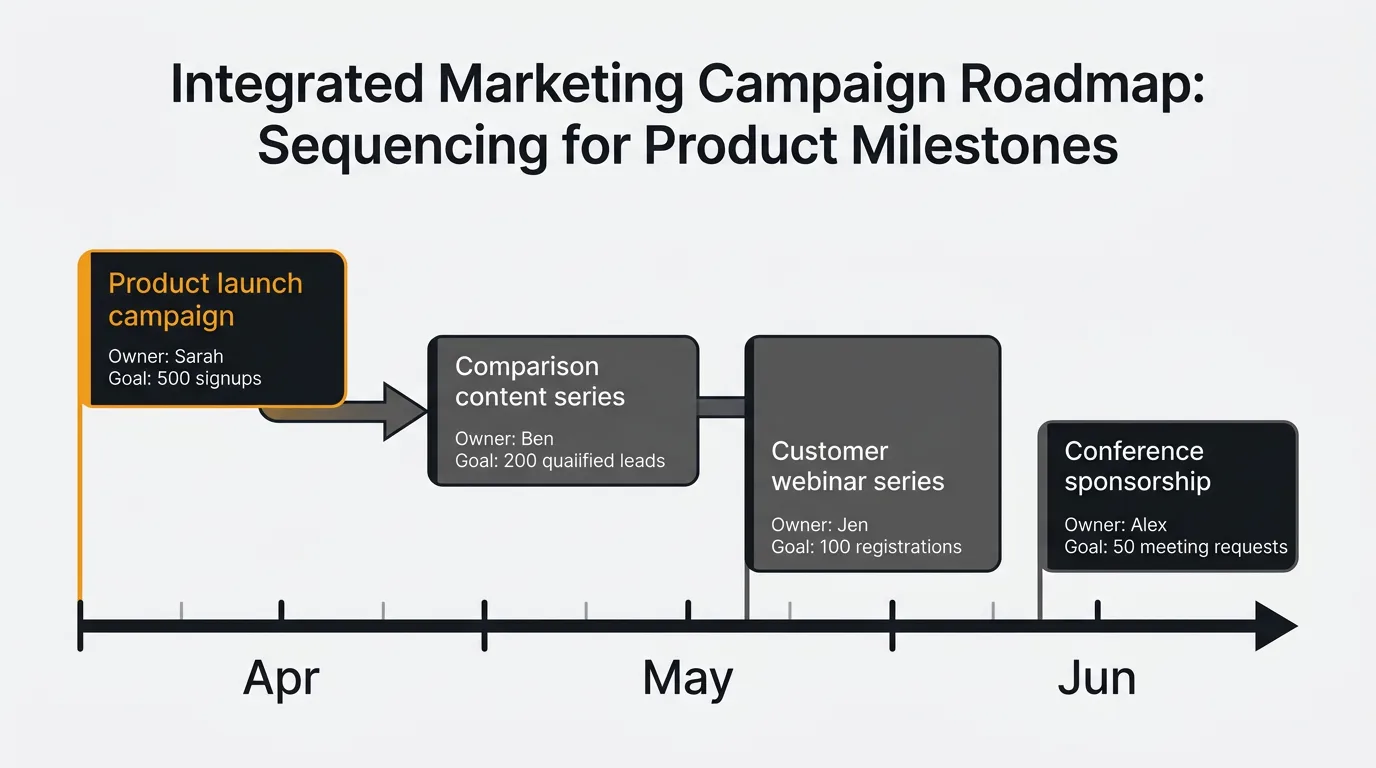
A marketing roadmap is a strategic plan that maps your marketing initiatives across a timeline, connecting business goals to the campaigns, content, and events that support them. To build one, define goals tied to business objectives, map campaigns to product milestones, prioritize by impact, assign owners and timelines, then share with stakeholders and review monthly. The result keeps marketing aligned with product instead of reacting to it.
A marketing roadmap is the document that turns strategy into a sequence of coordinated actions. It shows what you are doing, when you are doing it, and why it matters to the business. It keeps campaigns aligned with product milestones, gives stakeholders visibility, and helps your team say no to the right things.
This guide covers what a marketing roadmap includes, how to build one step by step, and how to keep it useful after the first week.
What is a marketing roadmap?
A marketing roadmap is a strategic plan that maps your marketing initiatives across a timeline. It connects high-level business goals to the specific campaigns, content, events, and channel strategies that support them.
It is not a task list. A task list tells your team what to do today. A roadmap tells them where they are headed this quarter and why.
Think of it as the bridge between your annual marketing strategy and your weekly execution. The strategy says "increase product-qualified leads by 40%." The roadmap says "launch a comparison content series in Q2, run a webinar campaign in Q3, and sponsor two industry events in Q4." The task list says "write the first comparison post by Friday."
A good marketing roadmap does three things:
- Aligns marketing with product and sales. When your product team ships a feature, marketing should already have launch assets ready. When sales needs new collateral, it should already be in the pipeline.
- Creates shared understanding. Leadership, product, sales, and marketing all see the same plan. Disagreements happen early, not the week before launch.
- Forces prioritization. You cannot do everything. A roadmap makes trade-offs visible and deliberate.
Marketing roadmaps work at different time horizons. Some teams plan quarterly. Others maintain a rolling six-month view. Annual roadmaps exist but tend to break down after the first quarter. Start with the shortest horizon that gives your team enough lead time to execute well.
What to include in a marketing roadmap
Every marketing roadmap looks different, but the effective ones share a common structure. Here are the elements worth including.
Campaigns and initiatives. These are the major efforts your team will run. A product launch campaign, a brand awareness push, a seasonal promotion, a content series. Each one should have a clear objective, a start and end date, and an owner.
Content calendar. Blog posts, case studies, whitepapers, videos, social media series. Map these to your campaigns so content supports broader goals rather than existing in isolation. If you are running a product launch campaign, the content calendar should include posts that build anticipation, explain the feature, and show it in action.
Product launches and milestones. Your marketing roadmap should reference your product roadmap directly. When the product team plans to ship a feature, marketing needs lead time for positioning, messaging, launch emails, and documentation. Misalignment here is one of the most common reasons marketing feels reactive.
Events and partnerships. Conferences, webinars, co-marketing campaigns, community events. These have long lead times and fixed deadlines, so they anchor the rest of your timeline.
Channel strategy. Which channels you will invest in and when. Paid search, organic content, email, social, partnerships, community. Not every channel runs at full capacity all the time. Your roadmap should reflect where you are concentrating effort in each period.
Goals and KPIs. Every initiative on the roadmap should connect to a measurable outcome. Traffic, leads, signups, pipeline, revenue. If you cannot explain how a campaign moves a number, question whether it belongs on the roadmap.
How to build a marketing roadmap
Step 1: Define marketing goals aligned to business objectives
Start with what the business needs. Not what marketing wants to try.
If the company goal is to enter a new market segment, your marketing goals might include building awareness in that segment, generating qualified leads from target accounts, and creating positioning that resonates with a new buyer persona.
If the company goal is to reduce churn, your marketing goals might focus on customer education, onboarding content, and feature adoption campaigns.
Write down three to five marketing goals for the period. Each one should trace directly to a business objective. If you find yourself writing goals like "increase social media followers," ask what business outcome that serves. If the answer is unclear, cut it.
Step 2: Map campaigns to product milestones
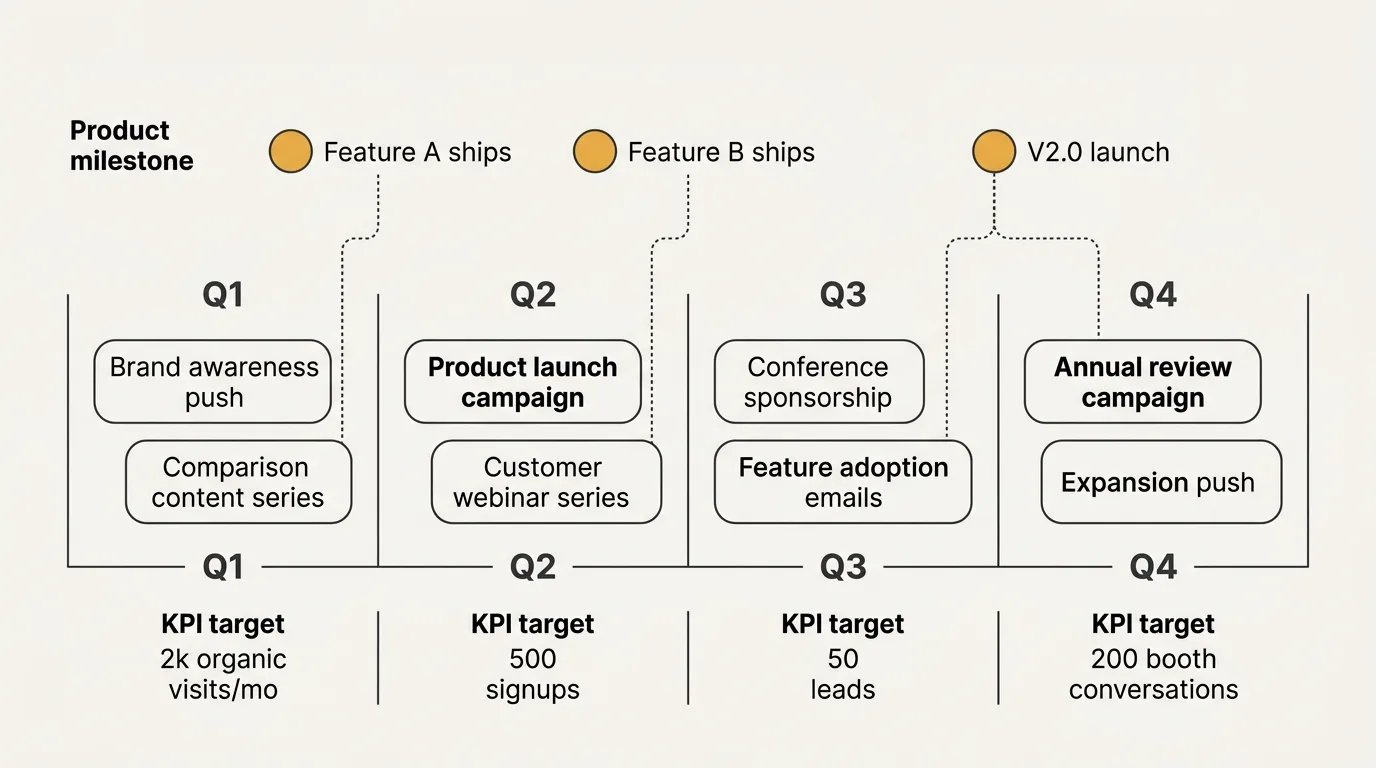
Pull in your product team's roadmap and changelog. Identify every feature launch, major update, and milestone on their timeline. Then map your marketing campaigns to support them.
For each product milestone, define:
- Pre-launch: Teaser content, beta access campaigns, landing page updates
- Launch day: Announcement email, blog post, social campaign, press outreach
- Post-launch: Case studies, how-to content, feature adoption emails
This is where most marketing teams fall short. They learn about a product launch a week before it ships and scramble to put together a blog post. Building your marketing roadmap alongside the product roadmap eliminates that scramble.
If your product team publishes a public roadmap or changelog, use those as your source of truth. When a feature moves from "planned" to "in progress," that is your signal to start preparing marketing assets. When it moves to "shipped," your launch campaign should already be ready to go.
Step 3: Prioritize by impact
Marketing teams are idea factories. The constraint is never "what could we do?" but "what should we do this quarter?" Prioritization separates a useful roadmap from a wish list.
Score each initiative by expected impact on your goals, confidence in that estimate, and effort to execute. The RICE scoring framework works well here. A webinar series that reaches 500 prospects with high conversion confidence and moderate effort scores higher than a brand video that reaches 10,000 people with low conversion confidence and high effort. The numbers make the decision obvious.
Rank your initiatives by score. Draw a line where your team's bandwidth runs out. Everything above the line goes on the roadmap. Everything below goes on a backlog for future consideration.
Step 4: Assign ownership and timelines
Every initiative on your roadmap needs an owner and a timeline. Not a team. A person.
The owner is not necessarily doing all the work. They are responsible for making sure the work gets done, dependencies are managed, and the initiative ships on time. If no one owns it, it will not happen.
For timelines, define:
- Planning window: When strategy and messaging are finalized
- Production window: When assets are created and reviewed
- Launch date: When the campaign goes live
- Review date: When you assess results and capture learnings
Work backwards from launch dates. If a product feature ships on March 15, and you need two weeks of production time and one week of planning, your planning window starts February 22. Put that on the roadmap.
Be honest about your team's bandwidth. A roadmap with twelve simultaneous campaigns and a team of three is not ambitious. It is fiction.
Step 5: Share with stakeholders and iterate
Marketing roadmaps fail when they stay inside marketing. A campaign planned without input from product, sales, or customer success will miss context that makes it better (or reveals that it is unnecessary).
Share your roadmap with product, sales, customer success, and leadership. The goal is not to get approval on every line item. The goal is to surface conflicts, dependencies, and opportunities early.
Product might tell you a launch date moved. Sales might flag that a particular segment needs collateral sooner. Customer success might point out that a feature you planned to market is actually causing support tickets. All of this is useful information that makes your roadmap better.
Review the roadmap on a regular cadence. Monthly works for most teams. Quarterly reviews are too infrequent because the roadmap drifts from reality. Weekly reviews are too frequent and turn strategic planning into status updates.
At each review, ask three questions:
- What shipped since the last review, and what did we learn?
- What changed in the business, product, or market that affects our plan?
- What do we need to add, remove, or reprioritize?
Marketing roadmap template
Here is a simple template to get started. Adjust columns to match your team's workflow.
| Initiative | Goal | Owner | Channel | Start | Launch | Status |
|---|---|---|---|---|---|---|
| Q2 product launch campaign | 500 signups | Sarah | Email, blog, social | Apr 1 | Apr 22 | Planning |
| Comparison content series | 2,000 organic visits/mo | Alex | Blog, SEO | Apr 15 | May 1 | Not started |
| Customer webinar series | 50 qualified leads | Jordan | Webinar, email | May 1 | May 20 | Not started |
| Industry conference sponsorship | 200 booth conversations | Sarah | Events | Jun 1 | Jul 15 | Confirmed |
| Feature adoption email sequence | 30% feature activation | Alex | Apr 22 | May 5 | Blocked on product |
Add a row for each initiative. Keep it at a level of detail that is useful in a stakeholder meeting. Detailed task breakdowns belong in your project management tool, not on the roadmap.
Marketing roadmap examples
Product launch roadmap
A product launch roadmap centers everything around a ship date. Work backwards from launch to schedule pre-launch teasers, landing page updates, beta invitations, press outreach, launch day announcements, and post-launch content.
For a SaaS product launching a new feature, this might span four to six weeks. Two weeks of pre-launch content and landing page preparation. Launch week with the announcement blog post, email blast, and social campaign. Two weeks of post-launch case studies, tutorials, and feature adoption emails.
The key is connecting marketing back to the product milestone. When the feature ships, your marketing campaign should already be in motion.
Content marketing roadmap
A content marketing roadmap plans your publishing calendar around topics, keywords, and funnel stages. It maps content to campaigns and business goals rather than publishing for the sake of publishing.
Start by identifying the topics that support your current quarter's goals. Group them into clusters. Schedule production so you publish consistently without burning out your writers. Track each piece from ideation through publication and promotion.
A quarterly content roadmap might include ten blog posts, two case studies, one whitepaper, and a webinar. Each piece ties to a specific campaign or keyword target. Each has an owner, a deadline, and a distribution plan.
Brand awareness roadmap
A brand awareness roadmap focuses on reaching new audiences and establishing recognition in your market. It typically spans six to twelve months and emphasizes consistency over individual campaigns.
This roadmap might include a conference sponsorship strategy, a thought leadership content series, a partnerships program, and a community building effort. The metrics are different from direct response: share of voice, branded search volume, social mentions, and press coverage.
Brand awareness roadmaps require patience. Results compound over months, not days. The roadmap keeps the team committed to the strategy when short-term metrics look flat.
Tools for marketing roadmaps
You can build a marketing roadmap in a spreadsheet. Many teams do, and it works fine for small teams with simple plans.
As your team grows, dedicated tools help. Common project management platforms like Asana, Monday, Notion, and Linear offer timeline and roadmap views that work well for marketing planning. They handle assignments, dependencies, and status tracking.
If your marketing roadmap needs to stay tightly aligned with your product roadmap, consider a shared roadmap tool that both teams reference. Quackback is built for this: it is open source and self-hosted or run on Quackback Cloud, so your whole marketing team can share it. When marketing and product share a single source of truth for what is planned, in progress, and shipped, alignment happens by default rather than by meeting.
Quackback also ships an MCP server, so your marketing team can query the product roadmap directly from an AI assistant. Ask "what features ship next quarter?" or "what changed since the last release?" and get answers from the live roadmap without booking time with product. That turns the roadmap from a static document into a source your launch planning can interrogate on demand.
For communicating shipped work to your audience, a public changelog bridges the gap between internal roadmap updates and external announcements. When a feature ships, the changelog entry becomes the foundation for your marketing launch content. Blog posts, emails, and social updates all reference the same announcement.
The specific tool matters less than the habit. Pick something your team will actually update, and review it regularly. For roadmap tooling options, see our guide to best public roadmap tools and best changelog tools.
If you're building roadmaps for other functions, see the technology roadmap guide for engineering-focused planning or the IT roadmap guide for infrastructure and compliance.
Try Quackback — open source with a managed cloud option. Start free. Get started | View on GitHub
Frequently asked questions
How often should you update a marketing roadmap?
Review a marketing roadmap monthly. Monthly reviews give you time to see results from recent campaigns while staying responsive to changes in the business or market. Update status and dates between reviews so it stays current. Daily updates mean it is too detailed; quarterly ones mean it is not embedded.
What is the difference between a marketing roadmap and a marketing plan?
A marketing plan defines overall strategy: target audience, positioning, messaging, budget, and goals. A marketing roadmap translates that strategy into a timeline of specific initiatives. The plan answers "what and why." The roadmap answers "when and in what order." Teams need both, but reference the roadmap week to week.
How do you handle roadmap changes when priorities shift?
Keep a ranked backlog of initiatives that did not make the cut, then swap one in when a priority drops off. When a priority changes, update the roadmap immediately and tell stakeholders why. If you cancel a campaign for a launch, say so explicitly so the roadmap matches the work.

Authored by James Morton
Founder of Quackback. Building open-source feedback tools.
Try Quackback
The open-source feedback platform. Boards, voting, and roadmaps.
Get startedStar on GitHub305