
A technology roadmap is one of the most misunderstood documents in software organizations. Teams confuse it with a product roadmap. Or they treat it as a list of tools they want to adopt. Or they build one, file it away, and never look at it again.
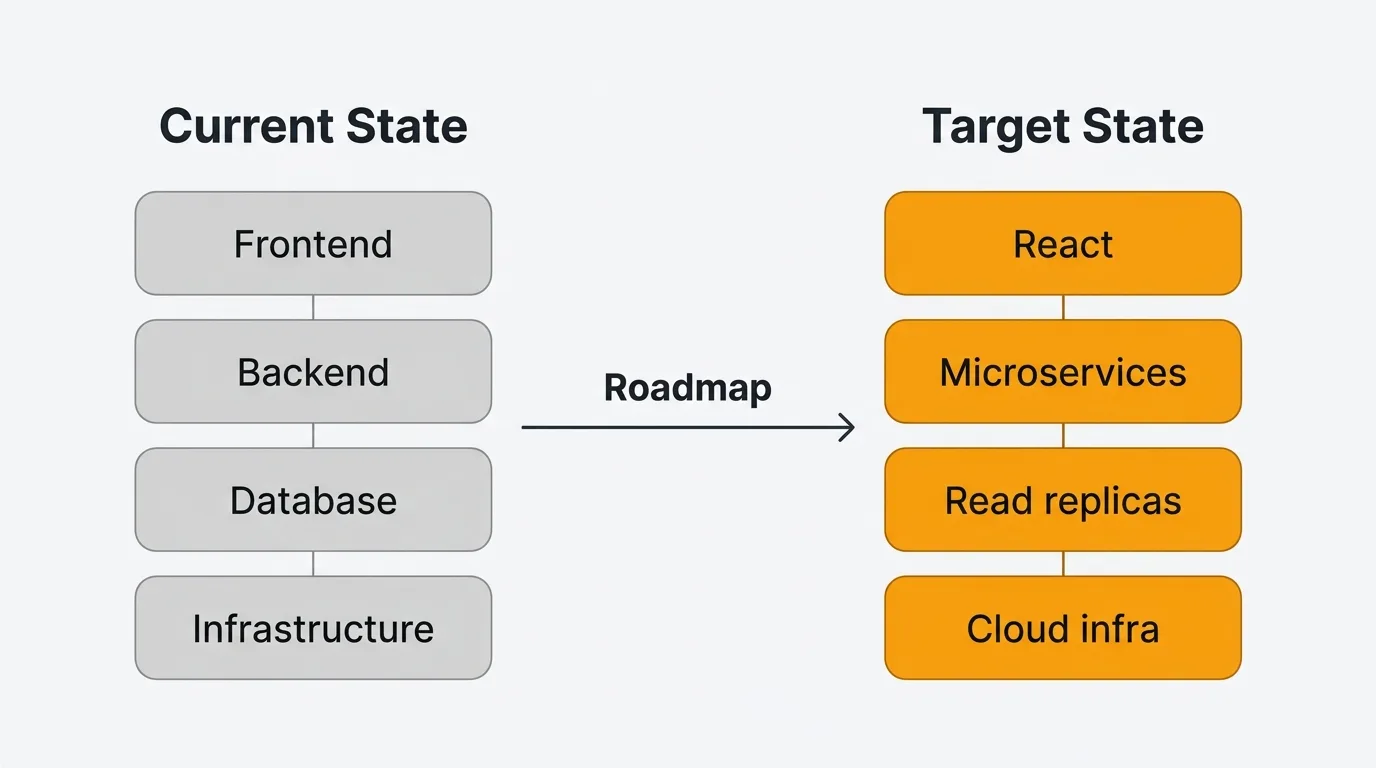
Done well, a technology roadmap gives your engineering team a shared plan for how the platform evolves. It connects technical decisions to business outcomes. It makes trade-offs visible before they become emergencies. And it keeps your stack from drifting into something nobody planned for.
This guide covers what a technology roadmap is, how it differs from a product roadmap or an IT roadmap, and a step-by-step process for building one that actually gets used.
What is a technology roadmap?
A technology roadmap is a strategic document that outlines how your technology platform will change over time. It covers decisions about your tech stack, architecture, infrastructure, and developer tooling, organized into phases with clear milestones.
Unlike a task list or sprint board, a technology roadmap operates at a higher altitude. It answers questions like:
- When do we migrate from the monolith to services?
- What does our database strategy look like in 12 months?
- Which platform investments will reduce deployment time by half?
- Where are we accumulating technical debt that will slow feature delivery?
The audience is your engineering team, but also your product managers, designers, and leadership. Everyone should be able to look at your technology roadmap and understand where the platform is headed and why.
A good technology roadmap has three properties. It is time-bound (organized into phases or quarters). It is outcome-oriented (each initiative ties to a measurable result). And it is maintained (updated at least quarterly, not left to rot).
Technology roadmap vs product roadmap
These two documents serve different purposes. Confusing them leads to misaligned priorities and frustrated teams.
Product roadmap: What you are building for users. Features, improvements, new capabilities. It is organized around user problems and business goals. The audience includes product managers, designers, sales, marketing, and leadership.
Technology roadmap: How you are building and evolving the underlying platform. Architecture changes, infrastructure upgrades, tooling improvements, technical debt reduction. The audience is primarily engineering and technical leadership, though product and business leaders benefit from visibility.
Here is a simple way to think about the distinction:
| Product roadmap | Technology roadmap | |
|---|---|---|
| Focus | User-facing features | Platform and infrastructure |
| Driven by | Customer needs, market opportunity | Engineering capacity, scalability, risk |
| Audience | Cross-functional | Primarily engineering |
| Time horizon | Quarters to a year | 6 months to 2 years |
| Success metric | Adoption, revenue, satisfaction | Performance, reliability, velocity |
The two roadmaps should inform each other. If the product roadmap calls for real-time collaboration features, the technology roadmap needs to account for WebSocket infrastructure. If the technology roadmap includes a database migration, the product roadmap should plan for a feature freeze during the transition.
Teams that only maintain a product roadmap tend to defer technical work until it becomes urgent. Teams that only maintain a technology roadmap risk building a platform that doesn't serve the product. You need both.
A marketing roadmap is a third variant, focused on campaigns, launches, and content. All three roadmaps should share the same planning cadence so they stay in sync.
How to create a technology roadmap
Building a technology roadmap is a six-step process. It does not require specialized software. A document, a spreadsheet, or a shared board will work. What matters is the thinking behind it.
Step 1: Assess your current tech stack
Start with an honest inventory of what you have. Document your languages, frameworks, databases, hosting providers, CI/CD pipeline, monitoring tools, and third-party services. Note versions. Note ownership (which team maintains what).
This assessment should answer two questions: What is the current state of our technology? And where are the boundaries between systems?
Do not skip this step. Teams that jump straight to planning often discover mid-execution that they misunderstood their own architecture. Dependencies that seemed simple turn out to be tangled. Services that seemed independent share a database.
Write it down. A diagram helps, but a clear list works too.
Step 2: Identify technical debt and risks
Every codebase accumulates technical debt. Some of it is intentional (you shipped fast to hit a deadline). Some of it is accidental (nobody noticed the coupling until it was deeply embedded).
Catalog the debt. Talk to your engineers. They know where the pain is. Common categories include:
- Outdated dependencies. Libraries or frameworks that are multiple major versions behind, approaching end of life, or no longer maintained.
- Scaling bottlenecks. Components that work at current load but will fail at 2x or 10x. Database queries that degrade under volume. Services that cannot be horizontally scaled.
- Security risks. Unpatched vulnerabilities, weak authentication patterns, secrets management gaps.
- Developer experience friction. Slow builds, flaky tests, manual deployment steps, poor local development environments.
- Architectural coupling. Systems that should be independent but share state, databases, or deployment pipelines.
Rank these by impact and urgency. Not all debt needs immediate attention. Some debt is fine to carry for another year. Other debt is actively slowing your team or exposing you to risk.
Step 3: Align with product and business goals
A technology roadmap that ignores the product roadmap will lose organizational support. Engineering leadership has to connect technical initiatives to outcomes that product and business stakeholders care about.
For each initiative on your roadmap, answer: What does this enable? Some examples:
- Migrating to a CDN reduces page load time, which improves conversion rates.
- Adopting feature flags lets the product team run A/B tests without engineering support.
- Breaking apart the monolith lets teams ship independently, reducing release bottlenecks.
- Upgrading the search infrastructure supports the product roadmap item for advanced filtering.
If you cannot articulate why a technical initiative matters to the business, reconsider whether it belongs on the roadmap right now.
Step 4: Prioritize initiatives
Engineering teams consistently underestimate how long platform work takes, which makes prioritization critical. You cannot afford to sequence incorrectly.
The RICE scoring model (Reach, Impact, Confidence, Effort) works for technology roadmap items, not just product features. Score "migrate to read replicas" the same way you would score a feature: how many services does it affect (Reach), how much does it improve performance or reliability (Impact), how sure are you about the estimates (Confidence), and how many person-months does it take (Effort).
Beyond RICE, apply these lenses:
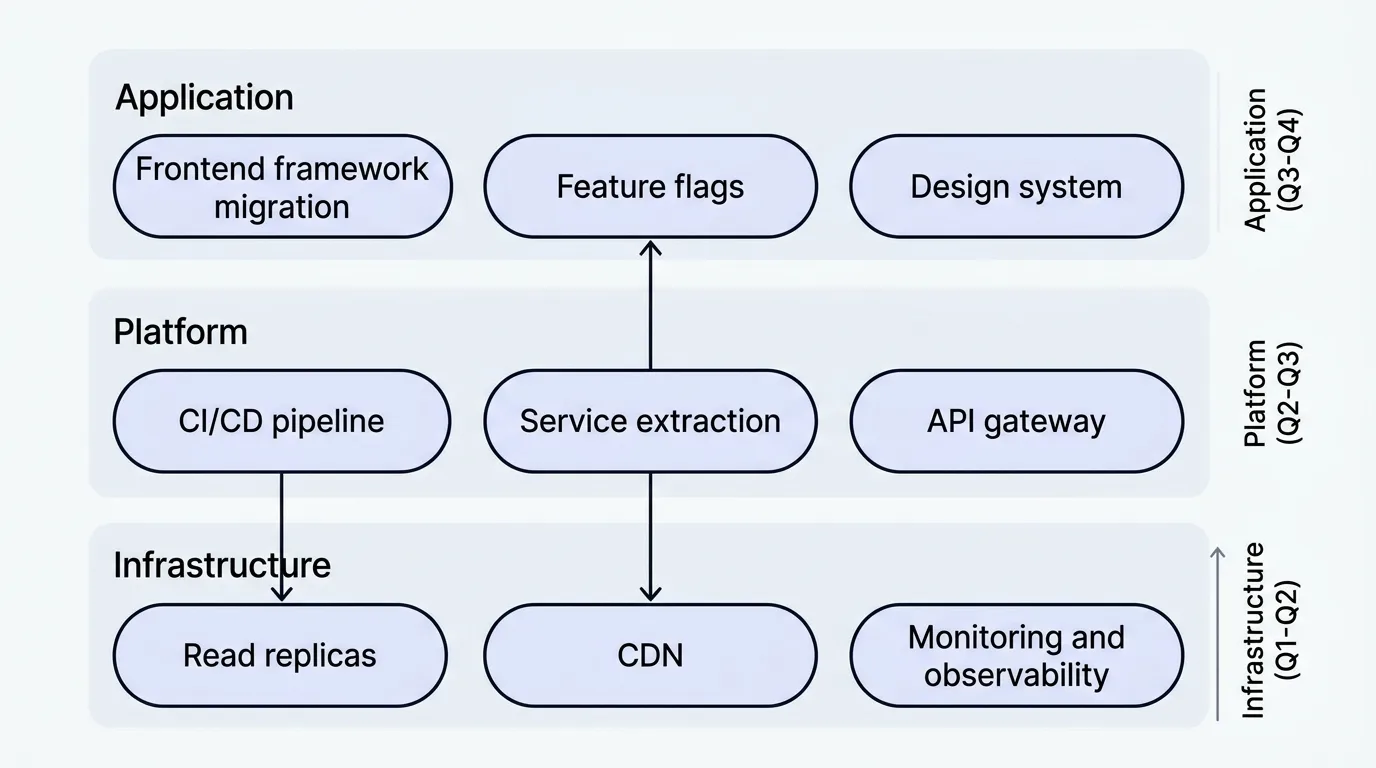
- Dependencies. Some initiatives unblock others. Map the dependency graph and sequence accordingly. A database migration might need to precede the service extraction that depends on it.
- Risk reduction. Initiatives that reduce the probability or blast radius of outages often deserve priority over feature-enabling work. If a single-point-of-failure takes down your product twice a quarter, that is your top priority regardless of what RICE says.
- Reversibility. Prefer reversible decisions over irreversible ones when priority is unclear. Adopting a new framework for one service is reversible. Rewriting your data model is not.
Avoid prioritizing based on enthusiasm alone. The thing your team is most excited about is not always the thing that matters most.
Step 5: Define phases and milestones
Organize your prioritized initiatives into phases. Three to four phases over 12 months is a reasonable structure. Each phase should have:
- A clear theme (e.g., "Foundation" or "Scale" or "Developer experience")
- Two to five initiatives
- Measurable milestones (not just "done" but a specific outcome like "p95 API latency under 200ms" or "deploy pipeline runs in under 5 minutes")
- A rough timeline (quarter, not exact dates)
Resist the urge to plan too precisely. A technology roadmap is a strategic document, not a sprint plan. If your milestones include specific Jira tickets, you have gone too deep.
Leave buffer. Technical work is harder to estimate than feature work because you are often changing systems while they are running. Budget 20-30% more time than your initial estimate.
Step 6: Share and collect feedback
The biggest risk to a technology roadmap is that it stays inside engineering. Product managers make commitments that conflict with it. Leadership allocates budget without knowing about it. Designers plan features that depend on infrastructure changes they have never seen.
Present the roadmap at a cross-functional planning meeting. Walk through the phases, explain why each initiative matters to the product, and flag where engineering needs coordination from other teams. Post it somewhere product managers can reference it when planning their own roadmap.
Some teams also make their technology roadmap visible to customers through a public roadmap. This builds trust, especially when users can see that you are investing in reliability or performance.
Collect feedback after sharing. Engineers closest to the systems will catch gaps. Product managers will flag conflicts with their priorities. Schedule a review two weeks after publishing to incorporate that input.
The roadmap is not final once published. It is a living document that improves through input.
Technology roadmap template
Here is a minimal template you can adapt. Start simple. Add complexity only when you need it.
| Phase | Initiative | Goal | Success metric | Target quarter |
|---|---|---|---|---|
| Foundation | Upgrade Node.js to v22 LTS | Reduce security exposure, access new APIs | All services running v22 | Q2 2026 |
| Foundation | Centralize logging | Single pane of glass for debugging | All services shipping logs to Datadog | Q2 2026 |
| Scale | Migrate primary DB to read replicas | Handle 3x current read traffic | Read queries served by replicas, primary load reduced 60% | Q3 2026 |
| Scale | Implement CDN for static assets | Reduce origin load, improve global latency | p50 asset load time under 80ms globally | Q3 2026 |
| Velocity | Adopt feature flags | Decouple deploys from releases | Product team can toggle features without eng support | Q4 2026 |
| Velocity | Parallelize CI pipeline | Faster feedback loop for developers | CI runs complete in under 4 minutes | Q4 2026 |
You can maintain this in a spreadsheet, a Notion doc, or a purpose-built roadmap tool. The format matters less than the discipline of keeping it current.
Technology roadmap examples
Three common technology roadmap patterns that product teams encounter.
Example 1: Monolith to microservices
A B2B SaaS company has a Rails monolith. It works, but deploys take 45 minutes, a bug in billing brings down the entire application, and two engineering teams step on each other constantly.
Their technology roadmap:
- Q1: Extract the billing service. It has the clearest domain boundary and the highest blast radius when it fails.
- Q2: Build a shared authentication layer so extracted services can verify users without calling back to the monolith.
- Q3: Extract the notification service. Reduce coupling between feature teams.
- Q4: Establish service mesh and observability. Distributed tracing across all services.
Each phase delivers a concrete improvement. Teams can ship billing changes without deploying the whole application after Q1. The monolith does not disappear in one quarter. It shrinks gradually.
Example 2: Frontend framework migration
A product team is running an aging Angular.js application. The framework is end-of-life. Hiring is difficult because candidates do not want to work with it. The component library is brittle.
Their technology roadmap:
- Q1: Adopt a micro-frontend shell. New features are built in React. Existing pages stay in Angular.js.
- Q2: Migrate the three highest-traffic pages to React. Measure performance improvement.
- Q3: Migrate remaining pages. Retire the Angular.js build pipeline.
- Q4: Consolidate the design system. Shared component library for all React surfaces.
The key decision here is the strangler fig pattern: new code uses the new framework, old code migrates page by page. No big rewrite. No feature freeze.
Example 3: Platform scalability
A consumer app is growing 40% quarter over quarter. The database is a single PostgreSQL instance. Background jobs run on the same server as the API. The team has already hit capacity limits twice, both times on weekends.
Their technology roadmap:
- Q1: Add read replicas. Route all read-heavy queries (dashboards, reports, search) to replicas.
- Q2: Separate background job processing onto dedicated workers. Introduce a job queue (Redis-backed).
- Q3: Implement connection pooling and query optimization. Target 50% reduction in average query time.
- Q4: Evaluate horizontal scaling options. Prepare for sharding or a managed database service if growth continues.
Each quarter addresses the next bottleneck. The team is not over-engineering for scale they do not have yet. They are staying one step ahead of the growth curve.
Tips for maintaining your technology roadmap
A roadmap is only useful if it stays current. Here is how to keep it alive.
Review quarterly. Set a calendar reminder. At the start of each quarter, review what shipped, what slipped, and what changed. Update the roadmap accordingly. This is also the right time to re-prioritize based on new information.
Connect to user feedback. Technical decisions affect users even when users cannot see the infrastructure. If your customers are reporting slow load times, that validates the CDN initiative on your roadmap. If support tickets mention downtime, that supports the reliability work. Closing the loop between user feedback and technical investment helps justify the work to stakeholders.
Keep it visible. Pin it in your engineering Slack channel. Reference it in sprint planning. When someone asks "why are we doing this?" point to the roadmap. Visibility creates accountability.
Accept that it will change. A production incident that reveals architectural fragility can reprioritize your entire Q3 plan overnight. A key hire joining the team might unlock an initiative you deferred. The roadmap should adapt. What should not change frequently is the strategic direction. Individual initiatives may move between quarters. The overall trajectory should stay stable.
Own it. Assign a single person (usually a VP of Engineering, CTO, or Staff Engineer) as the owner. They are responsible for updates, quarterly reviews, and cross-functional communication. Without an owner, the roadmap drifts.
Frequently asked questions
How often should you update a technology roadmap?
Review it quarterly. Make minor updates as needed between reviews, but a full reassessment every three months keeps it aligned with business reality. Avoid updating it so frequently that it loses strategic coherence. If your roadmap changes every sprint, it is not a roadmap. It is a backlog.
What tools should you use to build a technology roadmap?
Start with whatever your team already uses. A Google Doc, a Notion page, or a simple spreadsheet works for most teams. If you want to make it visible to non-engineering stakeholders or customers, consider a dedicated roadmap tool like Quackback that provides status updates and a shareable public view without maintaining a separate document. For more options, see our guide to best public roadmap tools.
How does a technology roadmap differ from an IT roadmap?
A technology roadmap focuses on your product's tech stack, architecture, and engineering platform. An IT roadmap typically covers internal infrastructure: corporate networks, employee devices, SaaS tool procurement, security compliance, and identity management. In smaller companies, these overlap. In larger organizations, they are maintained by different teams with different stakeholders.

Authored by James Morton
Founder of Quackback. Building open-source feedback tools.
Try Quackback
The open-source feedback platform. Boards, voting, and roadmaps.
Get startedStar on GitHub305