
People filter what they say when their name is attached. That is not a character flaw — it is human nature. The question is whether your feedback system accounts for it or pretends it does not exist.
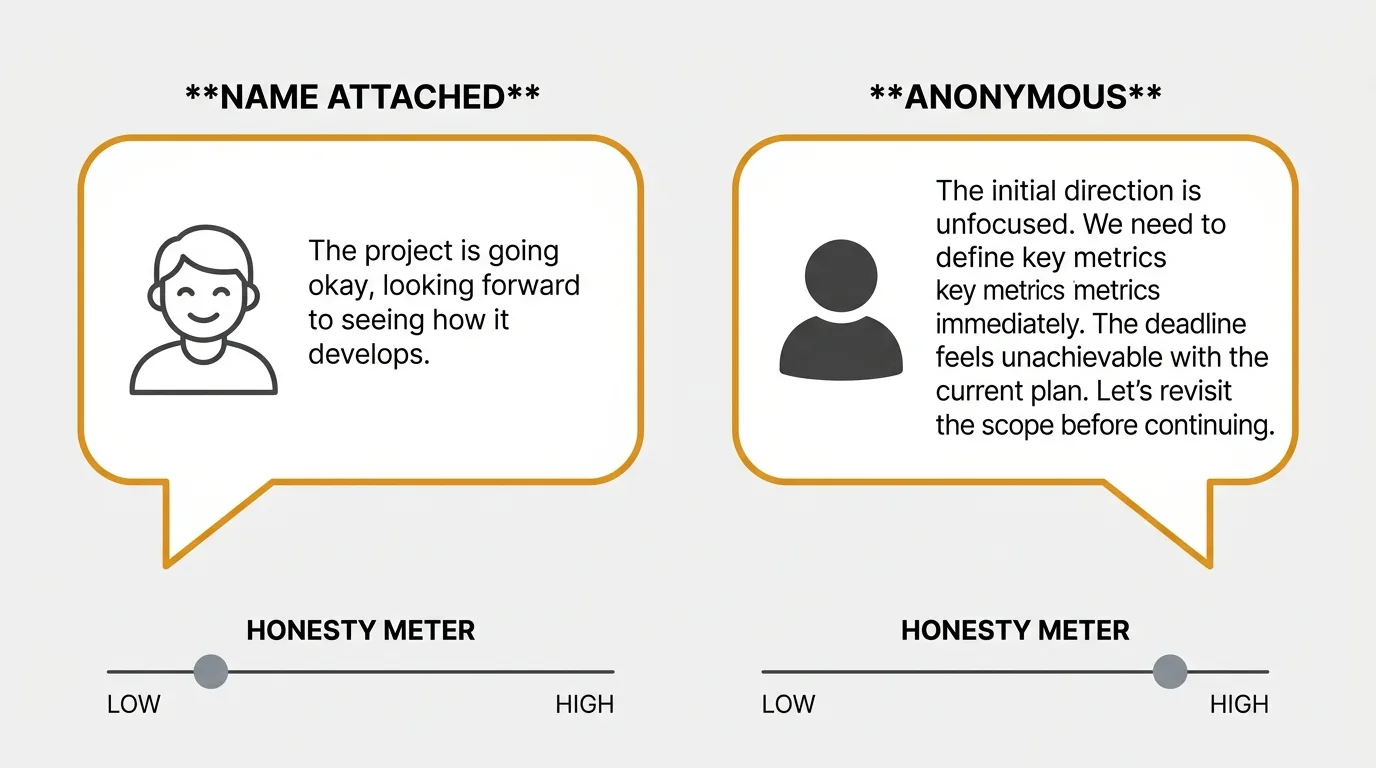
When a customer submits a feature request with their name and company visible, they are thinking about more than just the feedback. They are thinking about their relationship with your team, whether the request sounds reasonable, and whether anyone will judge them for asking. That self-censoring removes the rough edges — which are often the most valuable part.
Anonymous feedback does not replace identified feedback. It fills a gap that identified feedback cannot reach.
Anonymous feedback is feedback collected without attaching a name, account, or identity to the submission. It tends to surface more honest responses because people stop self-censoring when there is no risk of judgment, damaged relationships, or career consequences. Use it as an honesty check alongside identified feedback — not as a replacement — and enable it gradually, starting with anonymous voting before opening up anonymous commenting and posting.
The honesty gap
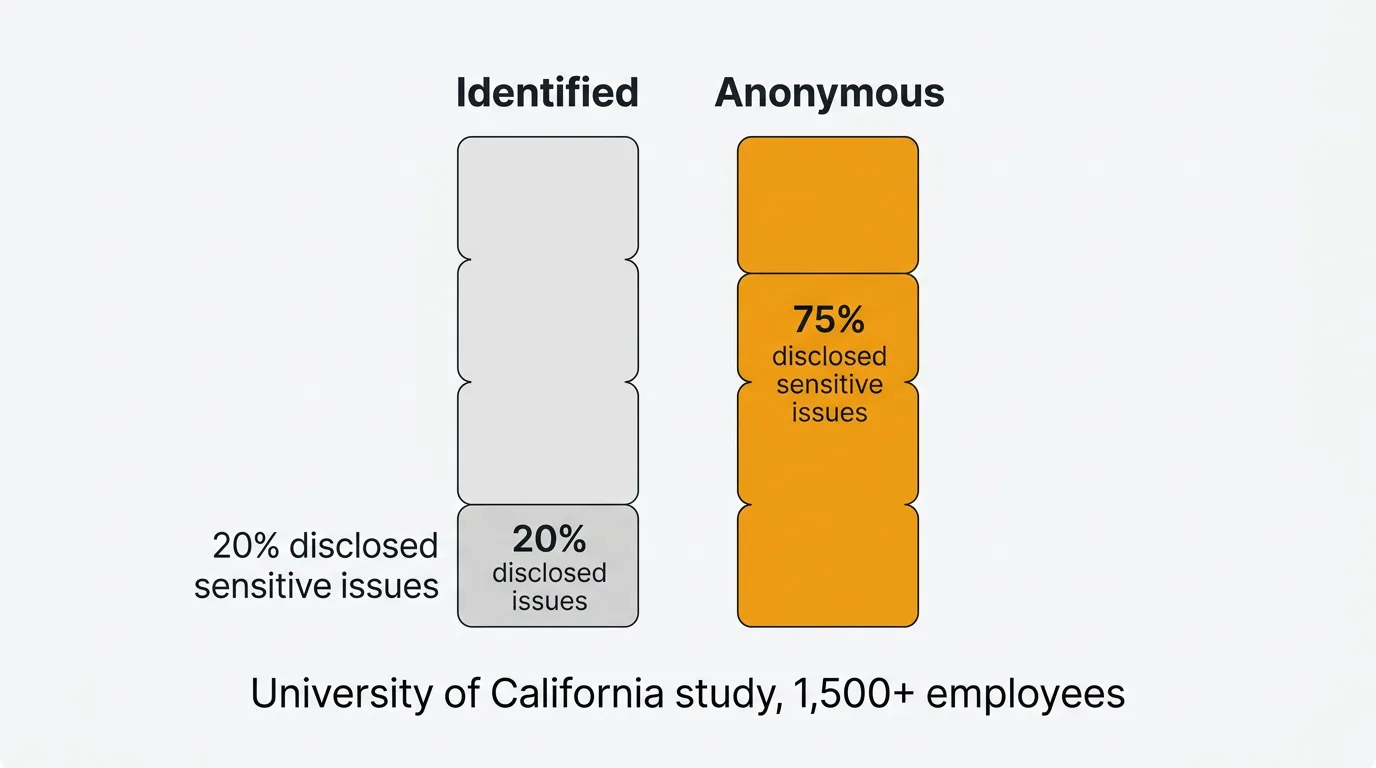
Research on anonymity and honesty is consistent across fields. People disclose more about sensitive topics when they believe their identity is protected, and they report lower social desirability bias under anonymous conditions. The effect is strongest exactly where the stakes feel personal — workplace issues, mistakes, and criticism people would rather not put their name to.
Social desirability bias is the tendency to give answers that will be viewed favorably by others. In identified feedback, users skew toward polite, constructive phrasing. They downplay frustration. They avoid criticizing features they know your team spent months building. Anonymous feedback bypasses this filter. Research published in Behavior Research Methods, Instruments, & Computers (Joinson, 1999) found that participants reported lower social desirability under anonymous conditions — which is exactly the dynamic that sanitizes product feedback.
The spiral of silence describes how people stay quiet when they think their opinion is unpopular. In a public feedback board where votes are visible and names are attached, a user who disagrees with a popular request may not speak up. Anonymous channels break this spiral and give minority opinions a voice.
Power dynamics amplify the effect. When a customer depends on your product for their workflow, they may avoid harsh feedback because they worry it could affect their relationship with your team or their account status. This is especially true for enterprise customers with dedicated account managers. An AllVoices report found that 84% of employees had at least one concern they wanted to raise with HR in the past year but never shared.
Selection bias in participation is often overlooked. Anonymity does not just make the same people more honest — it can bring in entirely different participants. The same dynamic applies to product feedback: your anonymous channel will hear from users who would never have submitted identified feedback in the first place.
The result: identified feedback tells you what people are comfortable saying publicly. Anonymous feedback tells you what they actually think.
When anonymous feedback works
Sensitive product areas
Users are more likely to share honest feedback anonymously when the topic involves something they find embarrassing or frustrating. A user struggling with your onboarding flow might not want to publicly admit they could not figure out how to set up their account. Anonymity removes the stigma.
Early-stage products
When your product is new and your user base is small, people are reluctant to post harsh feedback because they know you will see it and might know who they are. Anonymous feedback is especially valuable during beta phases when you need unfiltered reactions to rough features.
Internal feedback
If you use a feedback tool internally — for employees to suggest process improvements or product ideas — anonymity is critical. People will not criticize a VP's pet project with their name attached. They will if the submission is anonymous.
Churn signals
Users who are about to leave your product rarely tell you why if they have to identify themselves. They just leave. An anonymous feedback channel gives departing users a low-friction way to explain what went wrong without the awkwardness of a face-to-face conversation, which feeds directly into your customer retention strategy.
Price sensitivity
Feedback about pricing is almost never honest when identified. Customers do not want to look cheap. They do not want to damage their negotiating position. Anonymous feedback about pricing surfaces the real objections: "this is too expensive for what it does," "I cannot justify this to my manager," "the free tier is too limited."
When anonymous feedback does not work
Support issues
If a user reports a bug anonymously, you cannot follow up. You cannot ask for reproduction steps, check their account configuration, or tell them when it is fixed. Bug reports and support requests need identity to be actionable.
Feature requests that need context
Some feature requests only make sense with user context. "We need SSO" means something different from a three-person startup than from a 500-person enterprise. If you cannot see who is asking, you lose the context that helps you prioritize.
High-trust communities
In small, tight-knit user communities where people know each other, anonymous feedback can feel unnecessary or even counterproductive. If your users already trust your team and each other, anonymity adds friction without much benefit.
Accountability-sensitive decisions
When feedback directly influences a product decision — like voting on which feature gets built next — some teams prefer identified feedback because it lets them weight votes by customer segment, revenue, or usage. Anonymous votes count equally regardless of context.
How to implement anonymous feedback
The implementation depends on what you want to allow anonymous users to do. Most teams start with anonymous voting and expand from there. The Quackback docs walk through configuring these permissions end to end.
Configurable permission levels
The most flexible approach is a permission system where you control what anonymous users can do:
| Action | Default | When to enable |
|---|---|---|
| Anonymous voting | On | Almost always. Low friction, high signal. |
| Anonymous commenting | Off | When you want anonymous discussion on existing posts. |
| Anonymous posting | Off | When you want to collect anonymous submissions. |
Start with anonymous voting enabled and the others off. This lets unidentified visitors express preferences without opening the door to low-quality anonymous posts. Expand permissions if you find that anonymous voting surfaces demand for anonymous submissions.
Quackback supports all three permission levels — anonymous voting, commenting, and posting — configurable independently from the admin panel. Logged-in users get their feedback attributed automatically. Anonymous visitors participate without creating an account. Quackback is open source (AGPL-3.0), so you can open a channel to anonymous and identified participants alike on infrastructure you control.
Embedding in your product
The most effective anonymous feedback comes from in-product prompts, not standalone surveys. When a user finishes a task, encounters an error, or reaches a milestone, prompt them with an optional anonymous feedback widget. The context is fresh and the friction is minimal.
A feedback widget embedded in your product can identify logged-in users automatically while falling back to anonymous mode for visitors who are not signed in. This gives you the best of both: attributed feedback from known users and anonymous feedback from everyone else.
Preventing abuse
The main concern with anonymous feedback is abuse — spam, offensive content, or deliberately misleading submissions. In practice, this is less common than most teams expect, especially for product feedback tools (as opposed to social platforms). But basic safeguards help:
- Rate limiting — restrict how many anonymous submissions come from a single IP or session in a given time window
- Moderation queue — route anonymous submissions through a review step before they appear publicly
- Content filtering — flag submissions that contain offensive language for manual review
- Session tracking — even without identifying the user, track anonymous sessions to detect patterns (same person submitting the same request repeatedly)
Balancing anonymous and identified feedback
Anonymous feedback is not an all-or-nothing decision. The strongest feedback programs use both and keep them clearly separated.
Identified feedback is your primary channel. It gives you context, enables follow-up, and lets you weight feedback by customer segment. Feature requests, bug reports, and detailed product suggestions work best with identity attached.
Anonymous feedback is your honesty check. It surfaces the things people will not say publicly. Use it to validate or challenge what your identified feedback is telling you. If your identified feedback says users love your pricing and your anonymous feedback says it is too expensive, you have a signal worth investigating. Not every tool gives you this control over anonymous participation — see how the approaches differ in Quackback vs Canny.
Do not try to de-anonymize. If you offer anonymous feedback, respect the anonymity. Do not cross-reference timestamps, IP addresses, or writing style to figure out who submitted something. Users will find out, and you will never get honest feedback again.
Measuring the impact
How do you know if anonymous feedback is adding value?
Volume comparison. If anonymous submissions are significantly higher than identified submissions, that is a signal that users have things to say but are not comfortable saying them publicly. The gap between anonymous and identified volume tells you how much honesty your identified channel is leaving on the table.
Sentiment comparison. Compare the average sentiment of anonymous feedback to identified feedback. If anonymous feedback is consistently more negative, it is surfacing dissatisfaction that your identified channel masks.
New themes. Track whether anonymous feedback raises topics that never appear in identified feedback. If anonymous users consistently mention pricing, performance, or competitor features that identified users do not raise, those are blind spots in your public feedback. Quackback's AI analysis clusters submissions into themes, and its MCP server lets you query those themes directly from tools like Claude or Cursor.
Action rate. Track how often anonymous feedback leads to a product change. If anonymous insights are driving real decisions, the channel is working. If they are just noise, reconsider your approach.
Try Quackback — open source with a managed cloud option. Start free. Get started | View on GitHub
Frequently asked questions
Does anonymous feedback attract trolls and spam?
In product feedback contexts, spam and abuse are rare. Product feedback tools have a narrow audience (your users) and a specific purpose, so low-quality submissions are typically a small fraction of the total. Basic rate limiting, a moderation queue, and content filtering handle the rest.
Should I make all feedback anonymous by default?
No. Default to identified feedback for logged-in users and anonymous for visitors. Identified feedback is more actionable because you can follow up, segment by customer type, and weight by usage. Anonymous is a supplement, not a replacement.
How do I act on anonymous feedback if I cannot follow up?
Treat anonymous feedback as directional signal, not individual tickets. If one anonymous user says your pricing is too high, that is an anecdote. If twenty anonymous users say it, that is a trend. Use anonymous feedback to identify themes, then investigate those themes through other channels — customer interviews, surveys, or targeted outreach to specific segments.
Can anonymous users vote on existing posts?
Yes, in most feedback tools that support anonymous participation. Anonymous voting is the lowest-friction form of anonymous feedback — it lets visitors express preferences without writing anything. This is particularly useful for public feedback boards where you want the broadest possible participation in prioritization.
Is anonymous feedback GDPR compliant?
Truly anonymous feedback — where no personal data is collected or stored — falls outside GDPR's scope because there is no data subject to protect. However, if you track sessions, IP addresses, or any identifiers alongside "anonymous" feedback, it may qualify as pseudonymous data and still fall under GDPR. Consult your legal team about your specific implementation.

Authored by James Morton
Founder of Quackback. Building open-source feedback tools.
Try Quackback
The open-source feedback platform. Boards, voting, and roadmaps.
Get startedStar on GitHub305