
The feature is built, tested, and ready to ship. The launch itself takes a day. The preparation and follow-through take weeks. Most teams underinvest in both.
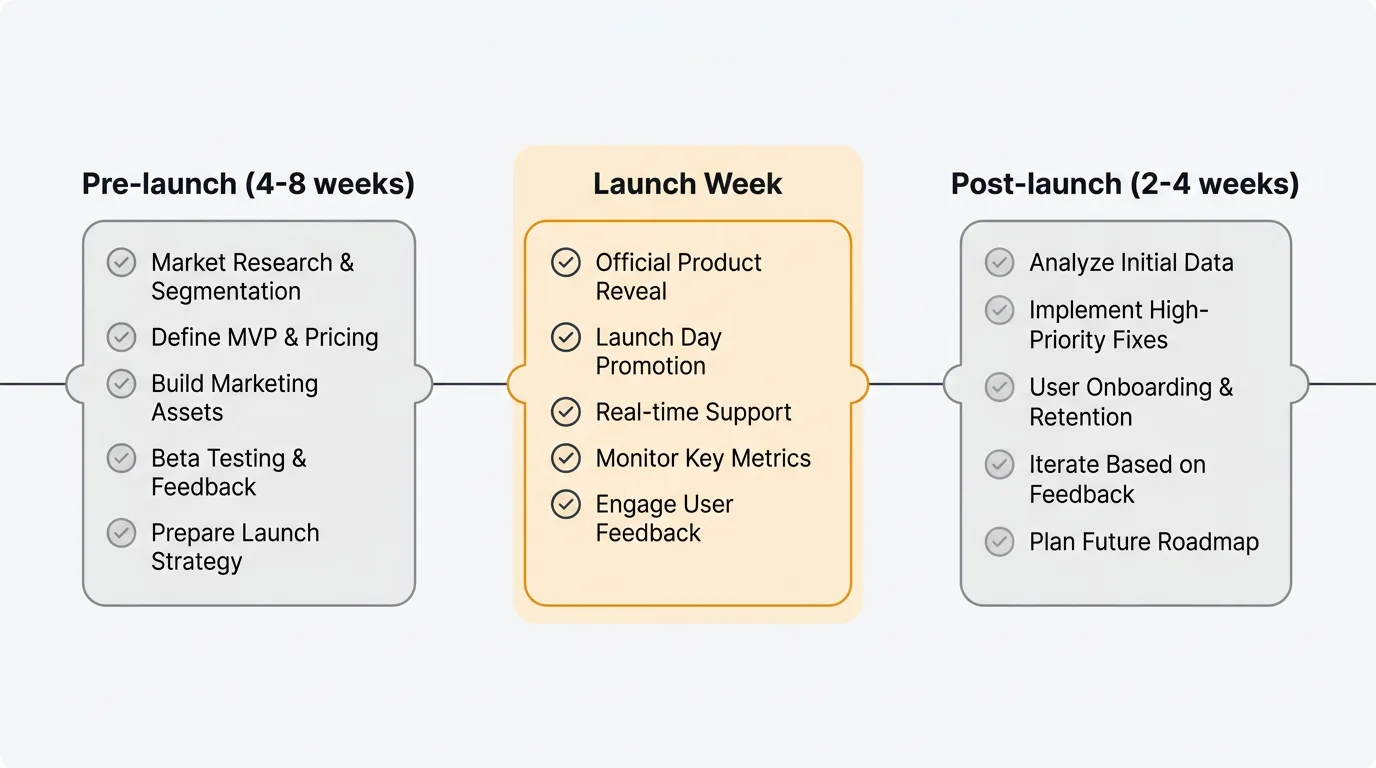
A SaaS product launch checklist organizes the work across three phases: pre-launch preparation (product, design, docs, marketing, sales), launch week execution (staged rollout, monitoring, announcements), and post-launch follow-through (adoption metrics, feedback review, iteration). Scale your effort to the launch type, and assign each activity an owner so nothing falls through the cracks.
A McKinsey study found companies lose 33% of after-tax profit by shipping six months late, but only 3.5% from overspending 50% on development. Speed matters. But shipping without a launch plan means your best features go unnoticed, your support team gets blindsided, and you miss the window to collect early feedback that shapes the next iteration.
This checklist covers three phases: pre-launch preparation, launch week execution, and post-launch follow-through. Use it as a starting template and adapt it to your team's workflow.
Pre-launch (4-8 weeks before)
Product and engineering
- Feature is code-complete and passing all automated tests
- Beta testing completed with at least 5-10 users from different segments
- Beta feedback reviewed and critical issues resolved
- Performance testing validates acceptable load times under expected traffic
- Feature flags configured for staged rollout (percentage-based or segment-based)
- Rollback plan documented — how to disable the feature without a full deployment
- API documentation updated if the feature exposes new endpoints
- Data migration scripts tested (if applicable) with rollback procedures
Design and UX
- Final designs reviewed against acceptance criteria
- Responsive design verified on mobile, tablet, and desktop viewports
- Accessibility audit completed (keyboard navigation, screen reader compatibility, color contrast)
- Empty states, error states, and loading states designed and implemented
- Onboarding flow or tooltip walkthrough created for new users discovering the feature
Documentation and support
- Help center articles written and reviewed (how-to guides, configuration options, troubleshooting)
- Knowledge base updated with new feature documentation
- Internal FAQ prepared for support team — common questions and answers
- Support team trained on the feature (demo, walkthrough, edge cases)
- Canned responses created for anticipated support tickets
- Known limitations documented (what does not work yet, what is planned for v2)
Marketing and communications
- Launch messaging finalized — one-sentence description, key benefits, target audience
- Blog post or announcement drafted
- Email announcement drafted for existing customers
- Social media posts scheduled
- Product screenshots and demo GIF/video created
- Landing page updated (if the feature warrants its own page)
- Changelog entry drafted
Sales enablement
- Sales team briefed on the feature — what it does, who it is for, how to demo it
- Battlecard updated with competitive positioning (how this feature compares to competitors)
- Pricing implications documented (is this included in existing plans or a new tier?)
- Customer-facing one-pager or feature brief created
Launch week
Day of launch
- Feature flag enabled for the target rollout percentage (start at 10-25%, not 100%)
- Monitoring dashboards visible — error rates, latency, feature adoption
- On-call rotation confirmed for engineering (who handles incidents?)
- Changelog entry published
- Email announcement sent to customer segments
- Blog post published
- Social media posts published
- In-app announcement or banner activated
- Sales team notified that the feature is live
Days 2-3
- Monitor error rates, support ticket volume, and adoption metrics
- Review initial customer feedback from feedback widget, support tickets, and social channels
- Address critical bugs within 24 hours
- Expand rollout percentage based on stability data (25% → 50% → 100%)
- Respond to social media mentions and community questions
Days 4-7
- Full rollout to 100% of users (if no critical issues)
- First adoption metrics report — how many users activated the feature?
- Feedback board reviewed for early feature requests and complaints
- Support team check-in — are the canned responses covering the real questions?
- Remove feature flag (or leave it in place for kill-switch capability)
Post-launch (2-4 weeks after)
Metrics and analysis
- Feature adoption rate measured (percentage of eligible users who used the feature)
- Retention impact assessed (did the feature improve or harm retention for the cohort?)
- Support ticket volume analyzed (is the feature generating more tickets than expected?)
- Performance metrics reviewed (load times, error rates under real traffic)
- Revenue impact measured (for monetized features: conversion rate, upsell rate)
Feedback and iteration
- All feedback from the launch period collected and categorized
- Top feature requests from launch feedback identified and added to backlog
- Bug reports triaged and prioritized
- V2 improvements scoped based on post-launch data
- Feedback loop closed — notify users who reported issues that fixes are shipped
Communication
- Post-launch retrospective held with the cross-functional team
- Product update sent to customers who did not engage with the initial announcement
- Public roadmap updated to reflect shipped status
- Internal wins shared — adoption numbers, customer quotes, impact metrics
Cross-functional RACI
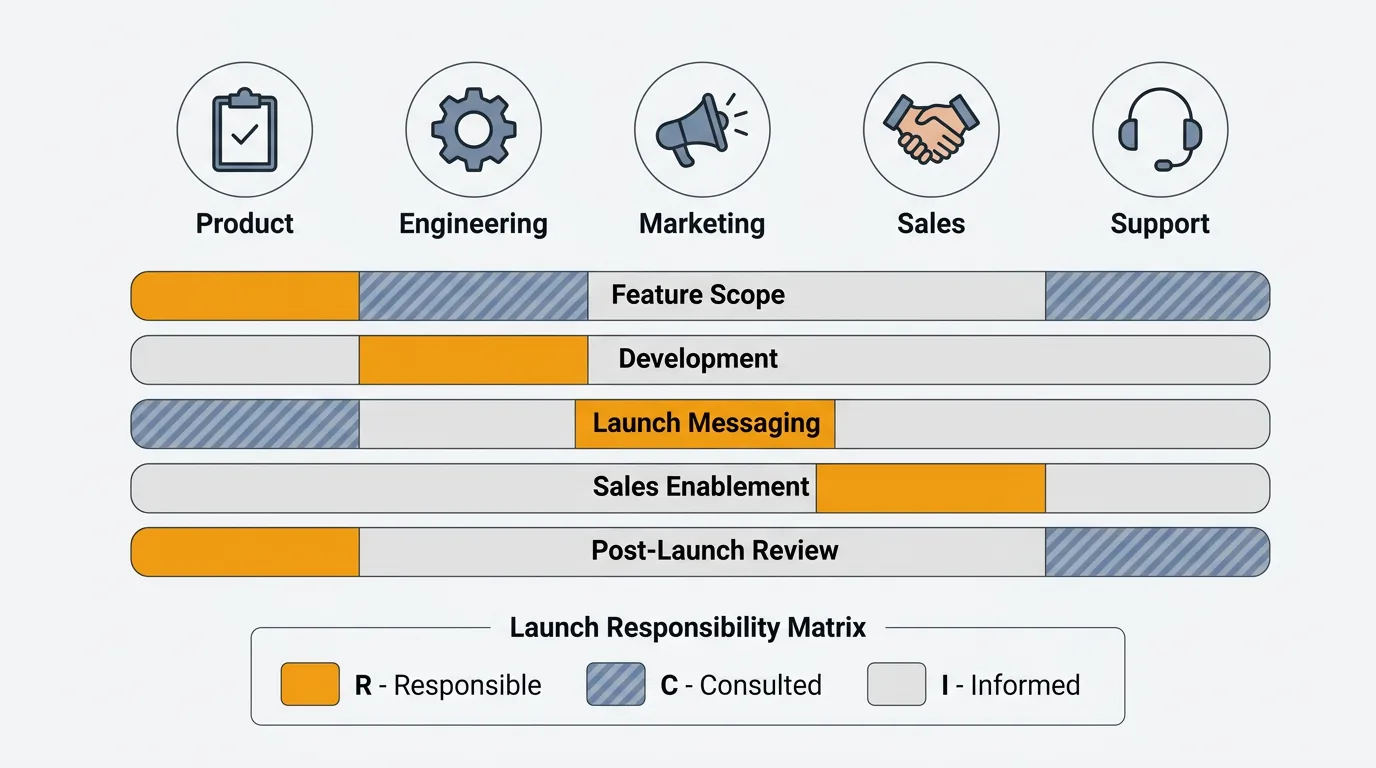
Who is responsible for what during a launch:
| Activity | Product | Engineering | Marketing | Sales | Support |
|---|---|---|---|---|---|
| Feature scope and acceptance criteria | R | C | I | I | I |
| Development and testing | C | R | I | I | I |
| Beta program coordination | R | C | I | I | C |
| Documentation and help articles | C | I | I | I | R |
| Launch messaging and blog post | C | I | R | I | I |
| Changelog and in-app announcement | R | I | C | I | I |
| Sales enablement and battlecard | C | I | C | R | I |
| Monitoring and incident response | C | R | I | I | I |
| Post-launch feedback review | R | C | I | C | C |
R = Responsible, C = Consulted, I = Informed
Launch types and how they differ
Not every launch needs the full checklist. Scale your effort to the launch type:
Major launch (new product or flagship feature)
Use the full checklist. All teams involved. External communications including blog post, email, social media, and potentially press. Beta program of 2-4 weeks. Full cross-functional retrospective.
Feature launch (significant new capability)
Use most of the checklist. Skip press and landing pages. Focus on changelog, email to affected segments, and in-app announcement. Beta testing with 5-10 users. Abbreviated retrospective.
Minor release (improvements and fixes)
Changelog entry and in-app notification are sufficient. No email blast, no blog post. Support team informed via Slack message. Engineering monitors for 24 hours. No formal retrospective.
Silent release (behind a feature flag)
No external communication. Feature flag enables the feature for a percentage of users. Engineering monitors metrics. If metrics are positive, expand rollout. If negative, roll back. Communicate only after the feature is proven at scale.
Common launch mistakes
Skipping the beta. Shipping directly to 100% of users means your entire user base discovers bugs simultaneously. A beta with 5-10 users catches the obvious issues before they scale.
Announcing before it is ready. Announcing a feature that is not yet live or is behind a feature flag for only 10% of users creates support tickets from the 90% who cannot find it. Time your announcements to match your rollout.
Forgetting support. Your support team gets the first wave of questions. If they learned about the feature from the same changelog entry as the customers, they cannot help. Brief support before launch, not after.
No rollback plan. "What do we do if this breaks?" should be answered before launch, not during an incident. Feature flags, database migration rollbacks, and deployment reverts should all be documented and tested.
Moving on too fast. Shipping and immediately starting the next sprint means you never measure whether the feature worked. Block two weeks of post-launch time for monitoring, feedback review, and iteration planning. The data from those two weeks determines whether you built the right thing.
Close the launch feedback loop
The post-launch phase is where most checklists fall apart. You ship, the next sprint starts, and the early signal disappears. Quackback keeps that loop in one place: a feedback board and feedback widget capture launch reactions in context, a public roadmap and changelog keep customers informed, and an MCP server lets you triage and summarize launch feedback from your AI assistant. Because Quackback is open source, your whole launch team — product, support, sales — can read and respond. Built-in AI helps you summarize a launch-week feedback spike.
Try Quackback — open source with a managed cloud option. Start free. Get started | View on GitHub
Frequently asked questions
How far in advance should I start launch preparation?
Four to eight weeks for a major launch. Two to four weeks for a feature launch. One week for a minor release. The documentation, training, and marketing assets take longer than most teams expect — start earlier than you think you need to.
Should every feature get a launch plan?
No. Bug fixes, minor improvements, and internal tooling changes do not need a launch plan. Use the full checklist for features that affect user workflows, change pricing, or require user education. Use a lightweight version (changelog + monitoring) for everything else.
How do I measure launch success?
Measure launch success with three metrics: adoption rate (percentage of eligible users who used the feature within 30 days), support impact (whether ticket volume rose or fell), and retention impact (whether the feature improved retention for that cohort). Set target numbers before launch to define success clearly.
What is the best way to announce a product launch?
A multi-channel approach: changelog entry for in-product visibility, email to relevant customer segments for reach, blog post for SEO and detail, and social media for awareness. The changelog and email are non-negotiable for any significant launch. Blog and social are optional for smaller releases.
How do I collect feedback during a launch?
Collect launch feedback through a feedback widget so users report issues in context, a feedback board for new submissions, support ticket patterns, and a post-launch survey to beta users. The first two weeks after launch are the highest-signal period, so watch them closely.

Authored by James Morton
Founder of Quackback. Building open-source feedback tools.
Try Quackback
The open-source feedback platform. Boards, voting, and roadmaps.
Get startedStar on GitHub305