
Intercom is a customer communications platform that combines live chat, a shared inbox, AI-powered support, and a help center. It sits at the intersection of customer support and engagement — not a pure ticketing tool like Zendesk, and not a product management platform. Teams use it to handle support conversations, run in-app messaging, and increasingly, to deflect volume with Fin, Intercom's AI agent.
Pricing has changed substantially over the past few years. Intercom moved to a seat-based model in 2023 and has layered Fin AI on top as a per-resolution add-on. What you pay depends on how many support seats you need and how much of your volume Fin handles.
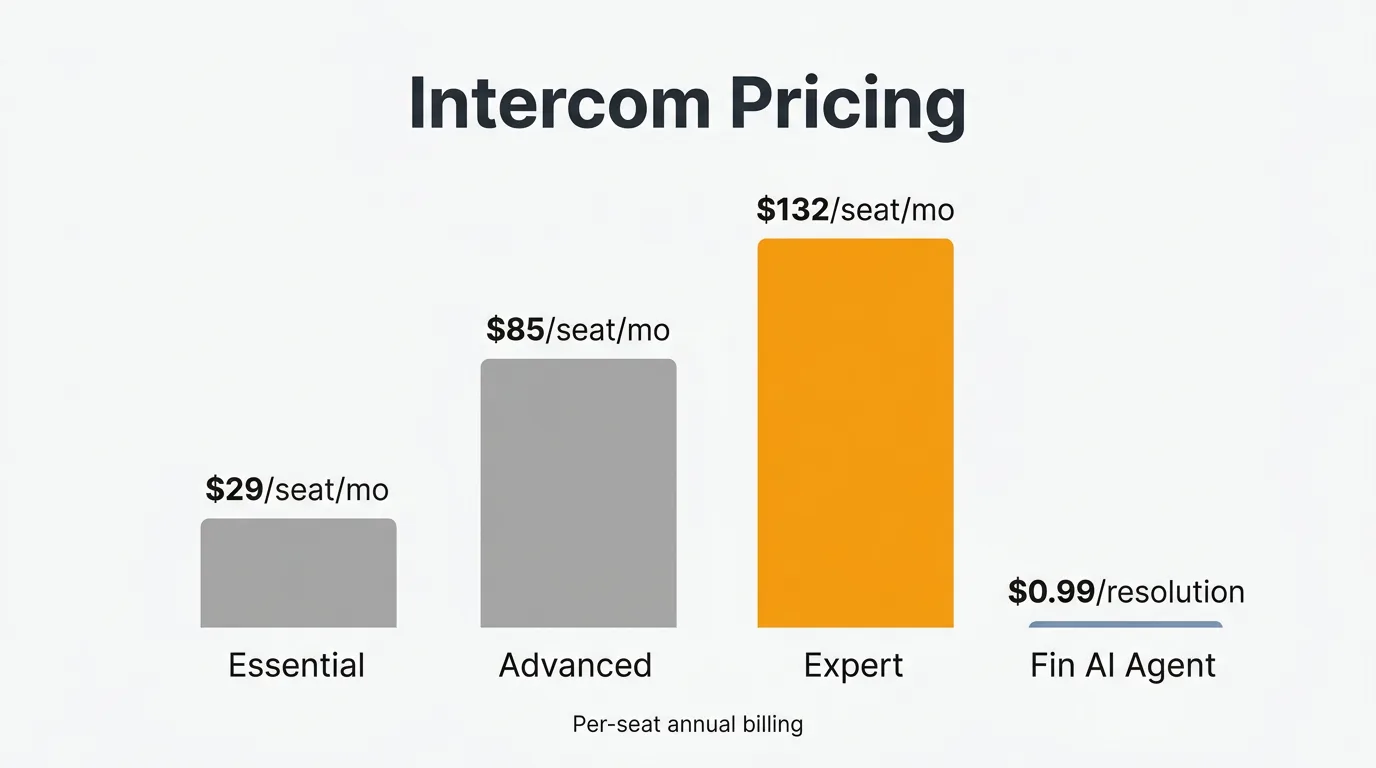
Intercom uses per-seat pricing: $29/seat/mo on Essential, $85/seat/mo on Advanced, and $132/seat/mo on Expert (annual billing). The Fin AI agent costs $0.99 per resolution on top of your base plan, so your bill scales with both headcount and support volume. If you need feature request tracking and a product roadmap alongside Intercom, Quackback integrates directly — open source, free to self-host, with built-in AI.
Pricing last verified February 2026. Vendors may change plans and pricing without notice. Check Intercom's pricing page for the latest figures.
Intercom pricing plans
Intercom offers three plans for its core platform. All prices are per seat per month, billed annually. Monthly billing is available at higher rates.
| Plan | Price (Annual) | Key Features |
|---|---|---|
| Essential | $29/seat/mo | Shared inbox, live chat, basic automation, help center, messenger, email, in-app messages, basic reporting |
| Advanced | $85/seat/mo | Everything in Essential plus AI-powered workflows, custom bots, advanced automation, SLAs, assignment rules, CSAT surveys, multiple team inboxes, custom reports |
| Expert | $132/seat/mo | Everything in Advanced plus Workload management, real-time reporting dashboard, SSO/SAML, custom roles and permissions, advanced security, priority support |
Essential covers the fundamentals: a shared inbox, live chat via the Intercom Messenger, a help center for self-service, and basic automation rules. It is the entry point for teams that need a managed support inbox and customer-facing chat without the deeper workflow tooling.
Advanced is where most growing support teams land. It adds AI-powered workflows, custom bots that can handle conversations before routing to humans, SLAs, assignment rules, CSAT collection, and custom reporting. The workflow builder on this tier lets you automate handoffs, tagging, and escalations in ways the Essential plan does not support.
Expert adds the operational and security features that matter at scale: workload management for balancing queue distribution across agents, real-time dashboards, SSO/SAML, and granular role-based access control. SSO is locked to Expert — any team with a security policy requiring SSO must be on the $132/seat/mo plan.
Fin AI agent pricing
Fin is Intercom's AI support agent. It reads your help center content and conversation history, handles inbound queries autonomously, and only escalates to a human agent when it cannot resolve the issue.
Fin is priced at $0.99 per resolution. A resolution is counted when Fin handles a conversation end-to-end without human intervention — typically when the customer's question is answered and the conversation closes without escalation.
Conversations that Fin starts but does not resolve (it escalates to a human) are not charged as resolutions. You pay for successful deflections, not attempts.
Here is how Fin costs scale by monthly resolution volume:
| Monthly Resolutions | Fin AI Cost | Notes |
|---|---|---|
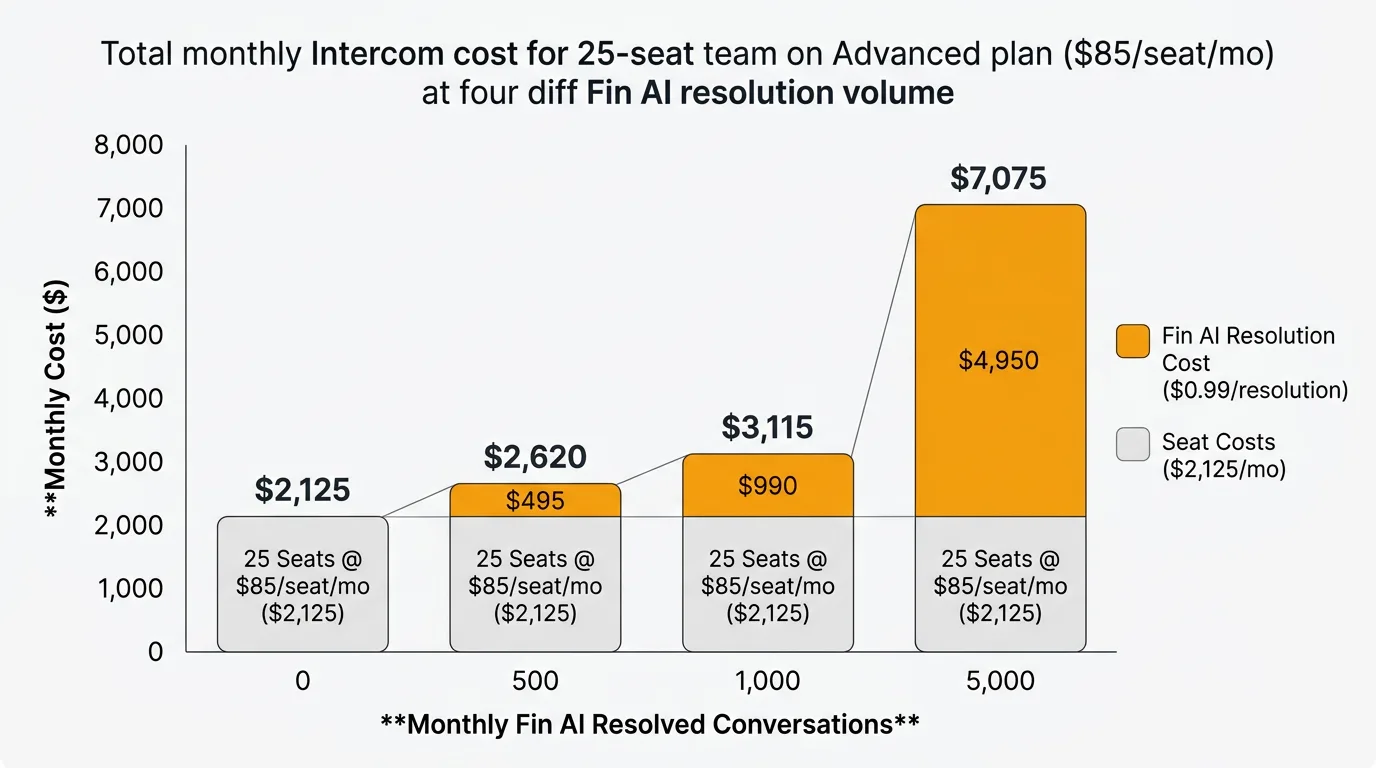
| 500 | $495/mo | Low-volume support team |
| 1,000 | $990/mo | Mid-size team with moderate automation |
| 5,000 | $4,950/mo | High-volume or scaled operation |
| 10,000 | $9,900/mo | Large team with significant deflection |
The per-resolution model is straightforward to understand but harder to budget. Your Fin costs are directly tied to your support volume, which fluctuates. A product launch, a service incident, or seasonal demand can spike resolutions in a given month. Teams with variable support volume should build buffer into their Fin budget.
Fin is available on all three plans. You enable it on your account and connect it to your help center content. Resolution billing starts immediately when Fin begins handling conversations.
Per-seat costs at scale
Base plan costs grow linearly with seat count. Here is what each plan costs annually for common team sizes.
| Seats | Essential ($29/seat/mo) | Advanced ($85/seat/mo) | Expert ($132/seat/mo) |
|---|---|---|---|
| 5 | $1,740/yr | $5,100/yr | $7,920/yr |
| 10 | $3,480/yr | $10,200/yr | $15,840/yr |
| 25 | $8,700/yr | $25,500/yr | $39,600/yr |
| 50 | $17,400/yr | $51,000/yr | $79,200/yr |
These figures cover the base plan only. Add Fin AI resolutions on top to get the full picture. At 25 seats on Advanced with 1,000 monthly Fin resolutions, your combined annual cost is approximately $25,500 (seats) + $11,880 (Fin) = $37,380/yr.
Add-ons and extras
Beyond the base plans and Fin AI, Intercom offers several add-ons that extend functionality at extra cost.
Proactive Support Plus adds advanced in-app messaging features: product tours, push notifications, checklists, and banners. This is relevant for teams that want to use Intercom for onboarding and in-product engagement, not just support. Pricing is not published publicly and is quoted based on MAU volume.
Product Tours is a specific add-on for building step-by-step in-app walkthroughs. It is available separately from Proactive Support Plus if you only need guided tours without the full messaging suite.
WhatsApp integration is available as an add-on on Advanced and Expert plans. It routes WhatsApp conversations into the shared inbox alongside other channels. There is a per-conversation charge from Meta that applies in addition to any Intercom fees.
SMS is another channel add-on. It allows outbound and inbound SMS through the Intercom inbox. Pricing is per message and varies by country.
Additional seats beyond the seats included in your plan are charged at the per-seat rate for your tier. If you are on Advanced and add a seat mid-contract, the additional seat is prorated for the remainder of your billing period.
The add-on model means your actual Intercom bill can differ meaningfully from the base plan price. Factor in which channels you need and whether Proactive Support or Product Tours fits your use case before committing to a plan.
What Intercom does well
Intercom has built a strong platform for customer-facing communication. Its core strengths are well-established.
Messenger and live chat. The Intercom Messenger is polished and highly configurable. It handles live chat, automated bots, and self-service help center access in a single widget. It is one of the most widely recognized in-app support experiences in SaaS.
Shared inbox. The inbox consolidates conversations across channels — chat, email, WhatsApp, SMS — in one place. Agents can see the full conversation history, customer data, and context from your product or CRM without leaving the inbox.
Fin AI agent. Fin is among the better AI support agents available. It uses your help center and conversation data to resolve queries autonomously, and the per-resolution pricing aligns cost with value delivered.
Help center. Intercom includes a built-in help center for self-service content. You can publish articles, organize them into collections, and surface them automatically in the Messenger before a user starts a conversation.
Automation and bots. Custom bots and the workflow builder let you automate routing, tagging, escalation, and initial triage. Advanced and Expert plans unlock the deeper automation rules these workflows depend on.
Customer data. Intercom stores conversation history, user attributes, and behavior events. This context shows up in the inbox alongside conversations, so agents know who they are talking to and what they have done in your product.
What Intercom doesn't do
Intercom is built for customer support and messaging. It is not a product management platform, and it does not try to be.
Feature request tracking with voting. Intercom has no structured way to capture, organize, and prioritize feature requests. Customers may mention requests in support conversations, but there is no built-in mechanism to surface, deduplicate, and rank them.
Public roadmaps. There is no customer-facing roadmap view where users can see what you are building and follow progress. Intercom does not publish or manage roadmap state.
Changelogs. Intercom does not have a product changelog — a structured record of what shipped and when, visible to customers. Announcing releases requires email campaigns or in-app messages built manually each time.
Feedback-to-roadmap workflow. The loop from "customer mentioned this in a support conversation" to "this is now a tracked feature request with votes and roadmap status" does not exist in Intercom. Support conversations generate signal, but there is no structured workflow to capture and act on that signal.
Structured prioritization. Intercom does not rank feedback, score requests, or give product teams a view of what customers want most. That workflow belongs in a separate product tool.
These gaps are not weaknesses — they reflect the product's intentional scope. Intercom is built for the support team, not the product team. The right answer is not to replace Intercom but to connect it to tools that cover what it does not.
Pairing Intercom with a feedback tool
Intercom generates a large volume of product signal. Every support conversation contains potential feature requests, pain points, and workflow descriptions. Without a structured way to capture that signal, it stays trapped in the inbox.
Quackback's Intercom integration bridges this gap. Support conversations can surface as feedback submissions in Quackback's boards. When a customer mentions a feature request in Intercom, that request flows into Quackback where it can be voted on, categorized, and tracked through to the public roadmap.
The cost model is also different. Quackback is open source (AGPL-3.0) and self-hosted free, with a managed Quackback Cloud option if you would rather not run it yourself. Adding product managers, founders, or stakeholders does not raise your bill the way Intercom seats do. AI analysis is built in, so you avoid the per-resolution metering that makes Fin costs hard to budget. For agentic workflows, the MCP server lets AI tools read and act on your feedback directly.
The workflow is complementary by design. Your support team continues working in Intercom — they handle conversations, manage the inbox, and use Fin AI as they normally would. The Quackback integration runs alongside that workflow without requiring agents to switch tools. When a conversation contains a feature request, it is captured in Quackback automatically or with a single action from the agent.
On the product side, the team works in Quackback. They see incoming feedback from Intercom conversations alongside requests from other channels — your website feedback widget, email, direct submissions. Everything aggregates in one place. Requests can be reviewed, merged with duplicates, assigned roadmap status, and communicated back to customers through a public roadmap and changelog.
The support team stays in Intercom. The product team works in Quackback. The feedback from support conversations becomes structured input to product decisions. See Quackback's feedback features for how the ingestion and tracking workflow operates.
If you are evaluating how Intercom fits into a broader toolset, see Best Customer Feedback Tools in 2026 and Feedback Tool Pricing Comparison for context on the wider category.
Try Quackback — open source with a managed cloud option. Start free. Get started | View on GitHub
Frequently asked questions
How much does Intercom cost per seat?
Intercom costs $29/seat/mo on Essential, $85/seat/mo on Advanced, and $132/seat/mo on Expert, all billed annually. Monthly billing costs more. Fin AI adds $0.99 per resolution on top of any plan, so a 10-seat Advanced team handling 500 Fin resolutions monthly pays roughly $16,140/yr combined.
What is a Fin AI resolution and how is it billed?
A Fin AI resolution is a support conversation Fin handles end-to-end without a human stepping in, counted when the conversation closes after Fin's response. Each resolution costs $0.99. Conversations Fin escalates to a human are not billed. Because costs track support volume, monthly budgeting is harder than fixed-seat pricing.
Does Intercom include SSO?
SSO/SAML is only available on the Expert plan at $132/seat/mo. Essential and Advanced do not include it. If your organization requires SSO for security or compliance, you must budget for Expert pricing across every support seat, a common cost driver for teams that start on Advanced.
Does Intercom handle feature requests and product roadmaps?
No. Intercom is a messaging and support platform with no built-in feature request boards, voting, or public roadmaps. Support conversations generate product signal, but Intercom has no workflow to capture or prioritize it. Teams pair Intercom with a dedicated feedback tool like Quackback to close that loop.

Authored by James Morton
Founder of Quackback. Building open-source feedback tools.
Try Quackback
The open-source feedback platform. Boards, voting, and roadmaps.
Get startedStar on GitHub305