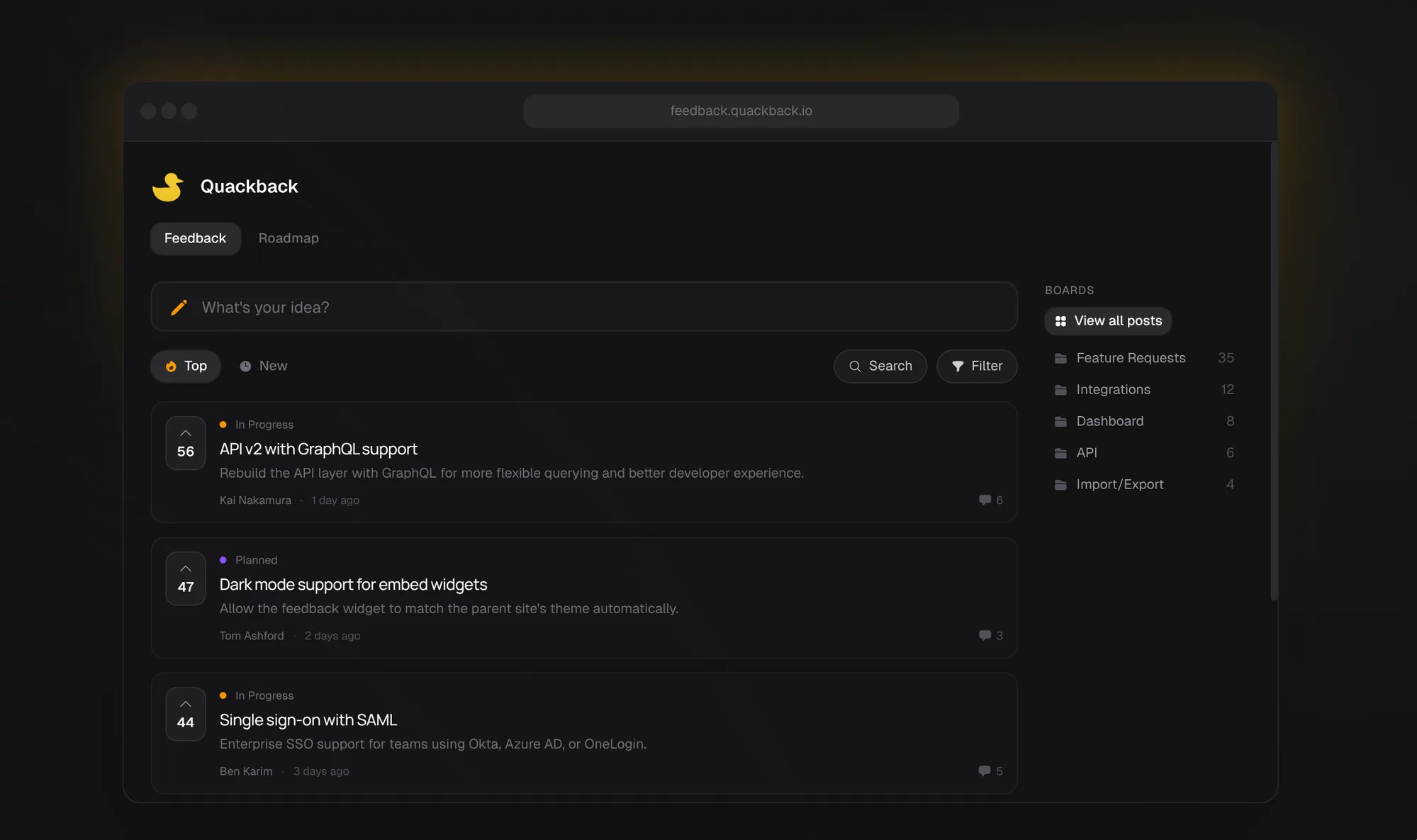
Quackback is an open-source feedback platform. It gives you voting boards, a public roadmap, changelogs, and a full set of integrations, the same workflow that tools like Canny and UserVoice established, but open source and with AI agent access built in.
Quackback is an open-source (AGPL-3.0) customer feedback platform with voting boards, public roadmaps, changelogs, and an MCP server that lets AI agents triage and respond to feedback. Self-host it free with no feature gates, or run it on Quackback Cloud without managing infrastructure. Cloud plans differ on seats and entitlements.
Why feedback tools need an open-source alternative
UserVoice starts at $16,000 per year with annual billing. Canny's free plan caps at 25 tracked users, and meaningful features like PM integrations require their paid plans. Productboard is similar. These tools got the collection model right. But they're all closed-source, expensive at scale, and there's no option to self-host. No way to extend them. No path to complete data sovereignty for those who need it.
At the same time, development workflows are accelerating. AI agents help write code, review pull requests, and ship faster than ever. But customer feedback is still stuck in a manual loop. Triaging, responding, updating status, notifying voters when something ships. For most teams, that work doesn't scale.
Plausible brought open source to web analytics. Cal.com did it for scheduling. Formbricks did it for surveys. PostHog did it for product analytics. Feedback collection hasn't had an equivalent. Until now.
You can try it locally in under a minute:
git clone https://github.com/QuackbackIO/quackback.git
cd quackback && bun run setup && bun run dev
Agents as part of the feedback loop
This is the part of Quackback that doesn't exist anywhere else.
Quackback ships with an MCP server, the same Model Context Protocol that Claude, Cursor, and Windsurf already support. Connect an agent and it gets real access to your feedback data. Not read-only. Not a summary. Actual ability to act.
An agent connected to Quackback can:
- Search across all feedback posts and changelogs
- Triage posts: update status, assign owners, add tags, write official responses
- Create new posts and changelog entries
- Comment and vote on behalf of your team
Every action is attributed. Every decision is auditable. When an agent triages a post, you see which agent did it, when, and what it changed. You stay in control. The agent handles the volume.
The practical effect: a solo founder or a team of three can respond to feedback like a team of ten. Posts that would sit unread for weeks get triaged in hours. Users who report bugs get a response the same day.
Open source. Self-host. Own your data.
Quackback is AGPL-3.0 licensed. The code is public. You can read every line, audit every dependency, and run it on your own infrastructure.
Self-host with Docker or deploy in one click on Railway. Your feedback data stays in your PostgreSQL database. Not on my servers. Not behind an API you don't control.
No vendor lock-in. No feature gates.
What ships today
For your users: Public feedback boards with voting, status tracking, nested comments, and official responses. A public roadmap so they can see what's planned, in progress, and shipped. A changelog that links back to the posts that requested each feature.
For your team: An admin inbox with unified triage, filtering, bulk actions, and automatic deduplication. Two-way sync with your issue tracker so status stays current across tools. SSO and OIDC for enterprise authentication.
For your stack: Integrations including Slack, Linear, Jira, GitHub, GitLab, Asana, ClickUp, Intercom, Zendesk, HubSpot, Freshdesk, Salesforce, Discord, Teams, Notion, Monday, Trello, Shortcut, Azure DevOps, Zapier, Make, n8n, and Stripe. Full API access, webhooks, and the MCP server for agents. Custom branding with your logo, colors, and domain.
Pricing
The self-hosted version of Quackback is free and includes the core platform: feedback boards, roadmap, changelog, integrations, API, and MCP server. Everything you need to run your feedback loop.
Over time, I plan to introduce enterprise-specific features (things like audit logs, advanced SSO configurations, and team management controls) as part of a paid tier. I want to be upfront about that. Keeping Quackback sustainable means some features built for larger organizations will help fund development for everyone.
Quackback Cloud is live for teams that don't want to run their own infrastructure. Paid plans are a flat workspace price from $29/mo on annual billing, with 5 seats on Pro. Portal users are free. Quinn is included on paid plans, with $10 top-up packs if you need more. There is a 14-day free trial with no card required. You get automatic updates, backups, and uptime monitoring, without managing your own servers.
What's next
- Import tools: Migrate from Canny and UserVoice with your data intact
- Agent workflows: Automated triage, AI-powered deduplication, and feedback summarization so every post gets a response without manual effort
Learn more
If you want to see how Quackback stacks up against existing tools, start with our best customer feedback tools in 2026 roundup or the side-by-side comparison pages. For teams interested in self-hosting and data ownership, see our guide to open source feedback tools.
Get involved
Quackback is on GitHub at QuackbackIO/quackback.
I'd especially like feedback on the MCP server. Giving agents access to user feedback is new territory, and I'm shaping the interface based on how people actually use it. Follow the MCP setup guide to connect your agent, then tell me what's missing.
Try Quackback — open source with a managed cloud option. Start free. Get started | View on GitHub
Frequently asked questions
Is Quackback really free?
Yes. The self-hosted version of Quackback is free and open source under AGPL-3.0. It includes feedback boards, roadmaps, changelogs, integrations, the full API, and the MCP server. Quackback Cloud adds managed hosting on paid workspace plans from $29/mo, with a 14-day free trial.
How is Quackback different from Canny and UserVoice?
Quackback is open source and self-hostable, so you own your data and avoid feature gates. It also ships an MCP server that lets AI agents triage and respond to feedback. See Quackback vs Canny and Quackback vs UserVoice.
What does the MCP server let AI agents do?
The MCP server gives AI agents real access to your feedback: search posts and changelogs, update status, assign owners, add tags, write official responses, and create posts. Every action is attributed and auditable, so you stay in control.
Can I self-host Quackback?
Yes. Self-host Quackback with Docker or deploy in one click on Railway. Your feedback data stays in your own PostgreSQL database. The code is public under AGPL-3.0, so you can audit every dependency and run it on your own infrastructure.
Does Quackback have a managed cloud?
Yes. Quackback Cloud is live now. Plans are billed per workspace from $29/mo with a 14-day free trial, and include automatic updates, backups, and uptime monitoring. See the pricing page for current tiers.

Authored by James Morton
Founder of Quackback. Building open-source feedback tools.
Try Quackback
The open-source feedback platform. Boards, voting, and roadmaps.
Get startedStar on GitHub305