
Traditional roadmaps promise dates. Agile roadmaps promise direction. That distinction matters the moment reality changes, and reality always changes.
A fixed-date roadmap built in January is obsolete by March. A competitor ships a feature you hadn't planned for. A user segment you thought was secondary turns out to be your best customers. A technical constraint surfaces that shifts three months of work. Teams that built their roadmap around calendar commitments spend the rest of the year defending a plan that no longer reflects what they know.
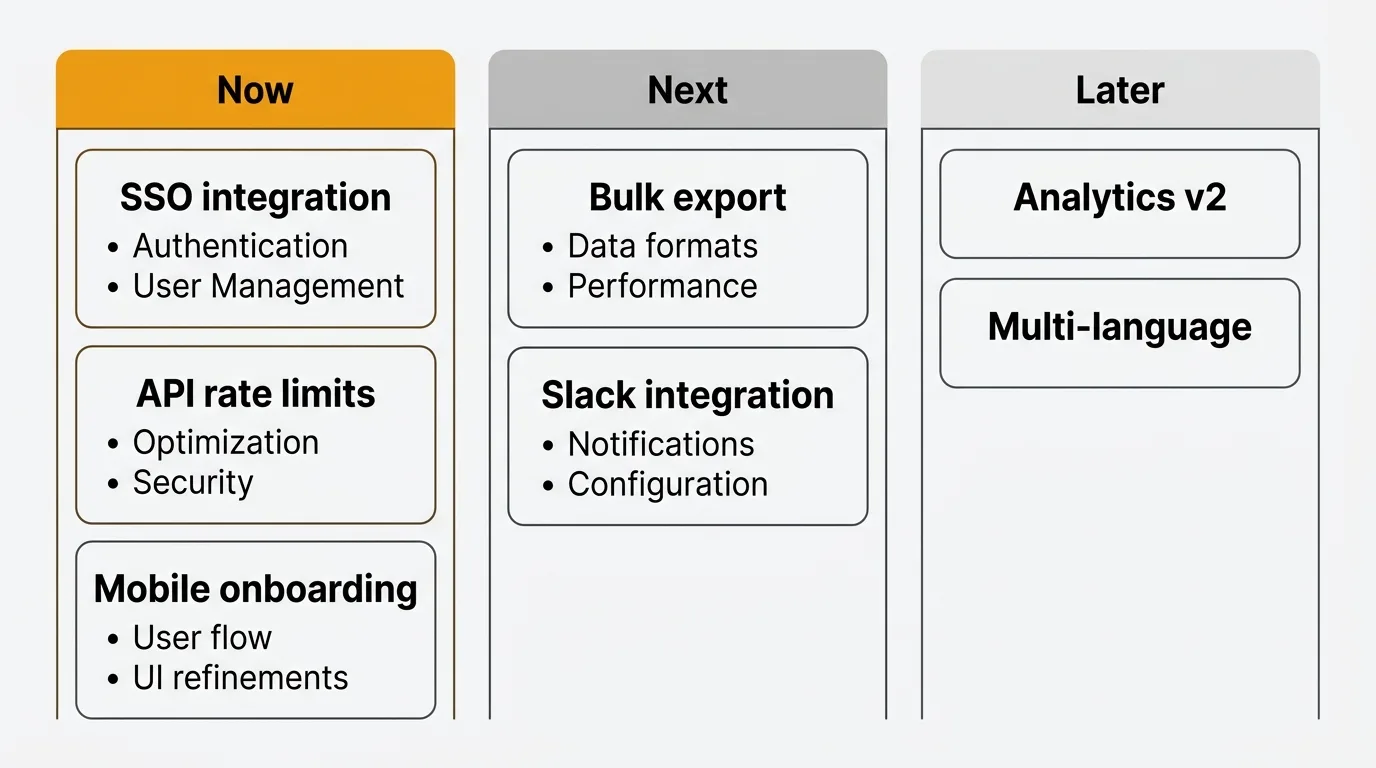
An agile roadmap is a flexible, outcome-focused plan that communicates product direction through themes and rough time horizons rather than fixed features and release dates. It is built around now/next/later horizons and updated each cycle as user feedback and evidence come in. Use it to communicate direction and learn, not to lock in a delivery schedule that will be wrong by the time you reach it.
An agile roadmap treats planning as an ongoing process, not a one-time event. It is a tool for communicating direction and learning from feedback, not for locking in a delivery schedule that will be wrong by the time you reach it.
What is an agile roadmap?
An agile roadmap is a flexible, outcome-focused plan that evolves as your team learns. It describes where you are going and why, organized around themes and goals rather than specific features and release dates.
It is not a Gantt chart. Gantt charts encode dates, dependencies, and sequences with a level of false precision that most product work cannot support. It is not a commitment calendar. A roadmap that promises feature X in Q3 treats planning like a contract, which creates the wrong incentives.
An agile roadmap answers different questions:
- What are we focused on right now?
- What comes next once current work is done?
- What are we considering for later, once we understand more?
- What user outcomes are we trying to achieve?
The format varies, but the underlying principle is consistent: the further out you plan, the less specific you should be. Near-term work is concrete. Future work is intentionally rough.
Agile roadmap vs traditional roadmap
The difference between an agile and a traditional roadmap is not just format. It reflects a different theory of how product development works.
Traditional roadmaps assume that requirements are knowable upfront, that estimates are accurate, and that the world stays stable long enough to execute the plan. Agile roadmaps assume the opposite: that you will learn things as you build, that the market will shift, and that the plan needs to accommodate that.
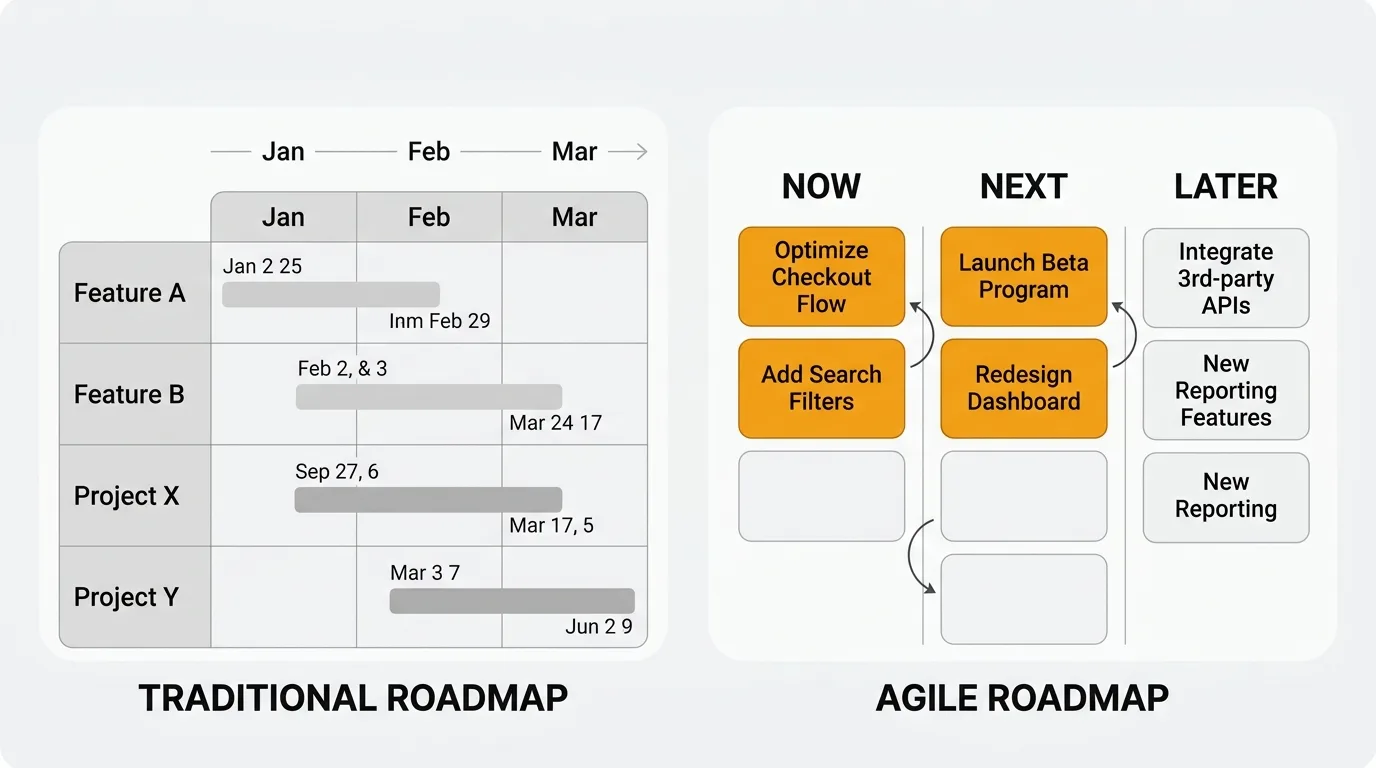
| Traditional roadmap | Agile roadmap | |
|---|---|---|
| Timeframe | Fixed quarters and annual plans | Rolling horizons (now/next/later) |
| Detail level | Feature-specific with acceptance criteria | Theme or outcome level, details emerge later |
| Flexibility | Low — changes require re-planning | High — review and adjust each cycle |
| Stakeholder communication | Status against a committed plan | Direction, priorities, and what you are learning |
| Date commitments | Specific release dates per feature | Rough time horizons, not hard dates |
| Driven by | Initial requirements | Ongoing feedback and evidence |
Neither approach is universally wrong. Some work genuinely requires fixed dates: regulatory deadlines, hardware dependencies, contractual launch windows. The issue is applying date-driven planning to product work that does not need it and losing the flexibility to respond when things change.
For most product teams building software, an agile roadmap is a better fit. You are making decisions under uncertainty, and your planning method should account for that.
Types of agile roadmaps
There is no single agile roadmap format. Different structures suit different teams and contexts.
Now/Next/Later
The most common agile roadmap format. Work is organized into three time horizons without fixed dates attached:
- Now: What the team is actively working on. This is concrete — specific problems, clear scope, work in progress.
- Next: What comes after current work is complete, assuming priorities don't change. Reasonably well-defined, but not scheduled.
- Later: Things you want to address eventually. Intentionally vague. The further out an item, the less you know about it.
Now/Next/Later works well for teams that need to communicate priorities without overpromising on dates. It manages stakeholder expectations honestly: "we're working on this now, and this is what we're thinking about next."
Theme-based
Work is grouped by strategic objective rather than time horizon. Themes might be things like "Improve onboarding," "Expand enterprise capabilities," or "Reduce churn." Each theme contains a collection of initiatives that contribute to that goal.
Theme-based roadmaps are useful when you want to communicate the strategic intent behind what you're building. They make it easier for stakeholders to see how individual features connect to larger goals.
Outcome-based
Instead of organizing by features or themes, outcome-based roadmaps are organized by the metrics you want to move. "Reduce time to first value from 7 days to 2 days." "Increase monthly active usage from 40% to 60%." "Reduce support tickets per user by 30%."
Features appear in service of outcomes, not as ends in themselves. This is the format most aligned with a product-led approach. It forces the team to connect their work to measurable results and to stay open about which specific features will achieve those results.
Sprint-level
A sprint plan that shows what the engineering team is working on in a specific two-week cycle. This is appropriate for engineering team communication, not for external stakeholders or executives.
The mistake teams make is treating the sprint plan as their roadmap. Sprint plans are too granular and too short-term to communicate product direction. A roadmap that changes every two weeks is not a roadmap. Use sprint-level views internally, and use a higher-altitude format for everyone else.
How to build an agile roadmap
Building an agile roadmap is less about the format and more about the inputs and the discipline to keep it current.
Step 1: Define product vision and goals
Start with the destination. Before organizing work into now/next/later, you need to know what you're moving toward. If you are still defining the shape of the plan itself, our guide to what a product roadmap is covers the fundamentals. What does success look like for your product in 12 to 18 months? What outcomes matter most to your users? What does your company need to achieve?
Without a vision, the roadmap becomes a prioritized list of requests with no connecting thread. Each item might be reasonable in isolation, but together they don't add up to anything. Your vision is the filter through which requests, ideas, and opportunities get evaluated.
Write it down in concrete terms. "We help small SaaS teams understand what their users want and close the loop publicly" is more useful than "we build a feedback platform." The more specific your vision, the more useful it is as a decision-making tool.
Step 2: Collect and prioritize feedback
Your roadmap should reflect what you know about your users, not just what your team thinks is important. Systematic feedback collection gives you evidence to back up prioritization decisions and surfaces problems you would not have found otherwise.
The RICE framework is a structured way to score and compare items in your backlog. It weighs Reach (how many users are affected), Impact (how much it moves the needle), Confidence (how sure you are), and Effort (how much work it takes). Scoring feedback items through RICE helps you move from instinct-based prioritization to evidence-based prioritization. If RICE feels heavy for your stage, MoSCoW prioritization and a prioritization matrix are lighter alternatives.
Your feedback board is the right place to collect this input continuously. Users who vote, comment, or submit requests are giving you signal about what matters to them. When you see 40 users requesting the same thing, that is stronger evidence than one vocal customer requesting something in a sales call.
Step 3: Group into themes or outcomes
Once you have collected and prioritized feedback, look for patterns. Multiple related requests often point to the same underlying problem or opportunity. Grouping them into themes helps you see the strategic shape of your backlog.
"Users want better notifications," "users want email digests," and "users want to know when their issues are resolved" might all point to the same theme: keeping users informed about status, which is the core of a healthy customer feedback loop. The theme is what goes on the roadmap. The specific features are what you figure out once you've committed to solving the problem.
This grouping step also helps you say no. If a request doesn't fit any theme you've defined, and the themes connect to your product vision, you have a principled reason to deprioritize it.
Step 4: Set rough time horizons
Assign work to time horizons, not specific dates. Now is what you're actively doing. Next is what comes after. Later is the queue.
Resist the pull toward quarters. Quarterly planning is often just date-driven planning with extra steps. The moment you write "Q3" next to a feature, stakeholders start treating it as a commitment. If you can't avoid quarters for organizational reasons, use ranges: "H2 2026" communicates less false precision than "Q3 2026."
Later items should deliberately stay vague. You don't have enough information yet to make detailed plans about work that is three or four cycles away. Treat later as a holding area, not a promise.
Step 5: Review and adapt each cycle
The discipline that makes an agile roadmap actually agile is the regular review. At the end of each sprint or cycle, ask: What did we learn? What changed? Does the roadmap still reflect our best current thinking?
This review should be short and structured. Did items in "now" complete? Do the items in "next" still make sense given what you learned? Has new evidence come in that should reprioritize "later"?
Move things. Remove things. Add things when strong evidence supports it. The roadmap is a living document. If it hasn't changed in three months, either you have exceptional planning skills or you're not updating it when you should be.
Agile roadmap template
Here is a simple now/next/later template you can adapt. The key columns are theme (the strategic goal), specific items under that theme, current status, and the evidence supporting the priority.
| Theme | Items | Status | Evidence |
|---|---|---|---|
| Onboarding | Guided setup flow, welcome email sequence | In progress | 12 support tickets/month on setup, 8% drop-off at step 3 |
| Notifications | Digest emails, in-app status updates | Next | 67 votes on feedback board, most-requested category |
| Integrations | Slack integration, Zapier connector | Next | 34 votes, 3 enterprise prospects blocked on this |
| Reporting | Usage analytics dashboard, export to CSV | Later | 18 votes, no urgency from current users |
| Mobile | Native iOS app | Later | 5 votes, low signal for now |
Status options: In progress, Next, Later, Won't do. Keep the "Won't do" category. It communicates deliberate decisions, not just gaps.
Update this table every sprint. If an item has been in "Next" for three cycles without moving, either pull it into active work or move it to "Later" with an honest assessment of why.
Common mistakes
Over-committing to dates. The most common roadmap mistake. Once a date is attached to a feature, it becomes a commitment in stakeholders' minds even if you said it was an estimate. Agile roadmaps use time horizons for a reason. Defend that choice.
Not connecting to user feedback. A roadmap built from internal opinions drifts from user reality. If you can't point to user evidence for each item on your roadmap, that is a sign the roadmap is being driven by assumptions rather than signals. Connect every theme to concrete feedback.
Treating the roadmap as a contract. A roadmap is your current best thinking about priorities given what you know now. It is not a legal commitment. Teams that treat it as one stop updating it honestly, because every change feels like a failure. Change is information, not failure.
Never saying "won't do." A roadmap without a "won't do" category is a prioritized list, not a strategy. Saying no to things is as important as saying yes. If everything is on the roadmap eventually, the roadmap doesn't help anyone understand your focus.
Building in isolation. Roadmaps built by product managers without input from engineering, design, customer success, or users tend to have the wrong priorities and unrealistic scopes. The roadmap should reflect the team's collective understanding, not a single person's opinion.
Tools for agile roadmapping
Most teams start with a spreadsheet or a Notion doc. That works fine when the team is small and the audience is internal. As your roadmap becomes something you share externally, the limitations show up quickly. A static document doesn't reflect real-time status, doesn't connect to user feedback, and doesn't give users a way to engage with your plans.
Purpose-built roadmap tools solve those problems. They maintain status automatically, link roadmap items to votes and comments on your feedback board, and give users a public view that builds trust.
Quackback's roadmap feature connects directly to your feedback board. When users vote on a request, that signal is visible alongside the roadmap item. When you move something to "in progress" or "shipped," users who voted get notified. The loop between user feedback and what you're building is closed in one place rather than managed across separate tools. When we built Quackback's own roadmap, this is the workflow we wanted for ourselves: the votes that justify a theme sit right next to the theme.
A few things matter for the way an agile roadmap actually gets used:
- An MCP server. Your roadmap and feedback data are accessible to AI agents over the Model Context Protocol, so you can ask an assistant "what is in Next and why" and have it read the real signal behind each item.
- Open source and self-hostable. Quackback is open source under AGPL-3.0 and free to self-host, with a managed Quackback Cloud option if you would rather not run it yourself.
Slack is the most common place teams discuss roadmap changes, so the Slack integration pushes new votes and status changes into a channel as they happen.
For a comparison of other options, see our guide to best public roadmap tools and our Quackback vs Productboard breakdown for a roadmap-heavy alternative. For more worked examples, see product roadmap examples.
Try Quackback — open source with a managed cloud option. Start free. Get started | View on GitHub
Frequently asked questions
What is the difference between an agile roadmap and a product backlog?
A product backlog is a prioritized list of work items at the task or story level. An agile roadmap operates at a higher level — themes, outcomes, and rough time horizons. The backlog is an input to the roadmap, not the roadmap itself. If your roadmap looks like a backlog with a lot of rows, you are probably too detailed.
How often should you update an agile roadmap?
Review it every sprint or cycle and make minor updates as needed. Do a more thorough reassessment every quarter: review what shipped, what changed in your understanding of user needs, and whether the themes still connect to your product vision. The cadence matters less than the consistency.
How do you communicate an agile roadmap to stakeholders who expect dates?
Acknowledge the tension directly. Explain that time horizons are more honest than specific dates for work where estimates are uncertain, and that the roadmap reflects current priorities rather than a delivery schedule. Stakeholders often accept this framing when they understand that date commitments on uncertain work lead to worse outcomes — delays get hidden rather than surfaced early.
Can agile roadmaps work for teams with fixed release cycles?
Yes. The now/next/later structure is compatible with fixed release schedules. "Now" maps to the current release. "Next" maps to the following one. "Later" is the queue beyond that. The key difference is resisting the urge to overpromise on the contents of future releases before you know what will actually fit.

Authored by James Morton
Founder of Quackback. Building open-source feedback tools.
Try Quackback
The open-source feedback platform. Boards, voting, and roadmaps.
Get startedStar on GitHub305