
You need to collect feature requests from your users. UserVoice wants $16,000 per year and an annual contract before you can start. That is the barrier most teams hit first.
UserVoice was one of the first customer feedback platforms. It helped establish the category. But in 2026, its pricing and commitment structure push many teams to look elsewhere.
The numbers are hard to ignore. UserVoice starts at $16,000 per year (~$1,333/mo) with custom pricing based on monthly feedback volume and integrations. No per-seat charges, but annual billing is required and you need to go through a sales process to get started.
There is no free tier, no monthly option, and no self-serve signup. A 30-day free trial is available, but you still talk to sales first, negotiate a contract, and wait for onboarding. For a detailed breakdown, see our Quackback vs UserVoice comparison.
That model made sense when UserVoice was one of the only options. It doesn't in 2026. The feedback tool category has matured. Open-source alternatives now match UserVoice's feature set.
Mid-range SaaS tools offer similar capabilities at a fraction of the cost. The features UserVoice charges a premium for, like CRM-linked prioritization and AI, are now available from tools that cost $0 to $79 per month. Here are seven alternatives worth considering.
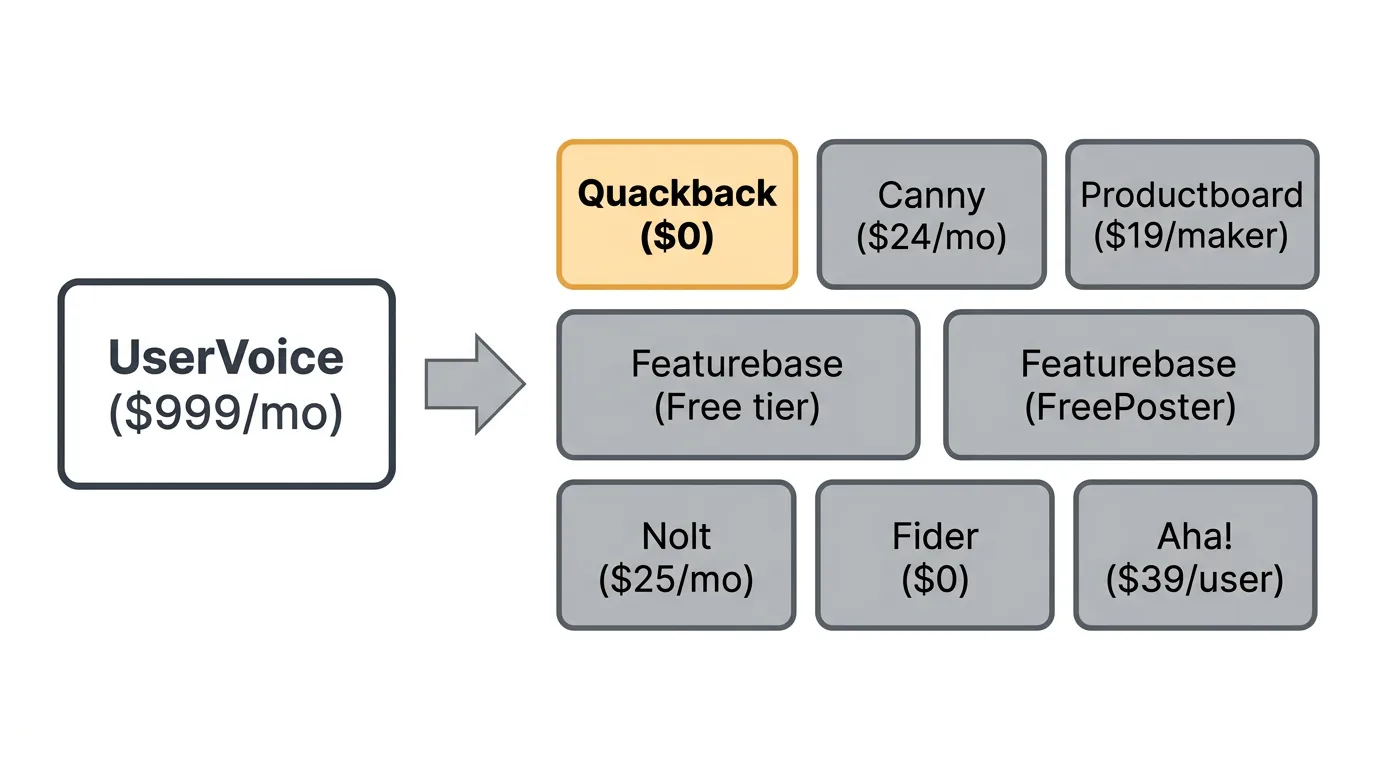
The best UserVoice alternative for most teams is Quackback, an open-source feedback platform that matches UserVoice's core workflow for free, with a managed cloud option for teams that prefer hosting. UserVoice starts at $16,000 per year with an annual contract, while the alternatives below range from $0 to $79 per month. Ranked best to worst fit:
- Quackback — Open source, self-hosted or managed cloud. Built-in AI + MCP server included.
- Canny — Established hosted feedback tool. Voting, roadmap, changelog, and AI Autopilot.
- Productboard — Enterprise product management suite with strategy and prioritization layers.
- Featurebase — Free tier. All-in-one feedback, support inbox, and help center.
- Nolt — Simple feedback board with flat-rate pricing. No per-user billing.
- Fider — Open source, lightweight voting board. Bare-bones but stable.
- Aha! Ideas — Full product management suite with strategic roadmapping and idea portals.
Pricing last verified March 2026. Vendors may change plans and pricing without notice. Check each vendor's pricing page for the latest figures.
Why teams switch from UserVoice
The most common reasons teams look for a UserVoice alternative:
- Enterprise-only pricing. UserVoice starts at $16,000/year (~$1,333/mo) with annual billing. Startups and mid-market teams are priced out before they can evaluate the product.
- Weeks-long onboarding. Enterprise procurement means sales calls, security reviews, and dedicated onboarding. Weeks pass before your team collects a single piece of feedback.
- No self-service signup. You cannot try UserVoice without going through sales. A 30-day free trial is now available, but there is no free tier and no public pricing beyond the $16,000/year starting point.
- Closed source. No ability to audit code, self-host, or customize the platform beyond their settings.
- Overkill for most teams. UserVoice's NLP analytics and revenue-linked prioritization are designed for enterprise product organizations. Teams that just need feedback boards and voting are paying for features they will never use.
For a detailed pricing breakdown, see UserVoice Pricing in 2026.
1. Quackback
Best for: Teams that want enterprise-grade feedback without enterprise pricing.
Quackback is an open-source customer feedback platform licensed under AGPL-3.0. It's free to self-host and covers the full workflow that UserVoice charges $16,000+ per year for: feature voting boards, a public roadmap, changelogs, and 25 integrations including Slack, Jira, Linear, GitHub, Intercom, Zendesk, and Salesforce.
Where UserVoice takes weeks to onboard, Quackback deploys in about five minutes with Docker Compose or a one-click Railway deploy. Your data stays in your own PostgreSQL database. If you would rather not run infrastructure, Quackback Cloud is a managed option that handles hosting for you. Either way: no contracts, no sales calls, no annual commitments.
The AI features are built in. Duplicate detection catches redundant posts before they pile up. Merge suggestions identify related requests with reasoning your team can accept or dismiss in one click. Sentiment analysis runs automatically on every post.
Summaries extract key quotes and next steps.
The MCP server is something no other feedback tool offers. It implements the Model Context Protocol, the standard that Claude, Cursor, and Windsurf support. Connect an AI agent and it gets structured access to your feedback data: search posts, triage requests, write responses, create changelog entries, and merge duplicates. Every action is attributed and auditable.
Key features:
- Feature voting boards with status tracking, nested comments, and official responses
- Public roadmap with planned, in progress, and shipped views
- Changelog with automatic voter notifications
- AI: duplicate detection, merge suggestions, sentiment analysis, post summaries
- MCP server for AI agents (search, triage, respond, create, merge)
- 25 integrations: Slack, Linear, Jira, GitHub, Intercom, Zendesk, Salesforce, and more
- SSO/OIDC, webhooks, full REST API
- Custom branding with themes, custom CSS, and your own domain
- User segments and admin inbox with bulk actions
Pricing: Free and open source (AGPL-3.0). Self-host at no cost, or use Quackback Cloud for managed hosting.
Pros:
- Full feature set that matches UserVoice at $0
- AI included at no extra cost
- MCP server for AI agent access, unique among feedback tools
- Open source means no surprise pricing changes or feature paywalling
- 5-minute setup vs UserVoice's weeks-long onboarding
Cons:
- Self-hosting means you manage your own infrastructure (Docker or one-click Railway deploy), unless you choose Quackback Cloud
- Newer project with a smaller community than UserVoice
Why switch from UserVoice: You get the same feedback workflow, more integrations, and AI features that UserVoice doesn't offer, for $0 per year instead of $16,000. The trade-off is self-hosting, which takes minutes, not months.
Try Quackback — open source with a managed cloud option. Start free. Get started | View on GitHub
2. Canny
Best for: Mid-size SaaS teams that want a hosted feedback solution without enterprise pricing.
Canny has been around since 2017 and is one of the most established hosted feedback tools. It covers feature request tracking, voting, roadmaps, changelogs, and AI-powered feedback discovery through its Autopilot feature.
Compared to UserVoice, Canny is dramatically cheaper. Canny offers a free plan (25 tracked users) and paid tiers starting at $19/mo (Core). The billing model uses tiered pricing based on tracked users — anyone who submits a post, vote, or comment counts toward your tier limit.
Costs increase as you cross tracked user thresholds, with auto-upgrades to the next tier (you can set spend caps). Pro starts at $79/mo and Business uses custom pricing.
Canny's Autopilot AI discovers feedback from support conversations in Intercom, Zendesk, Help Scout, and Gong, plus 10 public review sites. Smart replies prompt users for clarification. Credits are now uncapped on all plans.
Key features:
- Feedback boards with voting and prioritization
- Public and private roadmaps
- Changelog with email notifications
- Autopilot AI: feedback discovery, smart replies, comment summarization
- Integrations with Jira, Linear, Slack, HubSpot (Salesforce requires Business plan)
Pricing: Free (25 tracked users). Core from $19/mo. Pro from $79/mo. Business is custom pricing.
Pros:
- Established product with a large user base
- Lower starting price than UserVoice by a wide margin
- Strong AI feedback discovery features
- Good integration ecosystem
Cons:
- Tiered tracked-user pricing means costs increase as you cross user thresholds
- Auto-upgrades when you exceed tracked user limits unless you set spend caps
- No self-hosting or open source
- Removing "Powered by Canny" branding requires the Business plan
- Jira integration requires Pro ($79/mo)
Why switch from UserVoice: You save over $15,000 per year on day one. You get a modern interface, better AI capabilities, and faster onboarding. The risk is that tiered tracked-user pricing can push costs up as your community grows, though it starts much lower.
3. Productboard
Best for: Enterprise product organizations that need feedback as part of a broader product management suite.
Productboard is a product management platform that includes feedback capabilities. It connects customer insights to product strategy through opportunity scoring, prioritization matrices, and driver-based roadmaps. If your team thinks in terms of product strategy, not just feature requests, Productboard speaks that language.
You can capture insights from Intercom, Zendesk, Salesforce, email, and Slack. The layer on top links feedback to features, scores impact, and aligns teams around priorities. AI features are included via a credits system (250 credits per maker per month) for summarization, insight extraction, semantic search, and auto-linking.
Compared to UserVoice, Productboard offers more structure around product strategy at a lower price point. The Spark plan costs $15/maker/month (annual) or $19/maker/month (monthly). Enterprise pricing for SSO and advanced features is custom.
Key features:
- Insights portal for collecting and organizing customer feedback
- Feature prioritization with custom scoring frameworks
- Driver-based roadmaps tied to company objectives
- Integrations with Jira, Azure DevOps, Slack, Salesforce, Zendesk, Intercom
- AI included via credits (250/maker/month) for summarization, insight extraction, semantic search
Pricing: Spark at $15/maker/month (annual) or $19/maker/month (monthly). Enterprise is custom.
Pros:
- Deep product strategy features beyond feedback
- Strong prioritization frameworks
- Deep CRM integrations for revenue-linked insights
- AI included in the base plan via credits
- Established enterprise vendor with compliance features
Cons:
- AI credits (250/maker/month) may be limiting for heavy users
- More product management tool than feedback tool, overkill for simple use cases
- No self-hosting
- Steep learning curve
Why switch from UserVoice: You get better product strategy features and a more modern platform. Pricing can be comparable at enterprise scale, so this is a lateral move on cost, not a downgrade. The value is in the product management layer that UserVoice lacks.
4. Featurebase
Best for: Startups and small SaaS teams that want free hosted feedback to start.
Featurebase bundles feedback boards, a changelog, roadmap, help docs, customer support inbox, and live chat into a single product. Every plan includes both the Support Suite and the Product Suite. The free plan gives you one seat with 50 help center articles and basic feedback features.
Their AI agent, Fibi, automatically resolves customer questions using context from your help center, feedback posts, changelogs, and past conversations. It can submit feature requests to your boards on behalf of customers. AI resolutions cost $0.49 each.
Compared to UserVoice, Featurebase is a modern, more affordable alternative with broader capabilities. The combined feedback-and-support model means fewer tools in your stack. The free tier makes it accessible to startups that UserVoice prices out entirely.
Key features:
- Feedback boards with voting, status tracking, and user segmentation
- Changelog, public roadmap, and surveys (NPS, CSAT, multiple choice)
- Unified support inbox with live chat, email, and ticketing
- Help center with AI-powered search
- Fibi AI Agent: auto-resolves questions, submits feedback on behalf of users
- 12 integrations: Linear, Jira, GitHub, ClickUp, Slack, Intercom, Zendesk, HubSpot
Pricing: Free plan (1 seat, 50 help center articles, no AI). Growth at $29/seat/month. Professional at $59/seat/month. Enterprise at $99/seat/month.
Pros:
- Free tier with usable feedback features
- All-in-one: feedback, support, and help center in one product
- Modern interface with fast iteration cycle
- AI agent can handle support and feedback simultaneously
Cons:
- Per-seat pricing adds up for larger teams
- AI resolutions at $0.49 each are usage-based and can become significant at volume
- Post merging and user segmentation locked to higher tiers
- No self-hosting or open source
Why switch from UserVoice: You go from $16,000 per year to free (or $29 per seat for paid features). You get a modern platform that combines feedback and support. The trade-off is less enterprise-specific functionality like revenue-weighted prioritization.
5. Nolt
Best for: Small teams that want the simplest possible feedback board.
Nolt keeps things deliberately simple. You get a clean feedback board, voting, custom statuses, a basic roadmap view, and status notifications. There are no AI features and no changelog. Setup takes minutes.
Nolt uses flat-rate pricing: $29 per month for one board on Essential (billed annually), $69 per month for five boards on Pro. No tracked-user limits, no per-seat charges. After UserVoice's pricing complexity, the simplicity is appealing.
The concern with Nolt in 2026 is pace. The product has seen minimal updates over the past two years. Core feature requests from users, like changelog support, comment threading, and bulk editing, remain unbuilt.
Key features:
- Feedback board with voting and custom statuses
- Roadmap view
- SSO, private boards, and password-protected boards
- Integrations: Slack, Discord, Jira, Linear, Asana, Trello, GitHub, Zapier (Pro plan)
- Custom domain and branding
Pricing: Essential at $29/month for 1 board (annual). Pro at $69/month for 5 boards. Enterprise is custom.
Pros:
- Flat-rate pricing with no per-user charges
- Clean, minimal interface
- Fast to set up and easy to use
- Good set of integrations for the price
Cons:
- No changelog
- No AI features
- Limited updates since 2022
- Per-board pricing means costs multiply if you manage multiple products
- No self-hosting
Why switch from UserVoice: You save over $15,000 per year and get a feedback board running in minutes instead of weeks. You lose revenue-linked prioritization, enterprise security features, and the breadth of UserVoice's internal capture tools. For small teams that just need voting and a roadmap, that trade-off often makes sense.
6. Fider
Best for: Developers who want a bare-bones open-source feedback board with no cost.
Fider is an open-source feedback tool licensed under AGPL-3.0. It's built with Go and React, backed by PostgreSQL, and deploys with Docker. Fider handles the core workflow: users submit ideas, vote, and comment. Admins manage posts with tags, custom statuses, and filters.
Fider has been around since 2017 and has a stable codebase. If all you need is a voting board and nothing more, it does the job well. Go makes it efficient on resources. The interface is clean and functional.
Where Fider falls short is everything beyond the basics. There is no changelog, no roadmap view, no AI features, and integrations are limited to webhook-based connections with Slack, Discord, and Microsoft Teams. No native Jira, Linear, or GitHub integration. The project moved to an open-core model in v0.33.0, putting content moderation and SEO indexing behind the paid cloud tier.
Key features:
- Feedback boards with voting, comments, and rich text editor
- Tags, filters, and customizable statuses
- REST API and webhooks (4 event types)
- Multi-language support (10+ languages, including RTL)
- SSO with OAuth providers
Pricing: Free and open source for self-hosting. Cloud free tier limited to 250 feedback items. Cloud Pro at $49/month.
Pros:
- Free and open source with a mature codebase
- Lightweight and resource-efficient
- Simple to set up with Docker
- Multi-language support out of the box
Cons:
- No changelog, no roadmap, no AI features
- Limited integrations (webhooks only, no native issue tracker connections)
- Open-core model means some features are paywalled on the cloud version
- Development pace has slowed
- No duplicate detection or post merging
Why switch from UserVoice: You go from $16,000 per year to $0. You get data ownership and an auditable codebase. The trade-off is significant: you lose roadmaps, changelogs, AI, and most integrations. Fider is a good choice if you need only the voting workflow and want to self-host. If you need more, consider Quackback, which offers the full feature set at the same price (free).
7. Aha Ideas
Best for: Large organizations that need product strategy, roadmapping, and feedback in a single enterprise platform.
Aha! is a product management suite where Ideas is the feedback module. It connects directly to Aha! Roadmaps, giving product teams a unified view from customer request to shipped feature. If your organization already uses Aha! for roadmapping, adding the Ideas module is a natural extension.
Aha! Ideas includes idea portals, voting, proxy voting (where internal teams submit and vote on behalf of customers), status updates, and dynamic forms. The integration with Aha! Roadmaps is the main draw: feedback flows directly into your strategic planning, with scoring, prioritization, and capacity planning built in.
The pricing is per user per month, and it adds up. Ideas Essentials starts at $39 per user per month. Ideas Advanced is $59 per user per month. Aha! Roadmaps, which you'll likely need to get the full value, costs an additional $59 per user per month. For a team of 10, you're looking at $590 to $1,180 per month before adding the roadmapping product.
Key features:
- Idea portals with voting, categories, and dynamic forms
- Proxy voting for internal teams to submit on behalf of customers
- Direct integration with Aha! Roadmaps for strategy-to-delivery workflows
- Custom scoring and prioritization frameworks
- Integrations with Jira, Azure DevOps, Slack, Salesforce, Zendesk
- Enterprise security: SAML SSO, audit logs, custom SLAs
Pricing: Ideas Essentials at $39/user/month. Ideas Advanced at $59/user/month. Aha! Roadmaps at $59/user/month (separate). Enterprise pricing available.
Pros:
- Tight integration with Aha! Roadmaps for end-to-end product management
- Strong enterprise security and compliance features
- Proxy voting for internal advocacy
- Well-maintained with consistent updates
Cons:
- Expensive, especially when combined with Aha! Roadmaps
- Per-user pricing scales quickly for larger teams
- Most valuable when used with the broader Aha! suite, less standalone appeal
- No self-hosting or open source
- Complex product with a learning curve
Why switch from UserVoice: You get a more modern platform with stronger product management integration. Pricing can be lower for small teams but approaches UserVoice-level costs for larger orgs. The main advantage is the strategic layer: connecting feedback to roadmaps, scoring, and capacity planning in a way UserVoice doesn't support natively.
Comparison table
| Feature | Quackback | Canny | Productboard | Featurebase | Nolt | Fider | Aha! Ideas | UserVoice |
|---|---|---|---|---|---|---|---|---|
| Starting price | Free | Free (25 tracked users) | $15/maker/mo (annual) | Free | $29/mo | Free | $39/user/mo | $16,000/yr |
| Billing model | Free (self-host) | Tiered by tracked users | Per maker | Per seat | Flat rate per board | Free (self-host) | Per user | Flat monthly |
| Free plan | Yes (open source) | Yes (25 tracked users) | No | 1 seat | No | 250 items (cloud) | No | No |
| Feedback boards | Yes | Yes | Yes | Yes | Yes | Yes | Yes | Yes |
| Public roadmap | Yes | Yes | Yes | Yes | Yes | No | Yes | No |
| Changelog | Yes | Yes | No | Yes | No | No | No | No |
| AI features | Yes (built in) | Yes (Autopilot) | Yes (included via credits, 250/maker/mo) | Yes ($0.49/resolution) | No | No | No | No |
| MCP server | Yes | No | No | No | No | No | No | No |
| Self-hosted | Yes | No | No | No | No | Yes | No | No |
| Open source | Yes (AGPL-3.0) | No | No | No | No | Yes (AGPL-3.0) | No | No |
| SSO | Yes (OIDC/SAML) | Yes | Yes | Yes | Yes | Yes (OAuth) | Yes (SAML) | Yes (SAML) |
| Integrations | 23 | 15+ | 20+ | 12 | 8+ | 3 (webhooks) | 15+ | 10+ |
| Setup time | ~5 minutes | Same day | Days to weeks | Same day | Minutes | ~5 minutes | Days | Weeks |
How to choose a UserVoice alternative
The right alternative depends on three things: your budget, your team size, and how much of the feedback workflow you want to own.
If cost is the primary driver: Quackback and Fider are free. Quackback gives you the full feature set that UserVoice charges $16,000 per year for. Fider covers the basics. Both are open source and self-hosted. Featurebase has a usable free tier if you prefer hosted.
If you want the closest match to UserVoice's features: Quackback covers voting, roadmaps, changelogs, integrations, SSO, and AI. It adds capabilities UserVoice doesn't offer, like an MCP server for AI agents and open-source transparency. You can self-host it for free or run it on Quackback Cloud. Canny and Featurebase are the closest hosted mid-range options.
If you need product strategy beyond feedback: Productboard or Aha! Ideas give you prioritization frameworks, scoring models, and strategic roadmapping tied to feedback. These are product management platforms with feedback built in, not feedback tools with product management bolted on. They cost accordingly.
If simplicity matters most: Nolt is the simplest tool on this list. Flat pricing, clean interface, minutes to set up. You lose AI, changelogs, and deep integrations, but you get a working feedback board fast.
If data ownership matters: Quackback and Fider are the only self-hosted options. Your feedback data stays in your PostgreSQL database, on your infrastructure. No vendor has access to your customer data. For teams with compliance requirements or data residency concerns, this can be the deciding factor.
If AI and automation matter: Quackback includes duplicate detection, merge suggestions, sentiment analysis, and post summaries. Its MCP server lets AI agents act on feedback directly. Canny's Autopilot discovers feedback from support conversations. Featurebase's Fibi resolves support questions.
Productboard includes AI via credits (250 per maker per month), which may limit heavy users. UserVoice has no comparable AI features. For a broader look at feedback tools with AI, see our guide to customer feedback tools in 2026.
Frequently asked questions
Why do people switch from UserVoice?
Pricing is the most common reason. UserVoice starts at $16,000 per year with annual billing, hard to justify when alternatives offer similar features for $0 to $79 per month. Other drivers include the dated interface, weeks-long onboarding, no public roadmap feature, and the absence of AI capabilities newer tools include.
Is there a free alternative to UserVoice?
Yes. Quackback is free and open source. You self-host it with Docker and get feature voting, roadmaps, changelogs, 25 integrations, and built-in AI at no cost. Fider is also free and open source but covers only basic voting boards without roadmaps, changelogs, or AI.
Featurebase offers a free tier with usage limits. For more open-source options, see our guide to open-source feedback tools.
Can I migrate my data from UserVoice?
Yes. Most feedback tools support data import through CSV or API. Quackback has a REST API you can use to import feature requests, votes, and comments from UserVoice. Plan for mapping user accounts, preserving vote counts, and maintaining status history. Check your UserVoice plan's export options first, since lower tiers limit them.
Does UserVoice offer a free plan?
UserVoice has no free plan, though it offers a 30-day free trial. The entry price is $16,000 per year with annual billing, and you go through a "Talk to an Expert" sales process to start. Most alternatives on this list offer a free plan, a lower-cost trial, or are free and open source.
What features does UserVoice have that alternatives don't?
UserVoice's primary differentiator is revenue-linked prioritization. Connect Salesforce or HubSpot, and UserVoice pulls in account-level ARR data so you see the revenue behind each request. Most alternatives lack this exact feature, though Productboard and Aha! offer similar prioritization frameworks. For teams that do not need CRM-linked revenue data, it rarely justifies the price.

Authored by James Morton
Founder of Quackback. Building open-source feedback tools.
Try Quackback
The open-source feedback platform. Boards, voting, and roadmaps.
Get startedStar on GitHub305