Canny and UserVoice both help product teams collect feature requests, prioritize what to build, and close the loop with customers. They cover the same category but target different segments of the market.
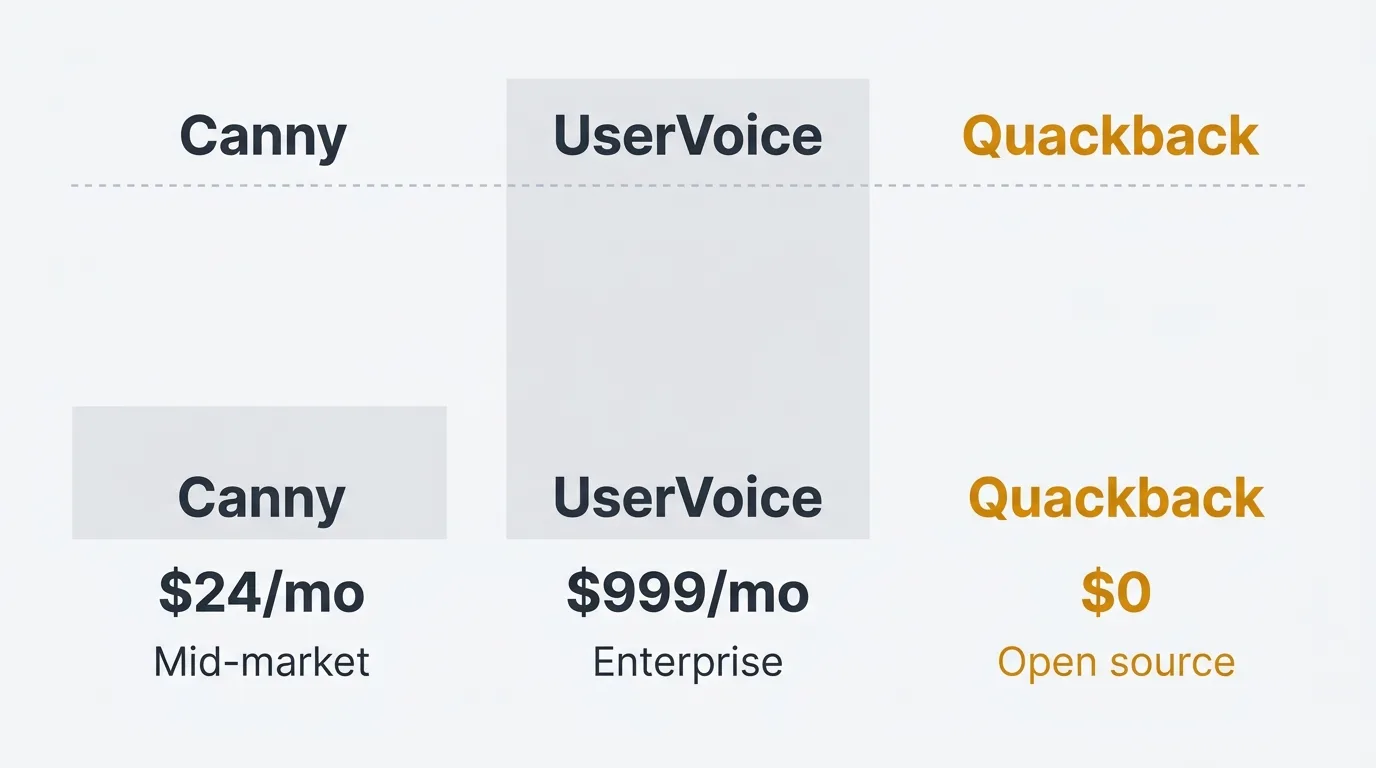
Canny is a mid-market feedback tool with a free plan (25 tracked users) and paid tiers from $19/mo. UserVoice is an enterprise platform starting at $16,000/year (~$1,333/mo) with revenue-linked prioritization and NLP analytics. If you want an open-source alternative with no vendor lock-in, Quackback is free to self-host and offers a managed cloud option.
Pricing last verified March 2026. Vendors may change plans and pricing without notice. Check each vendor's pricing page for the latest figures.
Canny is built for mid-market SaaS teams. It offers a self-service signup, a lower starting price, and a product that's designed to get running in a day. UserVoice is built for enterprise product organizations. It leads with revenue-linked prioritization, NLP-powered feedback analysis, and deep CRM integrations. The starting price is $16,000 per year (~$1,333/mo) with annual billing.
If you're choosing between the two, the decision comes down to your team size, budget, how much analytics you need, and whether you want a tool you can start using this afternoon or one that takes weeks to onboard.
This guide compares Canny and UserVoice across features, pricing, and ideal use cases. It also covers where an open-source alternative like Quackback fits in for teams that want to avoid vendor lock-in entirely.
Canny overview
Canny launched in 2017 and has become one of the most widely used hosted feedback tools for SaaS companies. The core product covers feature request boards with voting, a public roadmap, changelogs, and an AI feature called Autopilot that discovers feedback from support conversations.
Pricing
In May 2025, Canny overhauled its pricing model. The company moved from per-admin billing to tiered pricing based on tracked users. A tracked user is anyone who posts, votes, or comments on your feedback board. Canny offers a free plan (25 tracked users, limited features) but most teams outgrow it quickly. For a detailed breakdown, see our Canny pricing analysis.
The current plans:
- Free — $0/mo for 25 tracked users, 5 managers. Autopilot AI included.
- Core — $19/mo (billed annually) for 100+ tracked users, 5 managers. Custom domains, content translations.
- Pro — $79/mo (billed annually) for 100+ tracked users, 10 managers. PM integrations (Jira, ClickUp, Linear), advanced privacy.
- Business — Custom pricing for 5,000+ tracked users. SSO/SAML, CRM integrations, white-label, dedicated support.
At scale, costs increase as you exceed tracked user limits and get auto-upgraded to the next tier. Tracked users accumulate over time. Someone who voted once six months ago still counts.
Strengths
Fast setup. You can create a Canny workspace, embed your first feedback board, and start collecting votes in under an hour. No sales calls required for the free, Core, and Pro plans.
Clean product design. Canny's interface is polished and intuitive. Feature request boards, voting, and status updates work well with default settings. The roadmap view gives users a clear picture of what's planned, in progress, and shipped.
Autopilot AI. Canny's Autopilot scans support conversations from tools like Intercom and Zendesk, identifies feature requests, and attributes them to the correct users. This saves product managers from manually reviewing support tickets for feedback signals.
Good integration ecosystem. Canny integrates with Slack, Jira, Linear, GitHub, Intercom, Zendesk, HubSpot, and several others. On the Pro plan and above, PM integrations like Jira and Linear are available.
Weaknesses
Tiered tracked-user pricing can surprise you. Your costs increase when you cross tracked user thresholds, triggering auto-upgrades to the next tier. You can set spend caps to prevent this, but a viral feature request can push you across a threshold quickly.
No self-hosting. Canny is a hosted SaaS product. You can't run it on your own infrastructure, audit the code, or fork it if the product direction changes.
SSO requires the Business plan. If your organization mandates SAML SSO for compliance, you need the Business plan (custom pricing).
Free plan is very limited. Canny's free plan caps at 25 tracked users. The Core plan at $19/mo provides 100+ tracked users but PM integrations like Jira require the Pro plan at $79/mo.
No open-source option. If Canny raises prices (which it did in 2025), you absorb the increase or migrate. There's no way to self-host as a hedge. For more on alternatives, see best Canny alternatives.
UserVoice overview
UserVoice launched in 2008 and is one of the original customer feedback platforms. It helped define the category. In 2026, it positions itself as an enterprise product management tool with a focus on revenue-linked prioritization and NLP-powered analytics.
Pricing
UserVoice is the most expensive standalone feedback tool on the market. There is no free plan and no self-service signup. You "Talk to an Expert," negotiate a contract, and commit to annual billing. A 30-day free trial is available. For a full pricing breakdown, see our UserVoice pricing analysis.
The current pricing:
- Starting at $16,000/year (~$1,333/mo). Custom pricing based on monthly feedback volume and integrations.
- No per-seat charges — anyone in your organization can access the platform.
- Annual billing with a sales process required.
- 30-day free trial available after engaging with sales.
Annual costs start at $16,000 and scale higher based on volume, integrations, and enterprise requirements. UserVoice does not publish this figure on its pricing page; the $16,000/year entry point is widely reported from sales quotes, so your negotiated number may differ.
Strengths
Revenue-linked prioritization. UserVoice connects to Salesforce and HubSpot and lets you see which feature requests have the most ARR behind them. Product managers can sort and filter requests by revenue impact, not just vote count. This is the feature that justifies UserVoice's price for many enterprise teams.
NLP-powered feedback analysis. On the Premium plan, UserVoice uses natural language processing to surface themes across thousands of feedback submissions. It groups related requests, detects sentiment patterns, and generates reports that help product teams see the bigger picture without reading every post.
Internal feedback capture. UserVoice provides structured workflows for sales and support teams to submit feedback on behalf of customers. Contributors can tag requests with account context, deal stage, and priority level. This keeps product managers informed without requiring them to sit in on customer calls or read support transcripts.
Enterprise compliance features. SSO/SAML, advanced permissions, audit logs, and SLA-backed uptime guarantees are available on the Enterprise plan. For organizations in regulated industries, these capabilities are non-negotiable.
Weaknesses
High entry price. At $16,000/year (~$1,333/mo) with annual billing, UserVoice is sized for enterprise budgets. Startups and smaller teams will find it out of range. A 30-day free trial is available, but the jump to paid is steep.
Longer onboarding. UserVoice deployments typically take weeks. Sales calls, contract negotiation, account configuration, SSO setup, CRM integration, and user training are part of the process. This is typical for enterprise software but slower than self-service tools.
Older interface design. The UI has improved over the years but still feels less modern than Canny or newer alternatives. Product teams accustomed to tools like Linear or Notion may notice the difference.
No self-hosting. UserVoice is hosted only. Your data lives on their infrastructure. There is no open-source version, no data portability guarantee beyond standard export, and no way to run it on-premises. For alternatives, see best UserVoice alternatives.
SSO availability unclear. UserVoice lists security and compliance as a feature, but the current pricing page does not break down which capabilities require higher-tier plans. Historically, SAML SSO required an enterprise-level contract.
Feature comparison
| Feature | Canny | UserVoice | Quackback |
|---|---|---|---|
| Feedback boards | Yes | Yes | Yes |
| Voting | Yes | Yes | Yes |
| Public roadmap | Yes | Yes | Yes |
| Changelog | Yes | No | Yes |
| AI duplicate detection | Autopilot (related feedback) | No | Yes |
| AI merge suggestions | No | No | Yes |
| Sentiment analysis | No | Yes (NLP, Premium+) | Yes |
| Revenue-linked prioritization | No | Yes (Premium+) | No |
| NLP theme detection | No | Yes (Premium+) | No |
| SmartVote surveys | No | Yes (Premium+) | No |
| Autopilot (support scanning) | Yes | No | No |
| MCP server for AI agents | No | No | Yes |
| SSO/SAML | Business (custom pricing) | Included (security/compliance) | Free self-hosted · Enterprise on Cloud |
| Custom branding | Business (custom pricing) | All plans | Included free |
| Self-hosting | No | No | Yes (Docker) |
| Open source | No | No | Yes (AGPL-3.0) |
| Integrations | 15+ | 10+ | 20+ |
| API | Yes | Yes | Yes |
| Slack integration | Yes | Yes | Yes |
| Jira integration | Pro ($79/mo)+ | Yes | Yes |
| Salesforce integration | Business (custom pricing) | Yes | Yes |
Canny and UserVoice each have capabilities the other lacks. Canny's Autopilot scans support conversations for feedback signals. UserVoice's NLP groups thousands of feedback submissions into themes and ties them to revenue data. Quackback takes a different approach: open source, self-hosted, with AI features like duplicate detection, merge suggestions, and an MCP server that lets AI agents interact directly with your feedback data.
Pricing comparison
| Canny | UserVoice | Quackback | |
|---|---|---|---|
| Free plan | Yes (25 tracked users) | No (30-day trial available) | Yes (self-hosted, unlimited) |
| Entry price | Free (25 tracked users), $19/mo (Core) | $16,000/yr (~$1,333/mo) | $0 |
| Mid-tier | $79/mo (Pro) | Custom (volume-based) | $0 |
| Enterprise | Custom pricing (Business) | Custom | $0 |
| Billing model | Tiered by tracked users | Annual (no per-seat charges) | None |
| Minimum commitment | None (monthly billing) | $16,000/yr | None |
| Annual cost (entry) | $1,188–4,800/yr | $16,000+/yr | $0 |
| SSO cost | Business (custom pricing) | Included | Included |
| AI cost | Included on all plans | Included | Included |
The pricing gap between Canny and UserVoice is significant. Canny's Pro plan at $79+/mo covers what most mid-market teams need. UserVoice starts at $16,000/year. Over a year, a team paying $79/mo for Canny Pro spends $948. The same team on UserVoice would spend $16,000 or more.
The question is whether UserVoice's enterprise analytics justify the price premium. For teams with large Salesforce deployments and thousands of feedback submissions per month, the answer may be yes. The lack of per-seat charges is a plus for large organizations. For everyone else, it's hard to make the math work.
When to choose Canny
Canny is the better choice if your team fits this profile:
You're a mid-market SaaS company. Your team has 5–50 people. You have a product manager (or a few) who needs to collect feedback, prioritize requests, and share a roadmap. You don't need revenue-linked prioritization tied to Salesforce opportunity data.
You want self-service setup. You want to sign up, configure your workspace, and start collecting feedback today. Not next month after a series of sales calls and an onboarding process.
Your budget is under $500/mo. Canny's Pro plan covers most needs for teams with moderate feedback volume. If you need SSO, the Business plan (custom pricing) is still a fraction of UserVoice's entry price.
You value Autopilot. If your team gets a lot of feedback buried in support conversations (Intercom, Zendesk, Help Scout), Canny's Autopilot can surface feature requests automatically. UserVoice doesn't offer an equivalent feature.
You want a polished, modern interface. Canny's product design is clean and well-maintained. The voting experience for end users is straightforward. If user experience matters to your team (and it should), Canny delivers a more modern feel than UserVoice.
When to choose UserVoice
UserVoice is the better choice if your team fits this profile:
You're an enterprise product organization. Your company has 200+ employees. You have multiple product managers, a product operations team, or a dedicated feedback analyst. The volume of feedback you receive justifies a tool that can process thousands of submissions with NLP.
Revenue-linked prioritization is critical. Your product decisions are tied to revenue impact. You use Salesforce or HubSpot, and you need to know which feature requests carry the most ARR. Sorting by vote count isn't sufficient. You need to sort by revenue at risk.
You need NLP-powered analytics. Your feedback volume is high enough that no human can read every submission. UserVoice's NLP groups related requests into themes, identifies sentiment trends, and generates reports. This saves product managers hours of manual categorization per week.
Internal feedback capture matters. Your sales and support teams are a primary source of customer feedback. You need a structured system where account executives and support agents can submit feature requests with account context, deal size, and urgency, without the overhead of ad hoc Slack messages to the product team.
You have enterprise compliance requirements. Your organization requires SAML SSO, audit logging, SLA-backed uptime, and dedicated support. UserVoice's Enterprise plan covers these needs. The price is steep, but for regulated industries, it may be the cost of doing business.
Consider Quackback if...
Neither Canny nor UserVoice is open source. Neither offers self-hosting. Both charge monthly fees that increase as your usage grows. If any of the following matter to your team, Quackback is worth evaluating.
You want to own your data. Quackback is self-hosted. Your feedback data lives in your PostgreSQL database, on your infrastructure. No third-party vendor stores, processes, or has access to your customer feedback. If you leave Quackback, your data stays right where it is.
You want no vendor lock-in. Quackback is open source under AGPL-3.0. You can read every line of code, fork the project, and modify it to fit your workflow. If the project's direction changes, you're not stranded. With Canny or UserVoice, a pricing change or feature removal means you either accept it or migrate.
You want to minimize feedback tooling costs. Quackback is free to self-host. There is no minimum contract. You deploy with Docker and you are running. The AI features (duplicate detection, merge suggestions, sentiment analysis, post summaries) are included on every self-hosted installation.
You want AI agent access to your feedback. Quackback's MCP server implements the Model Context Protocol. Connect Claude, Cursor, or Windsurf and your AI agent gets structured access to search posts, triage requests, write responses, create changelog entries, and merge duplicates. No other feedback tool offers this.
You need SSO without paying enterprise prices. Canny requires the Business plan (custom pricing) for SSO. UserVoice requires a $16,000+/year contract. Quackback includes SSO/OIDC free on every self-hosted installation, and on Quackback Cloud it is a listed self-serve price rather than a custom contract.
For direct comparisons, see Quackback vs Canny and Quackback vs UserVoice. For a broader look at the open-source feedback landscape, see open-source feedback tools.
Frequently asked questions
Can Canny and UserVoice both integrate with Salesforce?
Yes, but with different depth. Canny syncs Salesforce account data on its Business plan (custom pricing) and lets you filter feedback by Salesforce fields. UserVoice goes deeper with revenue-linked prioritization, surfacing the ARR behind each request. Quackback also includes a Salesforce integration, without revenue-linked prioritization yet.
Is UserVoice worth the price compared to Canny?
It depends on your needs. UserVoice's price premium buys NLP theme detection, revenue-linked prioritization, and structured internal feedback capture. Those analytics can justify the cost for high-volume, revenue-driven enterprise teams. Mid-market teams get the core workflow from Canny at 10–20% of the cost, or from self-hosted Quackback for free.
Can I migrate from UserVoice or Canny to Quackback?
Yes. Canny and UserVoice both offer data export, and Quackback accepts imports through a REST API you can script. Small workspaces migrate in hours; large deployments with complex user mappings take a few days. The migration docs and Quackback pricing cover self-hosted and cloud paths.

Authored by James Morton
Founder of Quackback. Building open-source feedback tools.
Try Quackback
The open-source feedback platform. Boards, voting, and roadmaps.
Get startedStar on GitHub262