
UserVoice is one of the original feedback management platforms. Founded in 2008, it helped establish the category that tools like Canny, Productboard, and Quackback now occupy. For nearly two decades, it has served enterprise product teams that need to collect feature requests, prioritize by revenue impact, and close the loop with customers.
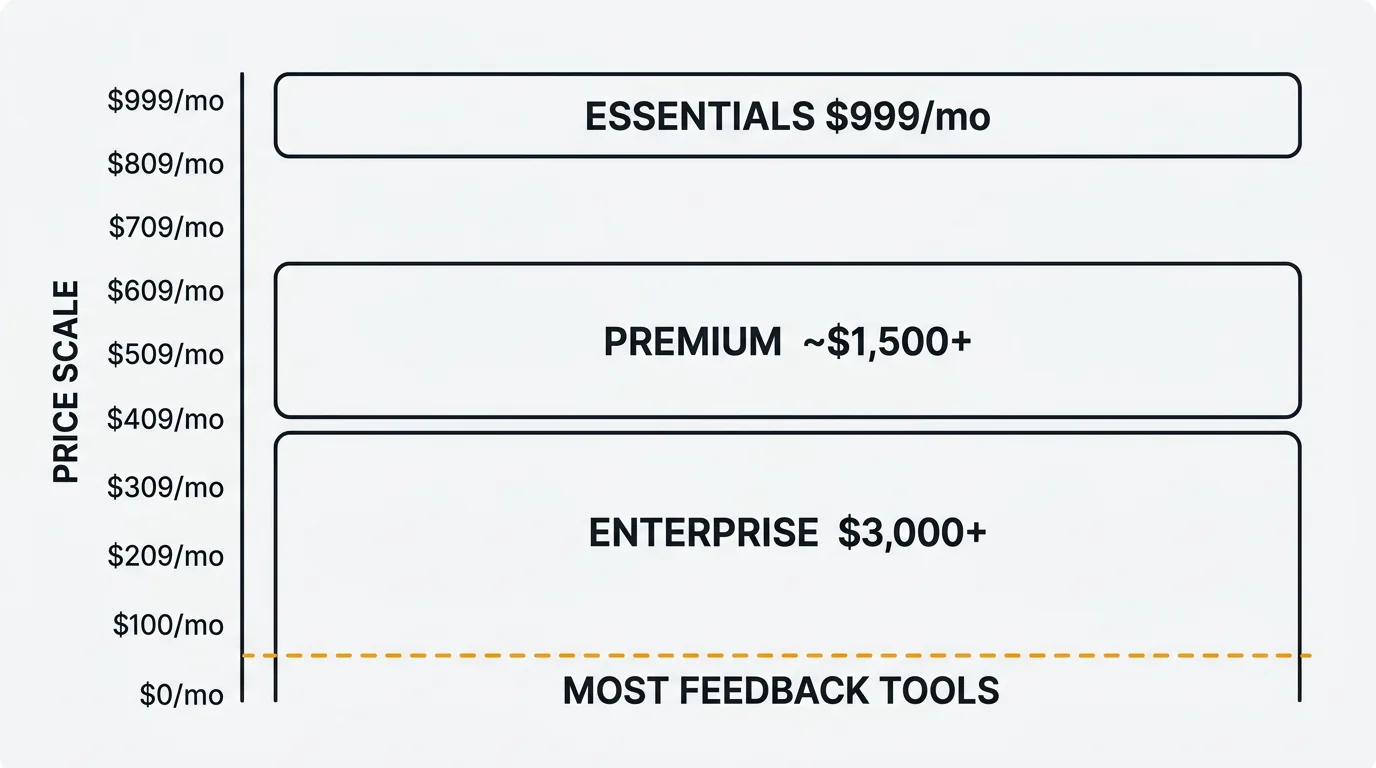
UserVoice pricing starts at $16,000/year (~$1,333/mo) with annual billing and no self-service signup. There are no visible tiered plans — pricing is custom based on monthly feedback volume and integrations, with no per-seat charges and a 30-day free trial. Free alternatives exist: Quackback is open source with a managed cloud, so you can start with a 14-day free trial in the cloud or self-host at no cost.
Pricing last verified March 2026. Vendors may change plans and pricing without notice. Check each vendor's pricing page for the latest figures.
The platform does genuine things well. Revenue-linked prioritization lets you connect Salesforce or HubSpot data and see which feature requests carry the most ARR behind them. NLP-powered feedback analysis surfaces themes across thousands of submissions. Internal feedback capture gives sales and support teams a structured way to relay what customers are asking for, without flooding product managers with unstructured Slack messages.
But UserVoice's pricing reflects its enterprise positioning. The entry point is $16,000/year (~$1,333/mo) with annual billing. There is no free plan and no self-service signup — you "Talk to an Expert" to get started, though a 30-day free trial is available. If you're a startup, a small team, or a mid-size company exploring feedback tools, the cost alone may rule UserVoice out.
This guide breaks down what UserVoice costs in 2026, what you get at each tier, and where the alternatives stand.
UserVoice pricing structure
UserVoice no longer publishes tiered plans on its pricing page. Instead, pricing starts at $16,000/year and scales based on monthly feedback volume and integrations. There are no per-seat charges — anyone in your organization can access the platform. You go through a sales process ("Talk to an Expert") to get a custom quote. A 30-day free trial is available.
What you get
The platform includes a single product with features that scale based on your contract:
- Centralized feedback portal for collecting feature requests
- Feedback capture tools for internal and external submissions
- Communications suite for closing the loop with customers
- Quantitative feedback data enhancement
- Taxonomy, filtering, and sorting
- Customer segmentation
- Security and compliance features
- Expert onboarding
Pricing factors
UserVoice does not publish a fixed feature matrix with visible tiers. Based on the current pricing page, your cost depends on:
- Monthly feedback volume — the number of feedback submissions your portal processes
- Integrations — which CRM and support tool connections you need
- Organization size — though there are no per-seat charges
The $16,000/year starting point (~$1,333/mo) is the floor. Larger organizations with high feedback volume, advanced integrations (Salesforce, HubSpot), and enterprise security requirements will pay more. Annual billing is standard.
What changed from previous pricing
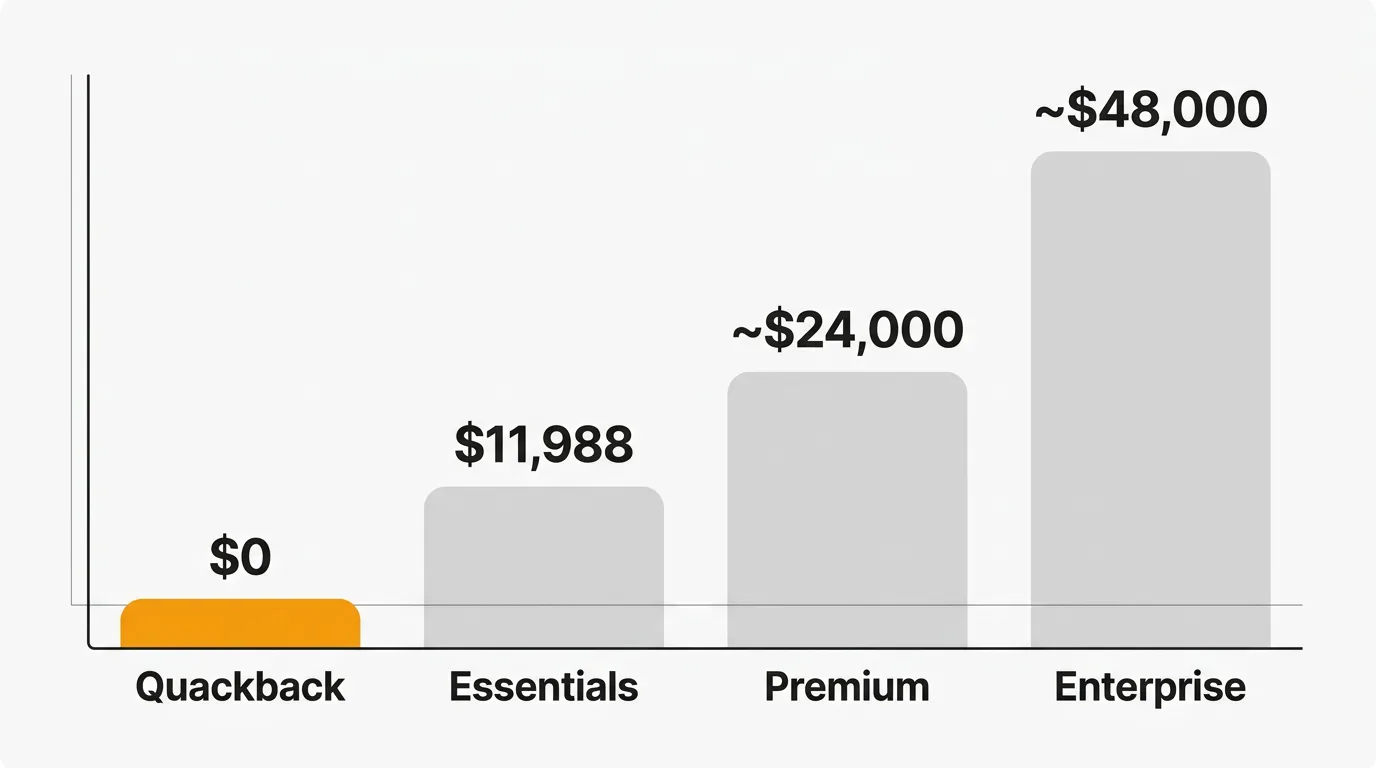
UserVoice previously published three visible tiers: Essentials ($999/mo), Premium ($1,500–2,500/mo estimated), and Enterprise ($3,000–5,000+/mo). The current pricing page no longer shows these tiers. The entry price has increased from $999/mo ($11,988/year) to $16,000/year (~$1,333/mo). UserVoice also now offers a 30-day free trial, which was not previously available, and highlights that there are no per-seat charges.
Why UserVoice is expensive
UserVoice's pricing is a direct consequence of its positioning. The company targets enterprise product teams at companies with 200+ employees. It is not trying to compete with Canny on the low end or with free tools like Quackback for startups.
Annual billing at $16,000/year. The minimum annual commitment is $16,000. While UserVoice now offers a 30-day free trial, the jump from trial to paid is significant. There is no monthly billing option.
No self-service signup. You cannot create an account, enter a credit card, and start using UserVoice. Every new customer goes through a "Talk to an Expert" sales process. A 30-day trial is available after that conversation, but you still need to engage with sales before evaluating the product.
Long onboarding cycles. UserVoice implementations often involve configuration, data migration, CRM integration, and team training. The platform assumes you'll have a dedicated rollout period. Expert onboarding is listed as a core feature. For teams that want to start collecting feedback today, this timeline is a poor fit.
Deep CRM integrations require investment. The revenue-linked prioritization that makes UserVoice unique depends on a properly configured Salesforce or HubSpot integration. Setting this up, mapping account data to feedback, and maintaining the connection over time requires ongoing effort from your ops team.
No per-seat charges is a plus. One thing in UserVoice's favor: there are no per-seat charges. Anyone in your organization can access the platform without adding to the bill. This is better than per-seat models where adding a product manager costs $19–59/month.
These factors contribute to a total cost of ownership that goes beyond the annual subscription. When evaluating UserVoice, factor in onboarding time, integration setup, and the implementation timeline alongside the subscription cost.
UserVoice pricing at scale
Here's what UserVoice costs at different commitment levels.
| Scenario | Annual Cost | 3-Year Cost |
|---|---|---|
| Entry (minimum) | $16,000 | $48,000 |
| Mid-range (est.) | $25,000–40,000 | $75,000–120,000 |
| Enterprise (est.) | $50,000–80,000+ | $150,000–240,000+ |
At the entry level, you're spending $16,000/year for a feedback portal with custom pricing based on volume. Over three years, that's $48,000.
For organizations with higher feedback volume and advanced CRM integrations, expect annual costs of $25,000–40,000 or more. Over three years, that's $75,000–120,000.
Hidden costs
The subscription price is only part of what UserVoice costs.
Annual commitment upfront. The minimum annual cost is $16,000. UserVoice now offers a 30-day free trial, which is an improvement over previous years. But once you commit, you're locked into an annual contract. If you decide after two months that UserVoice isn't the right fit, you've already committed for the year.
Implementation and onboarding time. UserVoice is not a tool you configure in an afternoon. Teams report onboarding timelines of 2–6 weeks, depending on integration complexity. During this time, you're paying for the subscription but not yet collecting feedback at full capacity. If your team bills internally for engineering and ops time, add that to the total cost.
No self-hosting option. UserVoice is a hosted SaaS product with no on-premises deployment. For teams with strict data residency requirements, this is a constraint worth noting.
CRM integration maintenance. The revenue-linked prioritization feature requires a live connection to your CRM. Salesforce and HubSpot integrations need ongoing maintenance: field mapping updates, permission changes, data sync monitoring. This is invisible work that adds to total cost of ownership.
No native changelog. UserVoice does not include a changelog feature. If you want to announce shipped features and notify voters, you'll need a separate tool. This adds another subscription and another integration to maintain.
Free and cheaper alternatives
UserVoice is the right tool for a specific type of organization: large enterprises with CRM-driven prioritization needs and budget to match. For everyone else, there are alternatives that deliver the core feedback workflow at a fraction of the cost, or for free.
Quackback
Quackback is open source (AGPL-3.0) with a managed cloud you can try free for 14 days. It covers feedback boards, voting, a public roadmap, changelogs, and 25 integrations. SSO/OIDC, an MCP server, and custom branding are included free on every self-hosted installation; on Cloud, MCP starts on the Pro plan and SSO on the self-serve Enterprise plan. Prefer to self-host? Run it with Docker or deploy on Railway at no cost. See the full comparison of Quackback vs UserVoice.
Canny
Canny offers a free plan (25 tracked users) and paid tiers starting at $19/mo (Core). It covers feedback boards, voting, roadmaps, and changelogs. The interface is polished and onboarding takes minutes, not weeks. The trade-off is tiered tracked-user pricing: your costs increase as you cross tracked user thresholds, with auto-upgrades to the next tier. Still far less than UserVoice, but costs can grow as your feedback community scales. See the Quackback vs Canny comparison.
Featurebase
Featurebase bundles feedback boards, a changelog, roadmap, and support inbox into one tool. A free plan exists (1 seat, limited features). Paid plans start at $29/seat/month. The AI agent charges $0.49 per resolution on top of plan cost. It's closed source and hosted only. See the Quackback vs Featurebase comparison.
Nolt
Nolt offers flat-rate pricing at $29/mo for a single feedback board (billed annually). No tracked-user billing, no per-seat charges. The feature set is limited: no changelog, no AI, and the product has seen minimal updates recently. Per-board pricing means costs multiply if you run multiple products.
Fider
Fider is open source and free to self-host. It covers the basics: feedback boards, voting, comments, and tags. Built on Go and PostgreSQL, it runs with Docker. The feature set is smaller than Quackback or Canny. No changelog, no roadmap view, no AI features, and limited integrations. But it costs nothing to run.
Cost comparison table
| UserVoice | Quackback | Canny | Featurebase | Nolt | |
|---|---|---|---|---|---|
| Starting price | $16,000/yr (~$1,333/mo) | Free | Free (25 tracked users) | Free (1 seat) | $29/mo |
| Billing model | Annual (custom) | Free / self-hosted | Tiered by tracked users | Per seat | Per board |
| User limits | No per-seat charges | None | 25 (Free), 100+ (Core/Pro) | None on free | None |
| Self-hosting | No | Yes (Docker) | No | No | No |
| Open source | No | Yes (AGPL-3.0) | No | No | No |
| SSO | Enterprise only | Free self-hosted · Enterprise on Cloud | Business (custom pricing) | $59/seat/mo plan | All paid plans |
| AI features | NLP (Premium+) | Included | Autopilot (all plans) | $0.49/resolution | No |
| Changelog | No | Yes | Yes | Yes | No |
| Revenue prioritization | Yes (Premium+) | No | No | No | No |
| MCP server | No | Yes | No | No | No |
| Annual cost (entry tier) | $16,000 | $0 | $0 (free plan) or $228 (Core) | $0 | $300 |
| Free trial | 30 days | N/A (free) | No | No | No |
UserVoice sits at the high end of the market. At $16,000/year for the entry tier, it is the most expensive standalone feedback tool available. Teams that need revenue-linked prioritization with CRM data may find the cost worthwhile. Teams that primarily need feedback boards and voting have less expensive options.
Try Quackback — open source with a managed cloud option. Start free. Get started | View on GitHub
Frequently asked questions
Does UserVoice have a free plan or free trial?
UserVoice does not offer a free plan. However, it now offers a 30-day free trial. You still need to go through the "Talk to an Expert" sales process to get started, but you can evaluate the product before committing to a paid contract. This is an improvement over previous years when no trial was available.
What is the minimum cost to start using UserVoice?
The minimum cost is $16,000/year (~$1,333/mo), billed annually. There are no per-seat charges — anyone in your organization can access the platform. You cannot pay monthly. This makes UserVoice the most expensive entry point among mainstream feedback tools.
Is UserVoice worth $16,000/year?
It depends on your organization. Enterprises needing revenue-weighted prioritization with a mature Salesforce integration get features cheaper tools lack, plus no per-seat charges. For startups and small teams that mainly need feedback boards and voting, $16,000/year is hard to justify when open-source alternatives deliver the core workflow free.
Can I migrate from UserVoice to a cheaper alternative?
Yes. UserVoice supports CSV data export. Quackback has a dedicated UserVoice import tool that maps UserVoice fields to Quackback fields. You can migrate posts, votes, and metadata. The process takes minutes for the data import, though you'll need time to reconfigure integrations and retrain your team.
What are the best UserVoice alternatives for small teams?
For small teams and startups, consider Quackback (free, open source, self-hosted), Canny (free plan or $19/mo Core), or Nolt ($29/mo flat rate). All three let you start collecting feedback within minutes and cost a fraction of UserVoice's entry price. For a deeper comparison, see Best UserVoice Alternatives and Best Customer Feedback Tools in 2026.

Authored by James Morton
Founder of Quackback. Building open-source feedback tools.
Try Quackback
The open-source feedback platform. Boards, voting, and roadmaps.
Get startedStar on GitHub305