You added a third product manager to your team and your Productboard bill jumped by another $15–19 per month. Per-maker pricing compounds fast.
Productboard is a product management platform built for enterprise product orgs. It connects customer feedback to strategy through prioritization frameworks, opportunity scoring, and driver-based roadmaps. For large teams managing complex product portfolios, it does the job.
But most teams don't need all of that. They need to collect feedback, let users vote, show a roadmap, and announce what shipped. Productboard's Spark plan charges $15/maker/month (annual) or $19/maker/month (monthly) for a full product management platform. AI is included via credits (250 per maker per month), but credit limits may constrain heavy users.
Enterprise pricing for SSO, advanced security, and custom features is custom. For a detailed side-by-side, see our Quackback vs Productboard comparison.
If you're paying for strategy tools you don't use, or watching your bill grow with every product manager you add, here are seven alternatives worth evaluating.
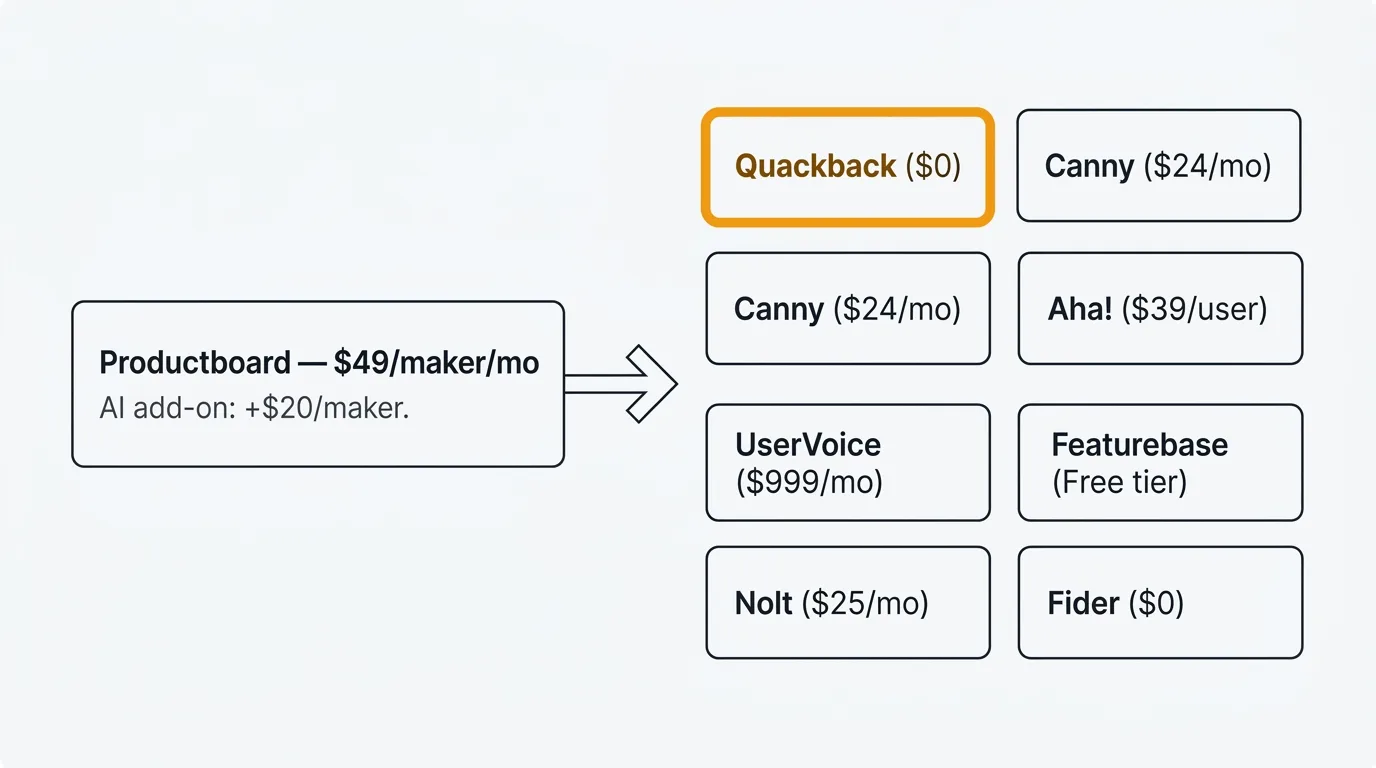
The best Productboard alternative for most teams is Quackback — open source, and the only tool on this list with an MCP server. Run it self-hosted for free or use the managed Quackback Cloud. Canny, Aha!, UserVoice, Featurebase, Nolt, and Fider round out the list, each suited to a different need. The ranked picks:
- Quackback — Open source. Self-hosted free or managed cloud. AI + MCP server included.
- Canny — Established hosted feedback tool. Voting, roadmap, changelog, AI Autopilot.
- Aha! — Full product management suite covering strategy, roadmapping, and development.
- UserVoice — Enterprise feedback with revenue-linked prioritization via Salesforce.
- Featurebase — Free tier. All-in-one feedback, support inbox, and help center.
- Nolt — Simple feedback board with flat-rate pricing. No per-user billing.
- Fider — Open source, lightweight voting board. Bare-bones but stable.
Pricing last verified March 2026. Vendors may change plans and pricing without notice. Check each vendor's pricing page for the latest figures.
Why teams switch from Productboard
The most common reasons teams look for a Productboard alternative:
- Per-maker pricing adds up fast. Productboard's Spark plan charges $15/maker/month (annual) or $19/maker/month (monthly). A 10-person product team costs $150–190/mo. Enterprise pricing for SSO and advanced features is custom and higher.
- AI credit limits. Each maker gets 250 AI credits per month. Teams that rely heavily on AI-driven feedback analysis may exhaust credits before the month ends.
- Complexity you may not need. Productboard is a full product management suite with strategy layers, objectives, and scoring frameworks. If you just need feedback boards and a roadmap, you're paying for features you won't use.
- No self-hosting. Your data lives on Productboard's infrastructure. No open-source option, no data portability beyond standard export.
For a detailed pricing breakdown, see Productboard Pricing in 2026.
1. Quackback
Quackback is open source (AGPL-3.0) and free to self-host. No feature gates tied to pricing tiers. Deploy it on your own infrastructure with Docker, or skip the ops and use the managed Quackback Cloud. Either way you get the full feature set from day one.
The core workflow covers everything Productboard charges for in its feedback loop: feedback boards with voting, a public roadmap, a changelog, SSO/OIDC, custom branding, and 25 integrations including Slack, Jira, Linear, GitHub, Intercom, Zendesk, and Salesforce. Productboard doesn't have a native changelog. You need a separate tool to tell users what shipped. Quackback handles collection through announcement in a single product.
Where Quackback differs most is its approach to AI. Duplicate detection catches redundant posts before they pile up. Merge suggestions identify related requests with reasoning your team can accept or dismiss in one click. Sentiment analysis runs on every post, and summaries pull out key quotes and next steps. Productboard includes AI via credits (250 per maker per month), but heavy users may hit those limits.
The MCP server is something no other tool on this list offers. It implements the Model Context Protocol, the standard that Claude, Cursor, and Windsurf support. Connect an AI agent and it gets full access to your feedback data: search posts, triage requests, write responses, create changelog entries, and merge duplicates. Every action is attributed and auditable.
Key features:
- Feature request boards with voting, status tracking, and nested comments
- Public roadmap and changelog with automatic voter notifications
- Built-in AI: duplicate detection, merge suggestions, sentiment analysis, post summaries
- MCP server for AI agents (search, triage, respond, create, merge)
- 25 integrations: Slack, Linear, Jira, GitHub, Intercom, Zendesk, Salesforce, and more
- SSO/OIDC, webhooks, full REST API
- Custom branding with themes, custom CSS, and your own domain
- Import/export for migration from other tools
Pricing: Free and open source to self-host with Docker or Railway. A managed Quackback Cloud is available if you would rather not run your own infrastructure.
Pros:
- Full-featured feedback, voting, roadmap, and changelog in one product
- AI included at no extra cost when self-hosted (bring your own model key)
- MCP server for AI agent access — unique in the category
- Open source — audit the code, fork it, own your data
- 25 integrations, SSO, and custom branding included on every self-hosted installation
- Built-in changelog that Productboard lacks
Cons:
- Self-hosting means you manage your own infrastructure (Docker or Railway) — though managed cloud removes that
- Newer project with a smaller community than Productboard
- No weighted scoring or objective-based prioritization (vote-based instead)
Best for: Teams that want focused feedback collection, voting, roadmap, and changelog without paying for a full PM suite.
For a detailed feature-by-feature breakdown, see the full Quackback vs Productboard comparison.
Try Quackback — open source with a managed cloud option. Start free. Get started | Self-host with Docker | View on GitHub
2. Canny
Canny is one of the most established feedback tools in the category. It covers the standard workflow: feature request boards, voting, a public roadmap, a changelog, and status notifications. The interface is clean and the product is mature.
Canny overhauled its pricing in May 2025, moving from per-admin billing to tiered pricing based on tracked users. A tracked user is anyone who posts, votes, or comments. Costs increase as you cross tracked user thresholds, with auto-upgrades to the next tier.
Canny offers a free plan (25 tracked users, 5 managers) but most teams outgrow it quickly. Core is $19/mo for 100+ tracked users. Pro is $79/mo for PM integrations (Jira, ClickUp, Linear). Business is custom pricing for 5,000+ tracked users.
Compared to Productboard, Canny is more focused on the feedback loop and less on product strategy. You get boards, voting, a roadmap, and a changelog. You don't get prioritization frameworks, opportunity scoring, or objective alignment. If that's what drove you to Productboard in the first place, Canny won't replace it. But if you only used Productboard for feedback collection, Canny covers that ground at a lower price point.
Canny's AI feature, Autopilot, handles feedback discovery, deduplication, smart replies, and comment summaries. It's included on all plans, including the free tier. SSO is locked behind the Business plan (custom pricing).
Key features:
- Feedback boards with voting, status tracking, and user segmentation
- Public roadmap and changelog
- Autopilot AI: feedback discovery, deduplication, smart replies, comment summaries (all plans)
- Integrations: Slack, Jira, Linear, GitHub, Intercom, Zendesk, Salesforce, and more
- Custom domain and branding
- SSO (Business plan, custom pricing)
Pricing: Free (25 tracked users). Core at $19/mo (100+ tracked users). Pro at $79/mo (PM integrations). Business is custom pricing (5,000+ tracked users).
Pros:
- Mature, well-designed product
- Covers the full feedback-to-changelog workflow
- Broad integration set
- Established company with a large user base
Cons:
- Tiered tracked-user pricing means costs increase as you cross user thresholds
- Free plan caps at 25 tracked users
- SSO locked behind the Business plan (custom pricing)
- No self-hosting, no open source
- AI (Autopilot) is included on all plans
Best for: Mid-size SaaS teams that want a proven hosted feedback tool and can budget for tracked-user pricing.
See how it compares: Quackback vs Canny.
3. Aha!
Aha! is a full product management suite. It goes beyond feedback collection into strategy, roadmapping, idea management, and development planning. If Productboard felt too focused on the insights-to-strategy pipeline, Aha! is even broader — it covers the entire product lifecycle from vision to sprint.
Aha! Ideas is the feedback-specific module. It lets you create an ideas portal where customers and internal teams submit feature requests, vote, and comment. Ideas link to features and epics in Aha! Roadmaps, creating a traceable path from customer request to shipped product.
The depth comes at a cost. Aha! Ideas starts at $39/user/month for the Essentials tier, with the Advanced add-on at +$20/user/month (annual). Aha! Roadmaps is a separate product at $59/user/month. A minimum of three paid seats is required, and a team of 10 product managers across both products faces a bill north of $500/month. Aha! also offers Aha! Develop for engineering workflows, which adds another layer (and another line item).
The product is dense. Setup takes time. Learning curves are real. But for enterprise product organizations that need a single platform covering strategy, roadmapping, idea management, and development, Aha! is one of the few tools that does it all.
Key features:
- Ideas portal for customer feedback and voting
- Strategic roadmapping with multiple views (timeline, Gantt, list, board)
- Feature scoring and prioritization frameworks
- Knowledge base and whiteboards
- Integrations: Jira, Azure DevOps, Slack, Salesforce, Zendesk, and 30+ more
- Reports, dashboards, and custom analytics
- SSO/SAML
Pricing: Aha! Ideas Essentials at $39/user/month, with the Advanced add-on at +$20/user/month (annual). Aha! Roadmaps at $59/user/month. Three-seat minimum. Enterprise pricing is custom.
Pros:
- Comprehensive product management platform
- Strong strategic roadmapping capabilities
- Deep integration between ideas, roadmaps, and development
- Established company (founded 2013) with a large enterprise customer base
Cons:
- Expensive — per-user, per-module pricing adds up fast across Ideas and Roadmaps
- Steep learning curve and complex configuration
- Overkill for teams that just need feedback and a roadmap
- No self-hosting, no open source
- Setup and onboarding take weeks
Best for: Enterprise product organizations that need a complete strategy-to-development platform, not just feedback collection.
See how it compares: Quackback vs Aha!.
4. UserVoice
UserVoice was one of the first customer feedback platforms. It pioneered the voting board concept that most tools in this category still use. In 2026, UserVoice positions itself as an enterprise feedback platform with CRM-linked prioritization and revenue-based scoring.
The differentiator is its ability to tie feedback to revenue. By integrating with Salesforce, UserVoice lets you see which feature requests come from your highest-value accounts. Product teams can prioritize by ARR impact, not just vote count. For enterprise B2B companies where a single customer might represent six or seven figures of revenue, this changes how you make product decisions.
The trade-off is cost and commitment. UserVoice starts at $16,000/year (~$1,333/mo) with custom pricing based on monthly feedback volume and integrations. No per-seat charges.
Annual billing is required. There is no free tier, no monthly option, and no self-serve signup. A 30-day free trial is available, but you go through sales first, negotiate a contract, and wait for onboarding.
If you came to Productboard for revenue-linked prioritization and found it lacking, UserVoice is the specialist. If you came to Productboard because you needed a feedback board and a roadmap, UserVoice is more tool than you need at a price that's hard to justify.
Key features:
- Feedback portal with voting and smart vote capture
- Revenue-based prioritization with Salesforce integration
- NPS surveys and contributor tracking
- Internal feedback capture for support and sales teams
- Product analytics and insights dashboards
- SSO/SAML, custom branding
Pricing: Starting at $16,000/year (~$1,333/mo). Custom pricing based on volume. Annual billing required. No per-seat charges. 30-day free trial.
Pros:
- Revenue-linked feedback prioritization
- Deep Salesforce integration for B2B teams
- Internal feedback capture across support and sales
- Established brand (founded 2008)
Cons:
- Starts at $16,000/year with annual billing
- No free tier, no self-serve signup
- No self-hosting, no open source
- Dated interface compared to newer tools
- Long onboarding process
Best for: Large B2B organizations with enterprise budgets that need revenue-based feedback prioritization.
See how it compares: Quackback vs UserVoice.
5. Featurebase
Featurebase bundles feedback boards, a changelog, roadmap, help docs, and a support inbox into one product. It has a free plan (1 seat, limited features), making it one of the more accessible starting points for teams that don't want to self-host.
The AI agent, Fibi, auto-resolves customer questions using context from your help center, feedback posts, and past conversations. It can submit feature requests on behalf of users. The catch: Fibi charges $0.49 per resolution on top of your plan cost. At volume, that adds up.
Compared to Productboard, Featurebase is simpler and cheaper. You won't get prioritization frameworks, opportunity scoring, or strategy alignment. You will get a feedback board, a changelog, help docs, and a support inbox in one tool for $29/seat/month. For teams that used Productboard primarily as a feedback collection layer, Featurebase covers that ground and adds things Productboard doesn't have — a changelog and built-in help docs.
Per-seat pricing ($29–99/seat/month on paid plans) still means costs grow with your team, though not as fast as Productboard. Post merging and user segmentation are locked to the Business tier ($38+/mo).
Key features:
- Feedback boards with voting, status tracking, and user segmentation
- Changelog, public roadmap, and surveys (NPS, CSAT)
- Unified support inbox with live chat and email
- Fibi AI Agent for auto-resolving questions ($0.49/resolution)
- Help docs / knowledge base
- 12 integrations: Linear, Jira, GitHub, Slack, Intercom, Zendesk, and more
Pricing: Free (1 seat, limited). Growth at $29/seat/month. Professional at $59/seat/month. Enterprise at $99/seat/month.
Pros:
- Free tier available for getting started
- All-in-one: feedback, support, help docs in one product
- Growing fast with regular feature updates
- Surveys (NPS, CSAT) included
Cons:
- Per-seat pricing adds up for larger teams
- AI resolutions are usage-based ($0.49 each)
- No self-hosting, no open source
- Post merging locked to Business tier
Best for: Startups and small teams that want a hosted all-in-one tool with a free starting point.
See how it compares: Quackback vs Featurebase.
6. Nolt
Nolt takes the opposite approach to Productboard. It's simple. You get a clean feedback board where users submit and vote on ideas, plus a basic roadmap view and status notifications. That's it. No AI, no changelog, no support inbox, no prioritization frameworks.
The pricing is flat-rate: $29/mo for one board on the Essential plan (billed annually). No tracked-user billing, no per-seat charges. You know exactly what you'll pay. After dealing with Productboard's per-maker pricing that scales with team size, Nolt's predictability is a relief.
The concern is pace. Nolt has seen minimal product updates over the past two years. Core feature requests from users — changelog, comment threading, bulk editing — remain unbuilt. Per-board pricing also means costs multiply if you manage feedback for multiple products. The Essential plan covers one board. The Pro plan covers five boards at $69/mo.
If your needs are simple — one product, one feedback board, flat pricing — Nolt handles it. If you need more than that, you'll outgrow it.
Key features:
- Feedback board with voting and custom statuses
- Roadmap view
- SSO, private boards, and password-protected boards
- Integrations: Slack, Discord, Jira, Linear, GitHub, Zapier (Pro plan)
- Custom domain and branding
Pricing: Essential at $29/mo for 1 board (annual). Pro at $69/mo for 5 boards. Enterprise is custom.
Pros:
- Flat-rate pricing — no per-user surprises
- Clean, focused UI
- Quick to set up
- SSO included on paid plans
Cons:
- No changelog, no AI features
- Minimal product updates since 2022
- Per-board pricing multiplies costs across products
- No self-hosting, no open source
Best for: Small teams that want a simple, predictable-cost feedback board and nothing more.
See how it compares: Quackback vs Nolt.
7. Fider
Fider is the other open-source option on this list. It's licensed under AGPL-3.0, built with Go and React, and deploys with Docker. Fider covers the core feedback workflow: users submit ideas, vote, and comment. Admins manage posts with tags, custom statuses, and filters.
Fider has been around since 2017 and has a stable, lightweight codebase. Go makes it efficient on resources — you can run it on a small VPS for $5/month. If you need a bare-bones voting board and nothing else, Fider does the job well.
Where Fider falls short is everything beyond the basics. There's no changelog. No roadmap view. No AI features. Integrations are limited to webhook-based connections with Slack, Discord, and Microsoft Teams. No native Jira, Linear, or GitHub integration. The project also moved to an open-core model in v0.33.0, putting content moderation and SEO indexing behind the paid cloud tier.
If you're leaving Productboard because it does too much, Fider is the extreme opposite — it does the minimum. You'll need separate tools for your roadmap, changelog, and integrations.
Key features:
- Feedback boards with voting, comments, and rich text editor
- Tags, filters, and customizable statuses
- REST API and webhooks
- Multi-language support (10+ languages)
- SSO with OAuth providers
- Self-hosted on any cloud or on-premise
Pricing: Free and open source for self-hosting. Cloud free tier limited to 250 feedback items. Cloud Pro at $49/month.
Pros:
- Mature, stable codebase (since 2017)
- Lightweight and resource-efficient
- Simple to set up and operate
- Truly open source for self-hosting
Cons:
- No changelog, no roadmap, no AI features
- Limited integrations (webhooks only)
- Open-core model means some features are paywalled on cloud
- Development pace has slowed
- No duplicate detection, no post merging
Best for: Developers who want a minimal, open-source voting board with low resource requirements.
See how it compares: Quackback vs Fider.
Comparison table
Here's how all seven alternatives stack up against Productboard on the features that matter most.
| Feature | Productboard | Quackback | Canny | Aha! | UserVoice | Featurebase | Nolt | Fider |
|---|---|---|---|---|---|---|---|---|
| Starting price | $15/maker/mo (annual) | Free self-hosted / $29/mo Cloud | Free (25 tracked users) | $39/user/mo | $16,000/yr | Free (1 seat) | $29/mo | Free |
| Pricing model | Per maker | Workspace (Cloud) or free self-hosted | Tiered by tracked users | Per user | Annual (no per-seat) | Per seat | Per board | Free / $49/mo |
| Open source | No | Yes (AGPL-3.0) | No | No | No | No | No | Yes (AGPL-3.0) |
| Self-hosting | No | Yes | No | No | No | No | No | Yes |
| Feedback boards | Yes | Yes | Yes | Yes | Yes | Yes | Yes | Yes |
| Public roadmap | Yes | Yes | Yes | Yes | No | Yes | Yes | No |
| Changelog | No | Yes | Yes | No | No | Yes | No | No |
| AI features | Included via credits (250/maker/mo) | Yes (built in) | Autopilot (all plans) | Limited | Limited | Fibi ($0.49/resolution) | No | No |
| MCP server | No | Yes | No | No | No | No | No | No |
| SSO included | Paid plans | Yes | Business (custom pricing) | Yes | Yes | Paid plans | Yes | Yes |
| Free tier | No | Free (open source) | Yes (25 tracked users) | No | No | Yes (1 seat) | No | Yes (250 items) |
How to choose
Start with two questions: what do you actually need, and what are you willing to manage?
If you used Productboard mainly for feedback collection: You were overpaying. Quackback, Canny, and Featurebase all cover feedback boards, voting, roadmaps, and changelogs. Productboard's value is in its strategy and prioritization layer. If you weren't using that, you don't need to replace it.
If cost is the priority: Quackback is free and open source to self-host. Fider is also free and open source but covers less ground. Among hosted options, Nolt ($29/mo flat) and Featurebase (free tier) are the most affordable starting points.
If you want open source: Quackback and Fider are your options. Quackback gives you the full feature set — boards, roadmap, changelog, 25 integrations, AI, MCP server. Fider covers basic voting boards. Both deploy with Docker.
If you want a tool you won't outgrow, Quackback is the stronger choice. For more options, see Open Source Feedback Tools.
If you need enterprise product management: Aha! is the closest replacement for Productboard's strategy and roadmapping capabilities. It's broader, more expensive, and has a steeper learning curve — but it covers ideation through development in one platform.
If you need revenue-linked prioritization: UserVoice is the specialist. Its Salesforce integration ties feedback to account revenue so you can prioritize by ARR impact. You'll pay $16,000/year or more for that capability, but no other tool on this list matches it.
If you want simplicity: Nolt is the lightest option. One board, flat pricing, minimal UI. It does not try to be a product management platform. It collects votes and shows a roadmap. If that is all you need, it is enough.
If you're migrating from Productboard: The most common reasons teams leave are per-maker pricing, AI credit limitations, and complexity they don't need. If you want the feedback loop without the PM suite, Quackback covers boards, voting, roadmap, changelog, integrations, SSO, and AI at no cost. See the full comparison for a detailed breakdown.
For a broader look at the feedback tool landscape, see Best Customer Feedback Tools in 2026.
Frequently asked questions
What is the best free alternative to Productboard?
Quackback is the most full-featured free alternative. It's open source (AGPL-3.0), self-hosted, and includes feedback boards, voting, a public roadmap, a changelog, 25 integrations, SSO/OIDC, and built-in AI features. There are no feature gates. Among hosted tools, Featurebase offers a limited free tier with one seat.
Why are people switching from Productboard?
Three factors drive most of the migration. First, per-maker pricing grows with team size — a team of 10 PMs costs $150–190/month on the Spark plan, and enterprise pricing with SSO is higher. Second, AI credits (250 per maker per month) may not be enough for teams that rely heavily on AI-driven feedback analysis. Third, many teams only use Productboard for feedback collection but pay for a full product management suite they don't need. Simpler tools cover that workflow at a fraction of the cost.
Is there an open-source Productboard alternative?
Yes. Quackback is the closest open-source equivalent to Productboard's feedback capabilities. It covers feedback boards, voting, a public roadmap, a changelog, 25 integrations, SSO, and AI — features that span multiple Productboard pricing tiers. The MCP server adds AI agent access that Productboard doesn't offer.
Fider is another open-source option, though it only covers basic voting boards. Both self-host with Docker. For a deeper comparison, see Open Source Feedback Tools.
Can I migrate from Productboard to another tool?
Productboard supports data export, so you can extract your feedback notes, features, and user data. The migration process depends on your destination tool. You'll need to map users, votes, statuses, and any linked objectives or scores.
Tools that focus purely on feedback (like Quackback or Canny) won't import Productboard's strategy layer — prioritization scores, objectives, and driver mappings don't have equivalents. Focus on migrating your feedback data and start fresh with the new tool's native features. Check the Quackback docs for import guidance.
Does Productboard have a free plan?
Productboard does not have a free plan. The Spark plan starts at $15/maker/month (billed annually) or $19/maker/month (monthly). New signups get 150 free credits to trial AI features, but the plan itself requires payment. For teams that want full feedback functionality, Quackback is free and open source to self-host.

Authored by James Morton
Founder of Quackback. Building open-source feedback tools.
Try Quackback
The open-source feedback platform. Boards, voting, and roadmaps.
Get startedStar on GitHub305