Canny is one of the most popular feedback management tools on the market. It has been around since 2017 and covers the standard workflow: feature request boards, voting, roadmaps, and changelogs. Thousands of SaaS teams use it to collect and prioritize user feedback.
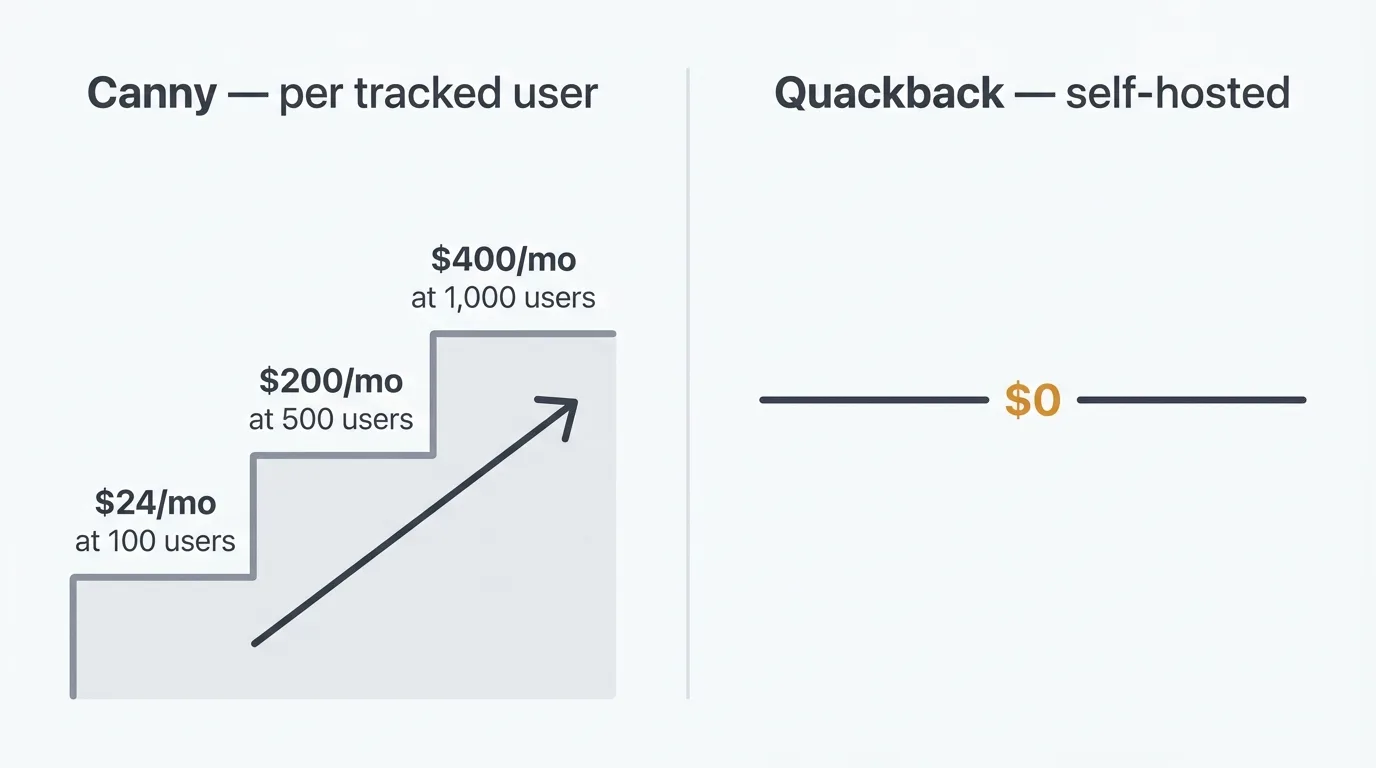
Canny has a free plan (25 tracked users) and paid plans starting at $19/mo billed annually. Costs rise as you exceed tracked-user limits and get auto-upgraded to the next tier, and SSO is locked to the custom-priced Business plan. Free alternatives exist — Quackback is open source and self-hosted at no cost.
Pricing last verified March 2026. Vendors may change plans and pricing without notice. Check each vendor's pricing page for the latest figures.
In May 2025, Canny overhauled its pricing model. The company moved from per-admin billing to tiered pricing based on tracked users, a shift that changes how much you pay and when costs increase. If you're evaluating Canny in 2026 or checking whether your current plan still makes sense, this guide breaks down exactly what Canny costs, what you get at each tier, and where the hidden expenses show up.
Canny's pricing plans
Canny offers a free plan and three paid tiers in 2026.
| Plan | Monthly Price | Tracked Users | Managers | Key Features |
|---|---|---|---|---|
| Free | $0 | 25 | 5 | Feedback boards, voting, roadmap, changelog, Autopilot AI, unlimited posts |
| Core | $19/mo (billed annually) | 100+ | 5 | Custom domains, content translations, Autopilot AI |
| Pro | $79/mo (billed annually) | 100+ | 10 | PM integrations (Jira, ClickUp, Linear), advanced privacy, Autopilot AI |
| Business | Custom pricing | 5,000+ | Custom | SSO/SAML, CRM integrations, dedicated support, white-label |
A few things to note. The free plan exists but caps you at 25 tracked users with limited features. Most teams outgrow it quickly. The Core plan at $19/mo is the first paid tier with 100+ tracked users and 5 managers. If you need PM integrations like Jira, ClickUp, or Linear, you need the Pro plan at $79/mo. The Business plan is the only tier that includes SSO, which matters for any team with enterprise security requirements. Business pricing is custom — you need to contact sales.
Autopilot AI (feedback discovery, deduplication, smart replies, comment summaries) is included on all plans, including the free tier.
What are tracked users?
Tracked users are the core of Canny's billing model. A tracked user is anyone who has a post, vote, or comment attributed to them in your Canny workspace. It doesn't matter whether the person is an active user of your product or someone who voted on a feature request six months ago and never came back. Once they're tracked, they count toward your limit.
Canny uses tiered pricing with tracked user limits. Each plan tier includes a set number of tracked users. If you exceed your tier's limit, Canny auto-upgrades you to the next tier. You can set spend caps to prevent unexpected upgrades, but by default your costs grow as engagement grows. A five-person startup with 2,000 users submitting feedback pays more than a fifty-person company with 50 internal users on the board.
The trade-off is that costs can increase when you cross tier thresholds. If you launch a public roadmap and a feature request gets traction on social media, each new voter becomes a tracked user. Your tracked user count could push you into a higher tier, driven by a single popular post rather than overall product growth.
Another scenario: you integrate Canny with your support tool (Intercom, Zendesk, Help Scout). Canny's Autopilot discovers feedback in support conversations and attributes it to the customer. Each attributed customer becomes a tracked user. The more support tickets you process, the faster your tracked user count grows.
There's no easy way to "un-track" users in bulk. Once someone is counted, reducing your tracked user count requires manual cleanup or waiting for Canny's periodic recalculation. This makes it difficult to bring costs back down after a spike.
Canny pricing at scale
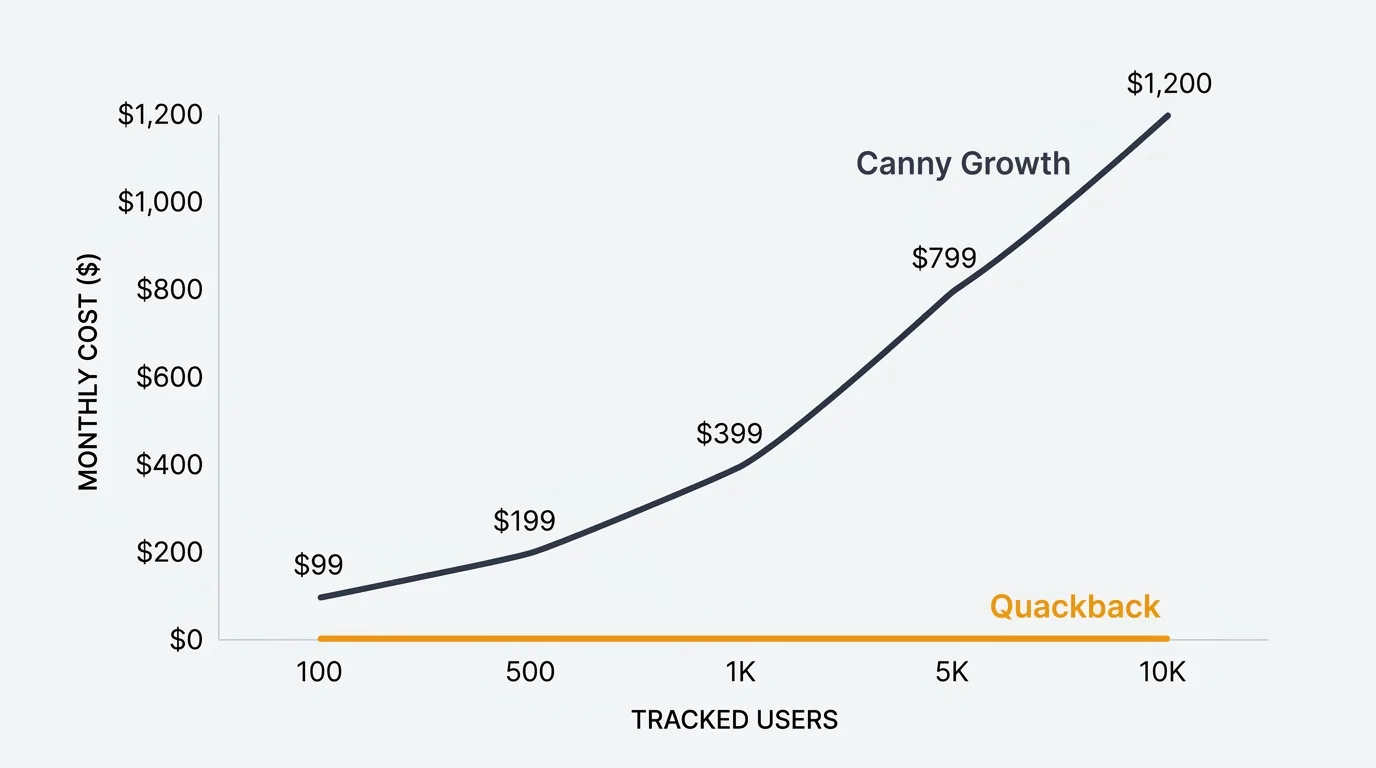
Canny uses tiered pricing with tracked user limits at each tier. The free plan allows 25 tracked users. Core starts at $19/mo with 100+ tracked users. Pro starts at $79/mo with 100+ tracked users and more managers. If you exceed your tier's tracked user limit, Canny auto-upgrades you to the next tier (though you can set spend caps to prevent this).
| Tracked Users | Free | Core (Est.) | Pro (Est.) | Business |
|---|---|---|---|---|
| 25 | $0/mo | — | — | — |
| 100 | — | $19/mo | $79/mo | Custom |
| 500 | — | Higher tier | Higher tier | Custom |
| 1,000 | — | Higher tier | Higher tier | Custom |
| 5,000+ | — | — | — | Custom |
Canny's exact per-tier pricing above the base is not fully published. As your tracked user count grows, you move into higher tiers within your plan, and costs increase accordingly. The Business plan requires 5,000+ tracked users and uses custom pricing.
The key takeaway: costs are predictable within a tier but increase as you cross tracked user thresholds. Teams with thousands of active feedback users should expect significant monthly costs. The auto-upgrade mechanism means your bill can increase without explicit approval unless you set spend caps.
Hidden costs to consider
The sticker price on Canny's pricing page doesn't tell the full story. Here are the costs that catch teams off guard.
Tracked users accumulate over time. Even if a user hasn't interacted with your feedback board in months, they may still count toward your tracked user limit. Your bill reflects the total number of tracked users, not just the active ones. Over the life of your product, this number only goes up.
Auto-upgrade risk. If you exceed your tier's tracked user limit, Canny automatically upgrades you to the next tier. You can set spend caps to prevent this, but the default behavior means your bill can increase without explicit approval.
AI Autopilot is included on all plans. Canny's AI features (feedback discovery, deduplication, smart replies, comment summaries) are included on every plan, including the free tier. This is a strength — you don't pay extra for AI.
SSO is locked to the Business plan. If your organization requires SAML SSO for compliance or security, you need the Business plan with custom pricing. For teams that need SSO but don't need the other Business-tier features, this is an expensive gate.
No self-hosting option. Canny is a hosted SaaS product with no on-premises deployment. For teams with data residency requirements or a preference for self-managed infrastructure, this is a constraint.
PM integrations require Pro. Jira, ClickUp, and Linear integrations require the Pro plan at $79/mo. The Core plan includes custom domains and content translations but not PM tool integrations. Most teams need at least one PM integration from day one.
Free and cheaper alternatives to Canny
If Canny's pricing doesn't fit your budget, or if you want to avoid tiered tracked-user pricing entirely, there are several alternatives worth considering.
Quackback
Quackback is free, open source (AGPL-3.0), and self-hosted, with a managed Quackback Cloud from $29/mo on annual billing if you would rather not run infrastructure. It covers feedback boards, voting, a public roadmap, changelogs, and 25 integrations. AI features and SSO/OIDC are included free on every self-hosted installation. On Cloud, Quinn is included on paid plans, and SSO is self-serve on Enterprise. A built-in MCP server lets AI agents read and triage feedback directly, something Canny does not offer. Self-host with Docker or deploy on Railway. See the full comparison of Quackback vs Canny.
Fider
Fider is another open-source option. It covers the basics: feedback boards, voting, comments, and tags. It's built on Go and PostgreSQL and self-hosts with Docker. The feature set is smaller than Canny or Quackback — no changelog, no roadmap view, no AI features, and limited integrations. But it's free to run and the code is open. See the comparison of Quackback vs Fider.
Featurebase
Featurebase bundles feedback boards, a changelog, roadmap, and support inbox into one tool. It has a free plan (1 seat, limited features). Paid plans start at $29/seat/month. It's closed source and hosted only. The AI agent (Fibi) charges $0.49 per resolution on top of your plan cost. See the comparison of Quackback vs Featurebase.
Nolt
Nolt offers flat-rate pricing starting at $29/mo for a single feedback board (billed annually). No tracked-user billing. The trade-off is a limited feature set: no changelog, no AI features, and the product has seen minimal updates in the past two years. Per-board pricing means costs multiply if you manage multiple products. See the comparison of Quackback vs Nolt.
Cost comparison table
Here's how Canny stacks up against alternatives on the features that matter most.
| Canny | Quackback | Featurebase | Nolt | |
|---|---|---|---|---|
| Starting price | Free (25 tracked users) | Free self-hosted / $29/mo Cloud | Free (1 seat) | $29/mo |
| First paid tier | $19/mo (Core) | $29/mo (Cloud) | $29/seat/mo | $29/mo |
| User limits | 25 tracked users (Free), 100+ (Core/Pro) | None | None on free, seat-based on paid | None |
| Pricing model | Tiered by tracked users | Workspace (Cloud) or free self-hosted | Per seat | Per board |
| Self-hosting | No | Yes (Docker) | No | No |
| Open source | No | Yes (AGPL-3.0) | No | No |
| AI features | Autopilot (all plans) | Quinn on paid Cloud · BYOK self-host | Fibi ($0.49/resolution) | No |
| MCP server | No | Yes | No | No |
| SSO | Business plan (custom pricing) | Free self-hosted · Enterprise plan on Cloud | Professional plan ($59/seat/mo) | All paid plans |
| Integrations | PM integrations on Pro ($79/mo) | 25 included | 12 included | 8–12 (plan-dependent) |
Each billing model has trade-offs. Canny's tiered tracked-user model means costs increase as you cross user thresholds. Per-seat pricing (Featurebase) scales with team size. Flat-rate pricing (Nolt) stays predictable but offers fewer features. Self-hosted tools (Quackback, Fider) eliminate subscription costs but require infrastructure management.
Is Canny worth it?
Canny is a mature product. The interface is polished. The integrations work well. Autopilot AI is included on all plans (including free) and adds real value for teams that process a lot of support conversations. The free plan is a reasonable starting point for small teams, and the Core plan at $19/mo is affordable for teams that need more than 25 tracked users.
The main concern is cost predictability at scale. Tiered pricing with tracked user limits means your costs increase as you cross thresholds, and auto-upgrades can catch you off guard without spend caps. SSO requires the Business plan (custom pricing). And because Canny is a hosted product, you depend on their pricing structure for as long as you use it.
For teams that want predictable costs or prefer to own their infrastructure, open-source tools like Quackback or Fider offer the core feedback workflow without tiered user billing. Flat-rate tools like Nolt offer another path to cost predictability.
The choice depends on what you value. Canny offers a polished, managed experience with strong AI features. Open-source and flat-rate alternatives offer cost control. Both are valid paths depending on your team's priorities.
For a broader comparison of feedback tools, see Best Canny Alternatives, Best Customer Feedback Tools in 2026, and Open Source Feedback Tools.
Try Quackback — open source with a managed cloud option. Start free. Get started | View on GitHub
Frequently asked questions
Does Canny have a free plan?
Yes. Canny's free plan includes 25 tracked users, 5 managers, unlimited posts, and Autopilot AI. The 25 tracked-user cap means most teams outgrow it quickly. The first paid tier is Core at $19/mo. Free open-source alternatives include Quackback and Fider, both self-hosted.
How does Canny's tracked-user pricing work?
A tracked user is anyone with a post, vote, or comment attributed to them in your Canny workspace. Each tier includes a set number of tracked users, and exceeding your limit auto-upgrades you to the next tier unless you set a spend cap. Costs grow with engagement.
What is the cheapest Canny plan?
The free plan ($0/mo) is the entry point, with 25 tracked users, 5 managers, and Autopilot AI. The cheapest paid tier is Core at $19/mo (billed annually) for 100+ tracked users, custom domains, and content translations. PM integrations like Jira, ClickUp, and Linear require the Pro plan at $79/mo.
Is Canny worth the price?
It depends on your scale and requirements. For small teams, the free plan or Core plan at $19/mo is reasonable, and Canny's polish, AI Autopilot, and integrations are real strengths. The main trade-offs are auto-upgrades when you exceed tracked-user limits, SSO locked to the Business plan, and no self-hosting.
What is the best free alternative to Canny?
Quackback is the most complete free option: open source and self-hosted, with feedback boards, voting, a roadmap, changelogs, 25 integrations, SSO, and AI all included. Fider is also free and open source but lighter, covering voting boards, comments, and tags. See Quackback vs Canny.

Authored by James Morton
Founder of Quackback. Building open-source feedback tools.
Try Quackback
The open-source feedback platform. Boards, voting, and roadmaps.
Get startedStar on GitHub305