Canny and Productboard both deal with customer feedback, but they approach the problem differently. Canny is a focused feedback management tool: boards, voting, roadmaps, changelogs. Productboard is an enterprise product management platform that includes feedback as one piece of a broader strategy workflow.
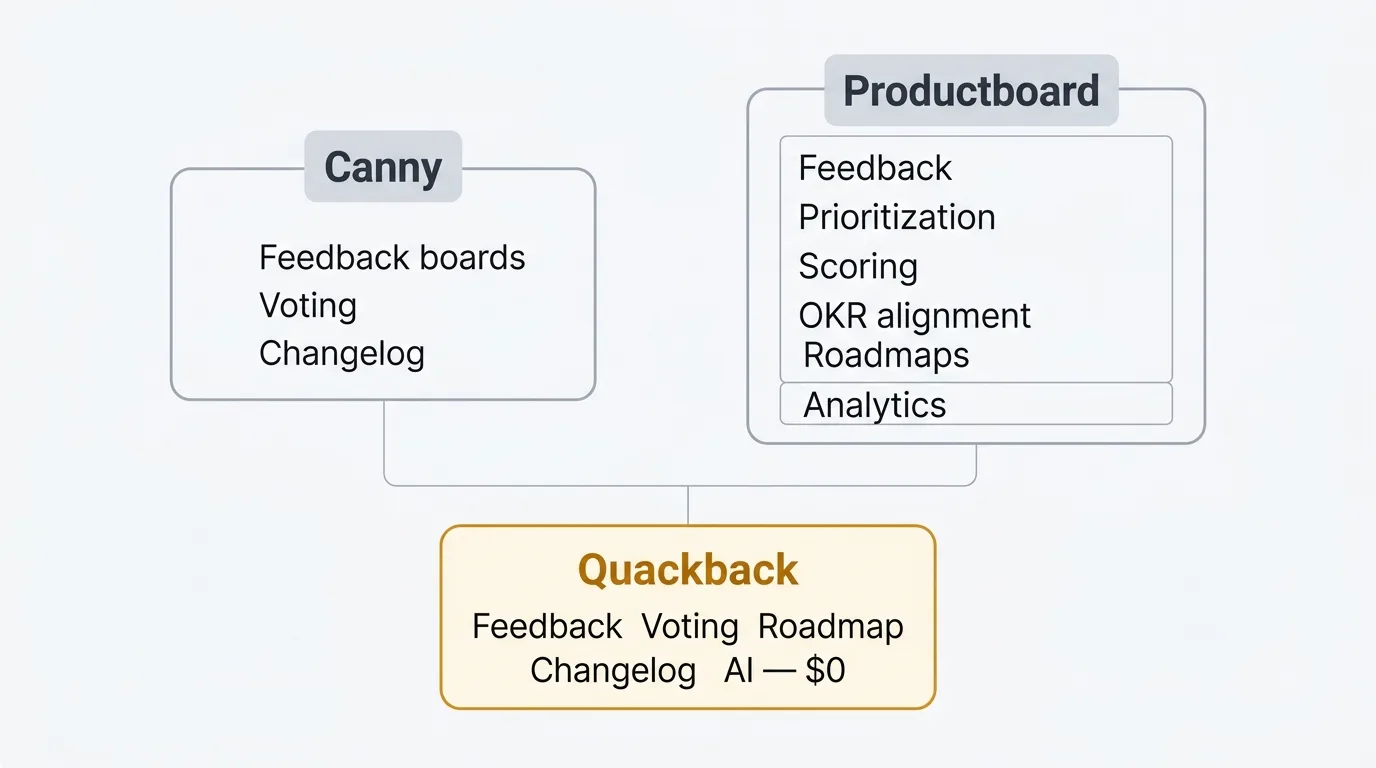
Canny is a focused feedback tool with boards, voting, and changelogs, best for teams that want a clean feature-request workflow. Productboard is an enterprise product management platform with prioritization frameworks and strategy alignment, built for product orgs that connect feedback to roadmaps. For an open-source alternative with no vendor lock-in, Quackback is free to self-host and also offers a managed cloud.
Pricing last verified March 2026. Vendors may change plans and pricing without notice. Check each vendor's pricing page for the latest figures.
If you're evaluating both tools in 2026, the right choice depends on what you're trying to solve. A team that needs a clean way to collect feature requests and show a public roadmap has different requirements than a product org that needs to connect customer insights to quarterly objectives and prioritization frameworks.
This guide breaks down what each tool does well, where each falls short, how they compare on features and pricing, and when an open-source alternative might be the better path. For deeper dives on each tool's pricing, see the Canny pricing breakdown and Productboard pricing analysis.
Canny overview
Canny has been in the feedback space since 2017. It covers the core loop that most SaaS teams need: users submit feature requests, vote on ideas they care about, and get notified when you ship something. Your team gets a centralized place to track what users want.
The product includes feedback boards, voting, a public roadmap, a changelog, and an AI feature called Autopilot that discovers feedback in support conversations from tools like Intercom, Zendesk, and Help Scout. Autopilot attributes that feedback to users and creates posts on your behalf, saving your team from manually combing through support tickets.
Pricing
Canny overhauled its pricing in May 2025, moving from per-admin billing to tiered pricing based on tracked users. A tracked user is anyone who has a post, vote, or comment attributed to them in your workspace.
- Free: $0/mo for 25 tracked users, 5 managers, Autopilot AI included
- Core: $19/mo (billed annually) for 100+ tracked users, 5 managers, custom domains, content translations
- Pro: $79/mo (billed annually) for 100+ tracked users, 10 managers, PM integrations (Jira, ClickUp, Linear)
- Business: Custom pricing for 5,000+ tracked users, SSO/SAML, CRM integrations, white-label
Costs increase as you cross tracked user thresholds — Canny auto-upgrades you to the next tier if you exceed your limit (you can set spend caps). A small team with 2,000 active feedback users pays more than a large team with 50 internal users on the board. For a detailed cost breakdown at different scales, see Canny pricing in 2026.
Strengths
- Focused product. Canny does one thing and does it well. The interface is clean and easy to learn. Most teams are up and running within a day.
- Autopilot AI. Feedback discovery from support conversations is genuinely useful. It surfaces insights your team would otherwise miss.
- Mature integrations. Slack, Jira, Linear, GitHub, Intercom, Zendesk, Salesforce (Business only), and more. The integrations are stable and well-maintained.
- Established product. Nine years in market. Thousands of customers. The product is reliable and unlikely to disappear.
Weaknesses
- Tiered tracked-user pricing. Exceeding your tier's tracked user limit triggers an auto-upgrade to the next tier. A viral feature request or a support tool integration can push you across thresholds quickly. You can set spend caps, but plan for cost growth tied to user activity.
- SSO requires the Business plan. If your organization needs SAML SSO for compliance, you need the Business plan (custom pricing).
- No self-hosting. Canny is hosted SaaS only. No way to run it on your own infrastructure or audit the source code.
- Free plan caps at 25 tracked users. Most teams outgrow the free tier quickly. The Core plan at $19/mo is the first paid tier with 100+ tracked users.
- PM integrations require Pro. Jira, ClickUp, and Linear integrations are locked to the Pro plan at $79/mo.
For alternatives to Canny, see best Canny alternatives in 2026.
Productboard overview
Productboard is a product management platform built for mid-size and enterprise product organizations. Feedback collection is one capability within a larger system that includes prioritization frameworks, opportunity mapping, driver-based roadmaps, and strategic alignment tools.
The feedback side works through a portal where users submit ideas and vote, plus an insights collection system that pulls feedback from Intercom, Zendesk, Salesforce, Gong, email, and manual notes. What sets Productboard apart is what happens after feedback arrives: product managers link insights to features, score features using custom prioritization criteria, map them to strategic objectives, and build roadmaps that reflect company priorities rather than raw vote counts.
Pricing
Productboard uses per-maker pricing. A "maker" is anyone who creates or edits features, roadmaps, or insights. Viewers and contributors (people who submit feedback) are free.
- Spark: $15/maker/month (billed annually) or $19/maker/month (monthly), 250 AI credits per maker per month
- Enterprise: Custom pricing for SSO/SAML, advanced security, custom roles, and dedicated support
Productboard consolidated its old tiered plans (Essentials, Pro, Scale, Enterprise) into a single Spark plan. AI features are now included via a credits system rather than sold as a separate add-on. Each maker gets 250 credits per month. New signups get 150 free credits to trial AI. For a detailed cost analysis, see Productboard pricing in 2026.
Strengths
- Product strategy tools. Prioritization matrices, opportunity scoring, OKR alignment, and driver-based roadmaps. No feedback tool offers this depth.
- Enterprise integrations. Deep Salesforce, Jira, and Zendesk integrations. Revenue data from CRM can weight feature requests by customer value.
- Multi-team alignment. Multiple product teams can share insights, align on objectives, and coordinate roadmaps in one place.
- Insights from everywhere. Capture feedback from support tickets, sales calls (Gong), email, CRM, and manual notes. Everything flows into a single repository.
Weaknesses
- Costs grow with team size. A 10-person team on the Spark plan pays $150/mo (annual) or $190/mo (monthly). Enterprise contracts with SSO and advanced features cost more.
- AI credits may be limiting. The 250 credits per maker per month power all AI interactions. Heavy AI users may exhaust credits before the month ends.
- Steep learning curve. The interface is complex. Onboarding a team takes weeks, not days.
- Overkill for feedback collection. If you just need a voting board and a roadmap, Productboard's strategy tools add complexity you don't need.
- No self-hosting. Hosted SaaS only, like Canny.
- No native changelog. Productboard focuses on the upstream process (insights to strategy). It doesn't include a changelog to announce what you shipped.
For alternatives to Productboard, see best Productboard alternatives in 2026.
Feature comparison
Here's how Canny, Productboard, and Quackback compare across the features that matter for feedback management and product planning.
| Feature | Canny | Productboard | Quackback |
|---|---|---|---|
| Feedback boards | Yes | Yes (portal + insights) | Yes |
| Voting | Yes | Yes | Yes |
| Public roadmap | Yes | Yes (portal roadmap) | Yes |
| Changelog | Yes | No | Yes |
| AI features | Autopilot (all plans) | Included via credits (250/maker/mo) | Included |
| MCP server | No | No | Yes |
| Integrations | PM integrations on Pro ($79/mo) | 20+ on all paid plans | 20+ included |
| API | REST API | REST API | REST API |
| SSO | Business plan (custom pricing) | Enterprise plan | Free self-hosted · Enterprise on Cloud |
| Self-hosting | No | No | Yes (Docker) |
| Open source | No | No | Yes (AGPL-3.0) |
| Starting price | Free (25 tracked users) | $15/maker/mo (annual) | Free self-hosted / $29/mo Cloud |
| Prioritization framework | Basic (impact/effort) | Advanced (custom scoring, drivers) | Community voting + AI insights |
| Duplicate detection | Basic | Manual | AI-powered |
The three tools cover different ground. Canny and Productboard gate some features (SSO, advanced AI, white-label) behind higher tiers, which is standard for SaaS pricing models. Quackback includes all features on every self-hosted installation, but requires you to manage your own infrastructure.
Pricing comparison
What each tool costs depends on your team size and how many users interact with your feedback system. Here's a side-by-side estimate at different scales.
Small team (3 product people, 500 feedback users)
| Canny | Productboard | Quackback | |
|---|---|---|---|
| Plan needed | Pro (for PM integrations) | Spark | Self-host or Cloud Pro |
| Monthly cost | From $79/mo (Pro), rising as tracked users grow | $45/mo (3 makers x $15 annual) | Self-host ~$10 · Cloud $29/mo Pro (5 seats) |
| Annual cost | $948+ | $540 | Self-host ~$120 · Cloud $348 |
| AI cost | Included on all plans | Included (750 credits/mo) | Self-host: your LLM bill. Cloud: included Quinn usage, then $10 top-up packs. |
Mid-size team (8 product people, 2,000 feedback users)
| Canny | Productboard | Quackback | |
|---|---|---|---|
| Plan needed | Pro or Business | Spark or Enterprise | Self-host or Cloud Business |
| Monthly cost | $79+/mo (Pro); 2,000 tracked users likely pushes toward Business (custom) | $120/mo (8 makers x $15 annual) | Self-host ~$20 · Cloud $59/mo Business (20 seats) |
| Annual cost | $948+ | $1,440 | Self-host ~$240 · Cloud $708 |
| AI cost | Included | Included (2,000 credits/mo) | Self-host: your LLM bill. Cloud: included Quinn usage, then $10 top-up packs. |
| SSO | Business plan (custom pricing) | Enterprise only (custom) | Free self-hosted · Enterprise on Cloud |
Enterprise (20 product people, 10,000+ feedback users)
| Canny | Productboard | Quackback | |
|---|---|---|---|
| Plan needed | Business or Enterprise | Enterprise | Self-host or Cloud Enterprise |
| Monthly cost | Contact sales | $300/mo (20 makers x $15 annual) + enterprise features | Self-host infra · Cloud $99/mo Enterprise |
| Annual cost | Likely $15,000–30,000+ | $3,600+ (enterprise with SSO likely higher) | Self-host infra · Cloud $1,188 |
Each pricing model scales differently. Canny's tiered tracked-user pricing means costs increase as you cross user thresholds. Productboard's per-maker billing means costs grow with team size. Quackback Cloud is a flat workspace price from $29/mo billed annually (Free plan, 1 seat), with portal users free. Self-host is $0 software plus infrastructure and your own LLM usage. The right model depends on which dimension you expect to grow fastest.
When to choose Canny
Canny is the right fit when your primary goal is focused feedback management and you don't need the product strategy layer that Productboard provides.
Choose Canny if:
- You want a dedicated feedback tool, not a product management platform. Canny's simplicity is a feature. Boards, voting, roadmap, changelog. Your team learns it quickly and users find it intuitive.
- Your tracked-user count will stay manageable. If your feedback community is in the hundreds rather than thousands, Canny's pricing stays reasonable. Teams with a smaller, engaged user base get good value from the Core or Pro plan.
- You rely on support conversation mining. Canny's Autopilot is genuinely useful for pulling insights out of Intercom, Zendesk, and Help Scout conversations. If your team processes a high volume of support tickets and wants feedback extracted automatically, Canny handles this well.
- You want a mature, established product. Canny has been in market since 2017. The product is stable, the integrations are well-tested, and the company isn't going anywhere.
Where Canny struggles: large-scale user bases (tracked-user costs become unpredictable), teams that need SSO without Business-tier custom pricing, and organizations that want to own their data or self-host.
When to choose Productboard
Productboard is the right fit for product organizations that need more than feedback collection — teams that need to connect customer insights to product strategy, prioritize with data, and align multiple stakeholders.
Choose Productboard if:
- You need strategic product management tools. Opportunity scoring, prioritization frameworks, OKR alignment, and driver-based roadmaps are Productboard's core strength. If your team debates feature priorities in spreadsheets and wants a structured process, Productboard provides that.
- Your product org has multiple teams. Productboard handles the coordination problem: shared insights, team-level roadmaps that roll up to a company view, and cross-team visibility into what's being built and why.
- You need deep CRM integration. Productboard's Salesforce integration ties feature requests to customer revenue data. Product managers can see which features would affect the most ARR. This matters for enterprise SaaS companies where a single customer's feedback can drive product decisions.
- You have budget for it. Productboard is a significant investment. If your organization budgets for product management tooling at the enterprise level, the cost is justifiable. If you're a startup watching every dollar, it's not.
Where Productboard struggles: small teams that just need a voting board, budget-conscious organizations, teams that want fast setup without weeks of onboarding, and anyone who needs a changelog.
Consider Quackback if...
Neither Canny nor Productboard is the only path. If the trade-offs of both tools don't sit well with you, Quackback takes a fundamentally different approach.
You want to avoid vendor lock-in. Quackback is open source under AGPL-3.0. The code is available, auditable, and forkable. You're not dependent on a vendor's pricing decisions, feature roadmap, or continued existence. If Quackback the company disappeared tomorrow, the software keeps running on your server.
You want everything on one installation. No feature gates based on plan tiers. One installation gives you feedback boards, voting, a public roadmap, a changelog, 25 integrations, SSO/OIDC, custom branding, and REST API access.
You want AI built in. Quackback includes duplicate detection, merge suggestions, sentiment analysis, and post summarization on every self-hosted installation. Productboard meters AI through 250 credits per maker per month, and Canny gates it by tier.
You want an MCP server. Quackback's MCP server implements the Model Context Protocol, the standard supported by Claude, Cursor, and Windsurf. Connect an AI agent and it gets full access to your feedback data: search posts, triage requests, write responses, create changelog entries, and merge duplicates. No other feedback tool offers this.
You want to self-host. Deploy with Docker or on Railway. Your data lives in your PostgreSQL database on your infrastructure. Full control over backups, access, and compliance. This matters for teams with data residency requirements or organizations that can't send customer feedback to a third-party SaaS platform.
The trade-off: you manage your own infrastructure instead of paying a SaaS vendor. For teams with DevOps capacity, a $10–20/mo VPS runs the full platform. For teams that want managed hosting without the ops work, Quackback Cloud is live now — the same open-source product, hosted and maintained for you.
For detailed head-to-head comparisons, see Quackback vs Canny and Quackback vs Productboard. For a broader look at the open-source landscape, see open-source feedback tools.
Try Quackback — open source with a managed cloud option. Start free. Get started | View on GitHub
Frequently asked questions
Is Canny or Productboard better for a small SaaS team?
Canny is the better fit for most small SaaS teams. It is simpler to set up and covers the core feedback workflow (boards, voting, roadmap, changelog) without Productboard's strategic-planning overhead. If budget is the primary concern, Quackback offers the same core feedback features open source at no cost.
Can I use Productboard just for feedback collection?
You can, but it is not a good use of the tool. Productboard's value is in prioritization, opportunity scoring, and strategic alignment after feedback arrives. If you only need a feedback portal and voting board, you are paying for a platform you will not fully use. Canny or Quackback fit better.
Do Canny or Productboard offer self-hosting?
No. Both Canny and Productboard are hosted SaaS products with no self-hosting option. If self-hosting, data ownership, or open-source licensing matters, Quackback is the primary alternative: open source (AGPL-3.0), deploys with Docker, and stores everything in your own PostgreSQL database. SSO, AI, and 25 integrations are included.
Is Canny or Productboard cheaper at scale?
It depends on which dimension grows. Canny's tracked-user pricing rises as your feedback community grows, while Productboard's per-maker billing rises with team size. A large feedback audience favors Productboard; a large product team favors Canny. Quackback is open source and free to self-host.
Does Productboard have a changelog?
No. Productboard has no native changelog to announce shipped features, because it focuses on the upstream process from insights to strategy. Canny includes a changelog, and so does Quackback. Teams using Productboard typically pair it with a separate changelog tool to close the loop with users.

Authored by James Morton
Founder of Quackback. Building open-source feedback tools.
Try Quackback
The open-source feedback platform. Boards, voting, and roadmaps.
Get startedStar on GitHub305