Productboard is an enterprise product management platform built around a specific idea: connect customer insights directly to product strategy. It does this well. Feedback from support tickets, sales calls, and NPS surveys flows into a centralized insights repository. Product managers can then link those insights to features, score priorities using customizable frameworks, and communicate decisions through visual roadmaps.
Productboard pricing in 2026 centers on a single plan called Spark at $15/maker/mo (annual) or $19/maker/mo (monthly), with AI included via a credits system (250 credits per maker per month). The old Essentials/Pro/Scale/Enterprise tiers are no longer listed, and SSO still requires custom Enterprise pricing. Free alternatives exist: Quackback is open source, available self-hosted for free or as a managed cloud.
Pricing last verified March 2026. Vendors may change plans and pricing without notice. Check each vendor's pricing page for the latest figures.
The platform has carved out a strong position with mid-market and enterprise product teams. Companies like Zendesk, Microsoft, and UiPath use it. The product-market fit is real, especially for organizations that struggle to connect what customers are saying to what the product team is building.
But Productboard's pricing still reflects that enterprise positioning. Plans are billed per maker, credits limit how much AI you can use, and key integrations may require contacting sales for custom pricing. If you're evaluating Productboard in 2026, this guide breaks down exactly what it costs, what the Spark plan includes, and where the alternatives stand.
Productboard pricing plans
Productboard revamped its pricing in 2026 around a single product called Spark. The old tiered structure (Essentials, Pro, Scale, Enterprise) is no longer listed on the pricing page. Enterprise pricing is still available through sales.
| Plan | Price | Credits | Key Features |
|---|---|---|---|
| Spark | $15/maker/mo (annual) or $19/maker/mo (monthly) | 250 credits/maker/month | Feedback portal, insights, feature prioritization, roadmaps, AI (via credits) |
| Enterprise | Custom pricing | Custom | SSO/SAML, advanced security, custom roles, dedicated support, audit log, custom credit limits |
The Spark plan consolidates what was previously spread across Essentials and Pro. You get the feedback portal, prioritization boards, roadmap views, and AI features in a single tier. AI is no longer a separate add-on — it runs on a credits system, with 250 credits per maker per month included. New signups also get 150 free credits to trial AI features.
The credits power all AI interactions in Productboard: insight extraction, summarization, semantic search, and auto-linking. How quickly you burn through credits depends on usage volume. Teams that rely heavily on AI-driven feedback analysis may find 250 credits per maker constraining, particularly at scale.
Enterprise pricing is not publicly listed. For organizations that need SSO/SAML, advanced security, custom roles, and dedicated support, you still contact sales for custom pricing.
What is a maker?
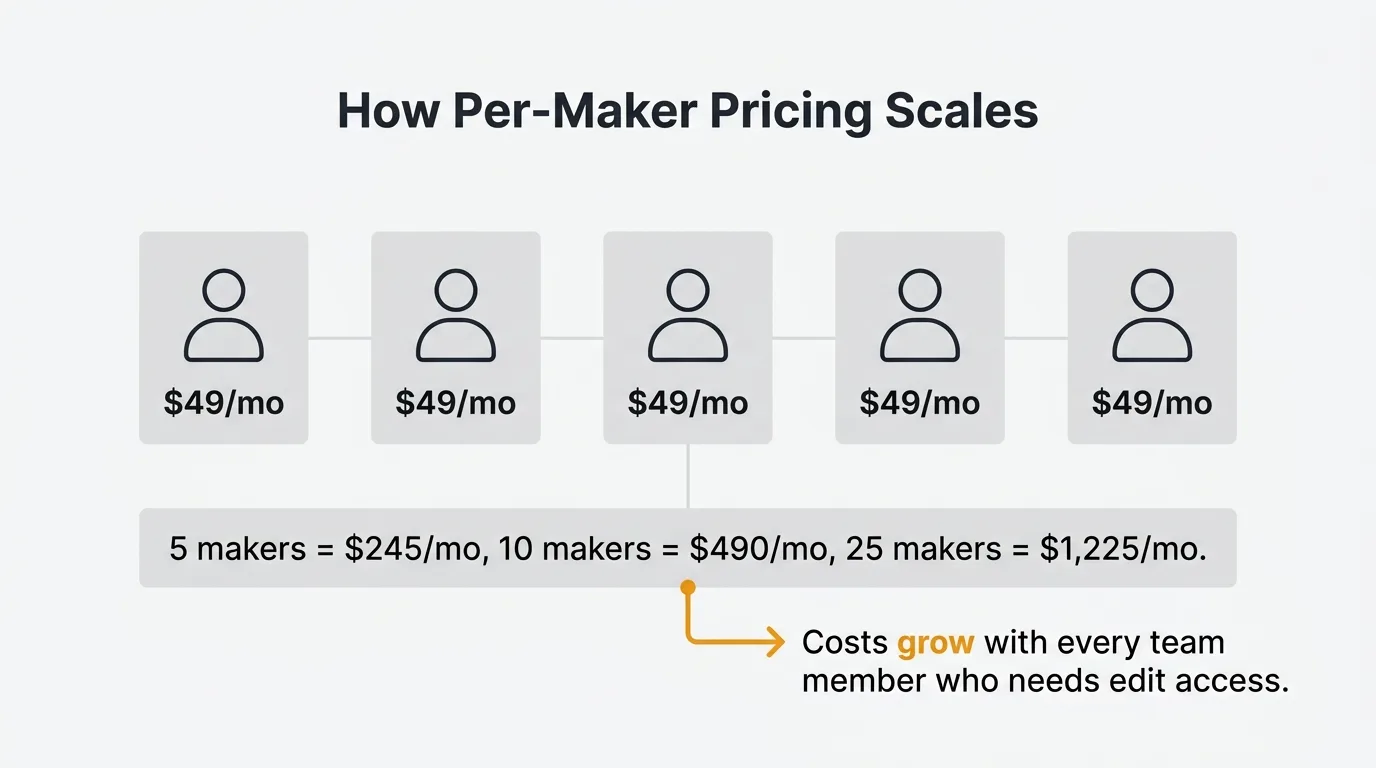
A maker is Productboard's billing unit. Anyone who creates, edits, or manages content in Productboard counts as a maker. This includes product managers, product owners, designers who update feature specs, and engineering leads who manage roadmap items.
Productboard also offers a contributor role. Contributors can view roadmaps, submit feedback through the portal, and leave comments, but they cannot create or edit features, modify prioritization scores, or manage the roadmap. Contributors are free and do not count toward your maker limit.
This distinction matters for budgeting. If you have a 10-person product team where 5 PMs actively manage the backlog and 5 engineers just need visibility, you pay for 5 makers. The 5 engineers use contributor access at no cost.
The challenge is that the maker role is broadly defined. A designer who occasionally updates a feature description counts as a maker. A support lead who logs customer feedback directly into the system rather than through the portal counts as a maker. As your organization adopts Productboard more deeply, the number of people who need maker access tends to grow beyond the original product team.
Productboard pricing at scale
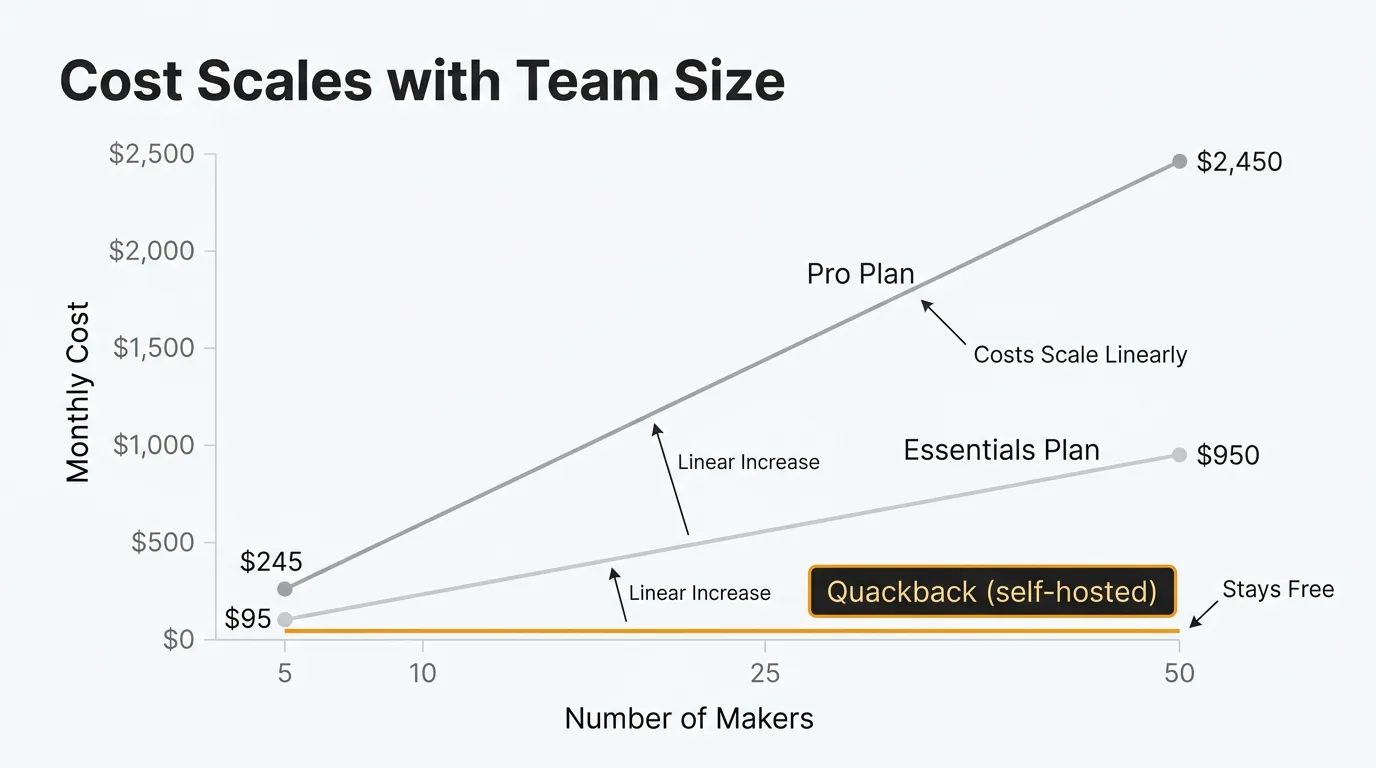
Here's what Productboard costs across team sizes on the Spark plan, based on the published annual pricing of $15/maker/mo.
| Makers | Spark (Annual) | Spark (Monthly) | Credits/Month | Annual Cost |
|---|---|---|---|---|
| 5 | $75/mo | $95/mo | 1,250 | $900/yr |
| 10 | $150/mo | $190/mo | 2,500 | $1,800/yr |
| 25 | $375/mo | $475/mo | 6,250 | $4,500/yr |
| 50 | $750/mo | $950/mo | 12,500 | $9,000/yr |
At 10 makers on the annual Spark plan, you're paying $1,800/yr. At 25 makers, it's $4,500/yr. For a 50-person product organization, annual costs reach $9,000 on the base plan. Enterprise pricing for organizations needing SSO, advanced security, and custom credit limits will be higher.
These numbers assume base Spark pricing. If your team needs more AI credits than the included 250 per maker per month, or requires enterprise features, costs increase from there.
Hidden costs
The plan prices above don't capture the full cost of running Productboard. Several expenses add up beyond the per-maker fee.
AI credits may not be enough. Productboard now includes AI via a credits system — 250 credits per maker per month on the Spark plan. Credits power insight extraction, summarization, semantic search, and auto-linking. This is an improvement over the old model where AI was a separate paid add-on. But 250 credits per maker may not go far for teams that process high volumes of feedback. If you exhaust your credits before the month ends, you either wait or negotiate additional credits with sales.
Key integrations may require enterprise pricing. Under the old tier structure, integrations like Salesforce and Zendesk were locked behind higher plans. With Spark consolidating the tiers, check whether the integrations you need are included or require an enterprise agreement. If your team relies on Salesforce opportunity data to prioritize features, confirm this is covered before committing.
SSO requires Enterprise. SAML SSO is only available on the Enterprise plan. For organizations with security policies that mandate SSO for all SaaS tools, this means skipping directly to custom Enterprise pricing. Even if your product team is small, the security requirement forces you into the most expensive tier.
No self-hosting option. Productboard is a hosted SaaS product. There is no on-premises or self-hosted deployment option. Your product data, customer feedback, and roadmap strategy live on Productboard's infrastructure. If you operate in a regulated industry or have data residency requirements, this is a constraint worth noting.
Annual contracts are the norm. While Productboard offers monthly billing, discounts are structured around annual commitments. Annual contracts mean committing thousands of dollars upfront. If your needs change within the first few months, you may still be locked into the annual term.
Onboarding and training overhead. Productboard is a deep tool with a learning curve. Setting up prioritization frameworks, configuring integrations, importing existing feedback, and training your team takes time. For large organizations, Productboard offers paid onboarding services. Even without paid services, the internal time investment is significant. Expect 2-4 weeks before your team is fully productive.
Free and cheaper alternatives
If Productboard's pricing exceeds your budget, or if you want to avoid per-maker billing entirely, these alternatives cover the core feedback-to-roadmap workflow at a fraction of the cost.
Quackback
Quackback is open source (AGPL-3.0), free to self-host, and also available as a managed cloud from $29/mo billed annually. It covers feedback boards, voting, a public roadmap, changelogs, and 25 integrations. AI features, SSO/OIDC, custom branding, and an MCP server are included free on every self-hosted installation. On Cloud, Quinn is included on paid plans, and SSO is self-serve on Enterprise. Self-host with Docker or deploy on Railway. See the full comparison of Quackback vs Productboard.
Quackback does not replicate Productboard's strategic planning layer (objectives alignment, capacity planning, portfolio roadmaps). If those features are critical to your workflow, Productboard may still be the right fit. For teams whose primary need is collecting and organizing customer feedback, Quackback covers that workflow.
Canny
Canny offers a free plan (25 tracked users) and paid tiers starting at $19/mo (Core). It covers feedback boards, voting, roadmaps, and changelogs with a polished interface. The billing model uses tiered pricing based on tracked users rather than per maker. Small teams with limited feedback volume can use Canny's free plan or Core tier affordably. But costs increase as you cross tracked user thresholds, with auto-upgrades to the next tier. The free plan caps at 25 tracked users. PM integrations like Jira require the Pro plan at $79/mo. See the full comparison of Quackback vs Canny.
Featurebase
Featurebase offers a free plan with 1 seat and limited features. Paid plans start at $29/seat/mo. The platform bundles feedback boards, a changelog, roadmap, and a support inbox into one tool. It's closed source and hosted only. The AI agent (Fibi) charges $0.49 per resolution on top of your plan cost. It covers more of the workflow than Canny but less of the strategic layer than Productboard.
Nolt
Nolt takes a simpler approach with flat-rate pricing at $29/mo per board (billed annually). No per-user billing. The feature set is minimal: feedback boards and voting with basic integrations. No changelog, no AI features, and development has slowed in recent years. It works for teams that want a simple, predictable-cost feedback board and nothing more.
Cost comparison table
Here's how Productboard compares to alternatives on the features and pricing dimensions that matter most.
| Productboard | Quackback | Canny | Featurebase | Nolt | |
|---|---|---|---|---|---|
| Starting price | $15/maker/mo (annual) | Free self-hosted / $29/mo Cloud | Free (25 tracked users) | Free (1 seat) | $29/mo |
| Pricing model | Per maker | Workspace (Cloud) or free self-hosted | Tiered by tracked users | Per seat | Per board |
| Cost for 10-person team | $150/mo (Spark annual) | $59/mo Cloud Business (20 seats) | $79+/mo (Pro tier) | $29/seat/mo (scales per paid seat) | $29/mo (1 board) |
| Self-hosting | No | Yes (Docker) | No | No | No |
| Open source | No | Yes (AGPL-3.0) | No | No | No |
| AI features | Included via credits (250/maker/mo) | Included | Autopilot (all plans) | Fibi ($0.49/resolution) | No |
| MCP server | No | Yes | No | No | No |
| SSO | Enterprise only (custom pricing) | Free self-hosted · Enterprise on Cloud | Business plan (custom pricing) | Professional ($59/seat/mo) | All paid plans |
| Integrations | Included on Spark (enterprise integrations may require custom pricing) | 20+ included | PM integrations on Pro ($79/mo) | 12 included | 8–12 |
| Roadmap | Yes (advanced, multi-view) | Yes (public) | Yes | Yes | No |
| Prioritization frameworks | Yes (custom scoring) | Community voting | Community voting | Community voting | Community voting |
Productboard's advantage is the strategic planning layer: custom prioritization scores, objectives alignment, capacity planning, and portfolio-level roadmaps. If your product organization needs that, Productboard delivers it. The alternatives listed here focus on the feedback collection and prioritization workflow and do it at a lower cost, but they don't replace Productboard's product strategy features.
For teams whose primary need is collecting customer feedback, organizing it, and sharing a roadmap, the cost difference between Productboard and simpler tools is worth evaluating carefully. A 10-maker Spark subscription costs $1,800/yr. Self-hosted and flat-rate alternatives cover the core feedback workflow at a fraction of that cost, or for free.
Try Quackback — open source with a managed cloud option. Start free. Get started | View on GitHub
Frequently asked questions
Does Productboard have a free plan?
No. Productboard does not offer a free plan. The cheapest option is the Spark plan at $15/maker/mo (annual) or $19/maker/mo (monthly). New signups get 150 free credits to trial AI. For a free tool, Quackback is open source and free to self-host.
How does Productboard's per-maker pricing work?
A maker is anyone who creates, edits, or manages content in Productboard, including product managers, designers, and engineering leads. Contributors who only view roadmaps and submit feedback are free. On Spark, your monthly cost equals makers multiplied by $15 (annual) or $19 (monthly), each with 250 AI credits.
Is Productboard AI included in the base price?
Yes. Under the Spark plan, AI features are included via a credits system. Each maker gets 250 credits per month, which power insight extraction, summarization, semantic search, and auto-linking. AI is no longer a separate paid add-on. The constraint is credit volume: heavy AI usage may find 250 credits per maker limiting.
Can I self-host Productboard?
No. Productboard is a hosted SaaS product with no self-hosting or on-premises deployment option. Your data lives on Productboard's infrastructure. If you need self-hosted product management, Quackback is open source and runs on your own servers with Docker.
What is the best alternative to Productboard for small teams?
For small teams focused on feedback collection and prioritization, Quackback is the most cost-effective alternative. It is open source, free to self-host, and includes feedback boards, voting, a public roadmap, changelogs, AI features, and 25 integrations.
For a full rundown of alternatives, see Best Productboard Alternatives, Best Customer Feedback Tools in 2026, Open Source Feedback Tools, and Feedback Tool Pricing Comparison. For teams that need Productboard's advanced features (custom prioritization frameworks, objectives alignment, capacity planning) but want to evaluate alternatives first, the Quackback vs Productboard comparison breaks down the differences feature by feature.

Authored by James Morton
Founder of Quackback. Building open-source feedback tools.
Try Quackback
The open-source feedback platform. Boards, voting, and roadmaps.
Get startedStar on GitHub305