
ServiceNow is the dominant enterprise IT service management platform. It powers ITSM, ITOM, HR service delivery, and customer service management for large organizations. If you work at a company with more than 1,000 employees, there is a good chance ServiceNow runs your internal help desk, change management, or asset tracking.
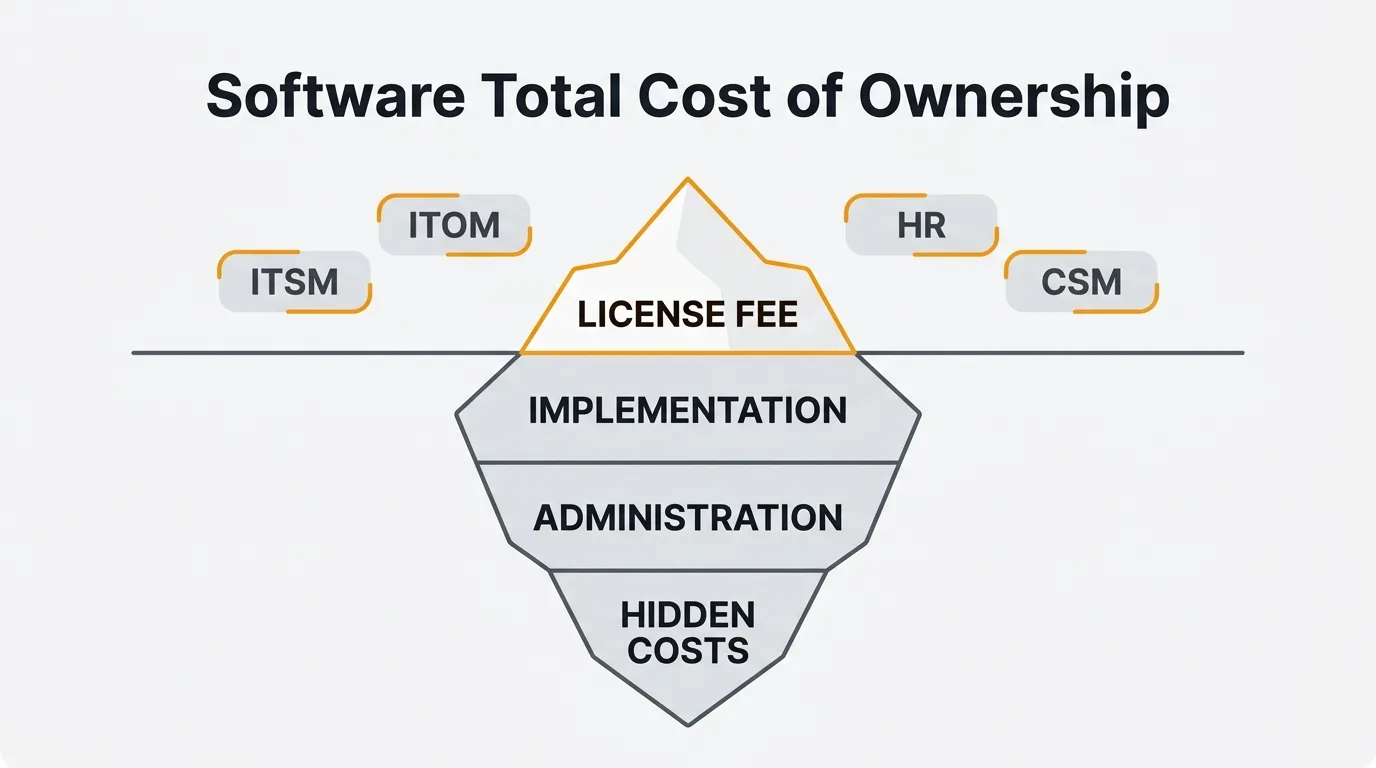
ServiceNow does not publish public pricing — every contract is a custom quote negotiated with sales. Industry estimates put ITSM at $70-$200+ per fulfiller per month depending on tier, with the Now Assist AI add-on adding a 50-60% uplift and implementation typically costing 3-5x the first-year license fee. A mid-market organization of 50 fulfillers should budget $500K-$2M for year one including implementation, and enterprise buyers routinely negotiate 40-50% off list prices.
Pricing last verified March 2026. ServiceNow does not publish public pricing. All figures are industry estimates from multiple sources. Actual pricing varies by contract size, modules, and negotiation. Contact ServiceNow for a quote.
ServiceNow's pricing model is fundamentally different from most SaaS tools. There is no pricing page, no self-serve signup, and no transparent per-user rate card. Everything is negotiated. The cost depends on which modules you license, how many fulfillers (agents) you have, what add-ons you select, and how much leverage you bring to the negotiation. For comparison, alternatives like Zendesk and Jira Service Management publish their pricing publicly.
How ServiceNow pricing works
ServiceNow uses a subscription model with several key dimensions. Understanding these dimensions is essential before entering a sales conversation.
Fulfiller-based licensing. You pay per fulfiller — the agents and admins who work within the platform. End users who submit tickets through a self-service portal generally do not count as fulfillers. The distinction matters: a 5,000-employee company might have only 50-100 fulfillers, but the licensing cost is based on that fulfiller count, not total headcount. Organizations with 1,000+ users sometimes see rates drop to $50-$75/fulfiller/month due to volume.
Module-based pricing. Each product area (ITSM, ITOM, HR Service Delivery, Customer Service Management, SecOps) is a separate module with its own pricing. You pick the modules you need and pay for each one. Bundling multiple modules may yield discounts, but each addition increases your annual commitment. Some modules have user minimums — you cannot buy a single seat.
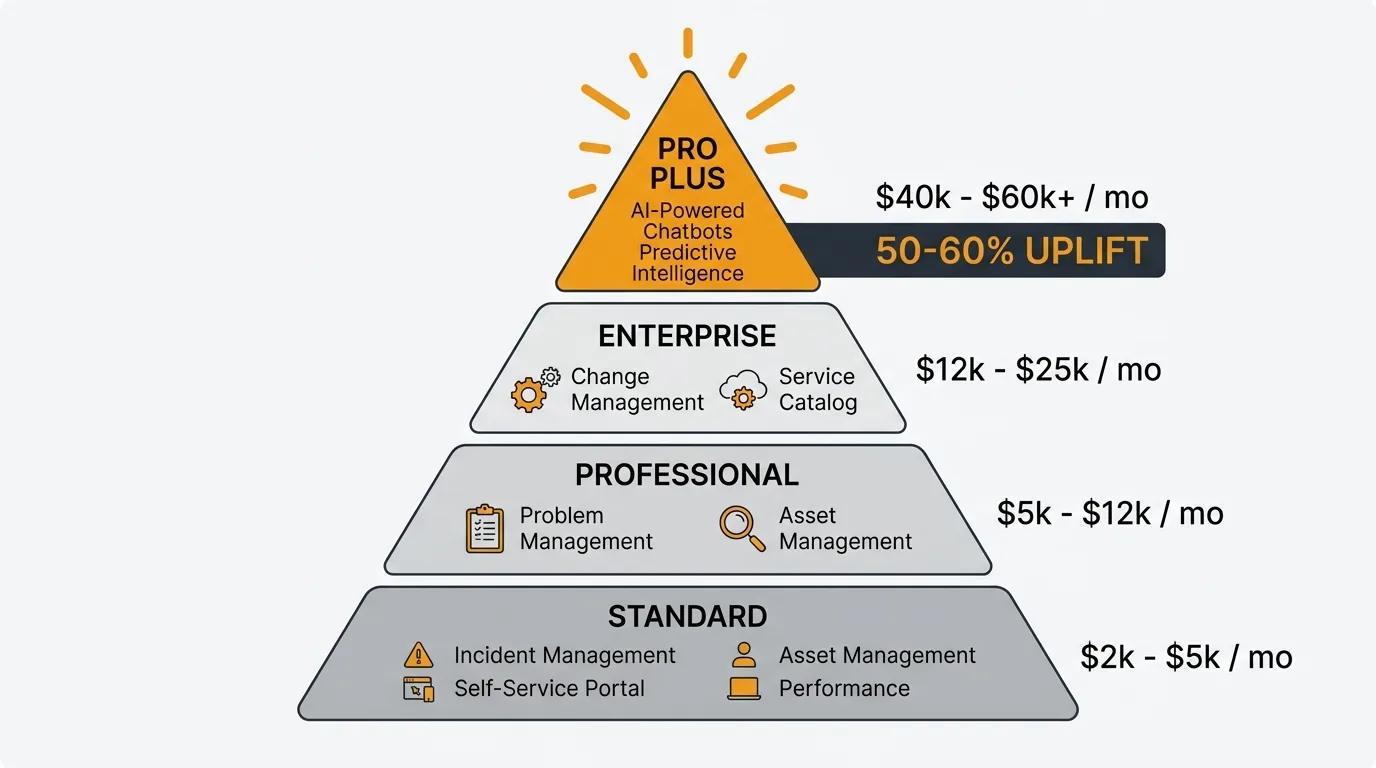
Tier-based feature access. Within each module, ServiceNow offers tiers (Standard, Professional, Enterprise, Pro Plus) that unlock progressively more features. Higher tiers cost more per fulfiller. The Pro Plus tier includes AI capabilities (Now Assist) and adds a 50-60% uplift.
Custom quotes only. There is no public price list. Every contract is negotiated directly with ServiceNow's sales team. Pricing depends on deal size, contract length, and your organization's negotiating position. The average annual contract value from public data is approximately $130,000, but this reflects a wide distribution from $50,000 mid-market deals to multi-million-dollar enterprise contracts.
Annual billing with multi-year commitments. ServiceNow contracts are billed annually, typically with 2-3 year commitments. Annual price escalators of 3-7% are standard. Your year-three cost is higher than your year-one cost even if nothing else changes.
ITSM pricing tiers
ITSM is ServiceNow's core product and the module most organizations start with. Here are the estimated per-fulfiller costs based on industry data.
| Tier | Est. Cost (per fulfiller/month) | Est. with AI Uplift | Key Features |
|---|---|---|---|
| ITSM Standard | $70-$100 | $105-$160 | Incident management, knowledge management, self-service portal, basic SLA management |
| ITSM Professional | $120-$150 | $180-$240 | Standard + Performance Analytics, Vendor Manager Workspace |
| ITSM Enterprise | $160-$200+ | $240-$320+ | Professional + Workforce Optimization, Process Mining |
ITSM Standard covers the basics: incident management, a knowledge base, a self-service portal for end users, and SLA management. Most organizations start here. At $70-$100/fulfiller/month, it is the entry point — but still significantly more expensive than alternatives like Jira Service Management ($19/agent/month) or Freshservice ($19/agent/month).
ITSM Professional adds Performance Analytics for reporting on team efficiency and SLA compliance, plus Vendor Manager Workspace for tracking third-party service providers. The jump from Standard to Professional is roughly $50/fulfiller/month — a meaningful premium for analytics and vendor management capabilities.
ITSM Enterprise layers on Workforce Optimization (agent scheduling, capacity planning) and Process Mining (automated workflow analysis). These features matter for large service desks with hundreds of agents where optimizing agent utilization directly impacts cost.
Pro Plus (Now Assist AI) is ServiceNow's generative AI add-on. It adds auto-generated incident summaries, suggested resolutions, conversational search, and AI-assisted knowledge article creation. The cost is a 50-60% uplift on your base tier price. At the Enterprise tier, that means an estimated $240-$320+ per fulfiller per month. In 2026, ServiceNow is also shifting toward consumption-based pricing for some AI features — "Assist" tokens and orchestration transactions may have monthly caps, with overage charges if limits are exceeded. Get clarity on this before signing.
Other module pricing
ServiceNow's platform extends well beyond ITSM. Each additional module is a separate line item with its own per-fulfiller pricing.
| Module | Est. Cost (per fulfiller/month) | Est. Annual (10 fulfillers) | Key Capabilities |
|---|---|---|---|
| ITOM | $150-$200 | $18,000-$24,000 | Discovery, service mapping, event management, cloud management |
| HR Service Delivery | $120-$180 | $14,400-$21,600 | Employee service center, case management, onboarding workflows |
| CSM | $150-$200 | $18,000-$24,000 | Customer support workflows, case management, customer portals |
| SecOps | $150-$250 | $18,000-$30,000 | Security incident response, vulnerability management |
| AI & Analytics Add-ons | $50-$100+ | $6,000-$12,000 | Advanced analytics, AI agents, predictive intelligence |
ITOM (IT Operations Management) is typically purchased alongside ITSM for organizations that want visibility into their infrastructure. At $150-$200/fulfiller/month, it is one of the more expensive modules but covers critical capabilities like automated discovery and service mapping.
HR Service Delivery powers employee service centers, case management, and onboarding workflows. The fulfiller count here is HR team members, not all employees. At $120-$180/fulfiller/month, a 10-person HR team adds $14,400-$21,600/year to your ServiceNow bill.
Customer Service Management (CSM) covers external-facing customer support workflows. Pricing varies widely based on scope and integration requirements. CSM tends to be one of the more expensive modules because it overlaps with dedicated customer support platforms like Zendesk and Intercom that cost a fraction of the price for most use cases.
Integration licensing is a hidden cost. Connecting ServiceNow to Slack, Salesforce, Jira, or other tools may require additional hub licenses beyond the base module pricing.
Each module you add increases your annual commitment. Organizations that start with ITSM often expand into ITOM, then HR, then CSM over several years. ServiceNow's sales motion is built around this land-and-expand pattern. Industry data on typical discounts by module: ITSM 40-50% off list, ITOM 35-55% off, HR Service Delivery 55-70% off. Newer and less popular modules tend to carry deeper discounts because ServiceNow is incentivized to drive adoption.
ServiceNow pricing at scale
Here is what ServiceNow ITSM costs at different scales, using the mid-range of industry estimates.
| Fulfillers | ITSM Standard (Est. Annual) | ITSM Professional (Est. Annual) | ITSM Enterprise (Est. Annual) |
|---|---|---|---|
| 10 | $10,200-$12,000 | $14,400-$18,000 | $19,200-$24,000 |
| 50 | $42,000-$60,000 | $72,000-$90,000 | $96,000-$120,000 |
| 100 | $84,000-$120,000 | $144,000-$180,000 | $192,000-$240,000 |
| 500 | $420,000-$600,000 | $720,000-$900,000 | $960,000-$1,200,000 |
These figures are license costs only for a single module (ITSM). They do not include implementation, customization, additional modules, or AI add-ons. The average ServiceNow contract value from public data is approximately $130,000 annually, which reflects a wide range of deal sizes from mid-market to large enterprise.
At 500 fulfillers on ITSM Enterprise, license costs alone can exceed $1M annually. Add ITOM, HR Service Delivery, and the Now Assist AI uplift, and total license fees can reach $3M+ per year for large organizations.
The real total cost of ownership
The license fee is only one part of what ServiceNow actually costs. The total cost of ownership is significantly higher — and this is where most organizations underestimate.
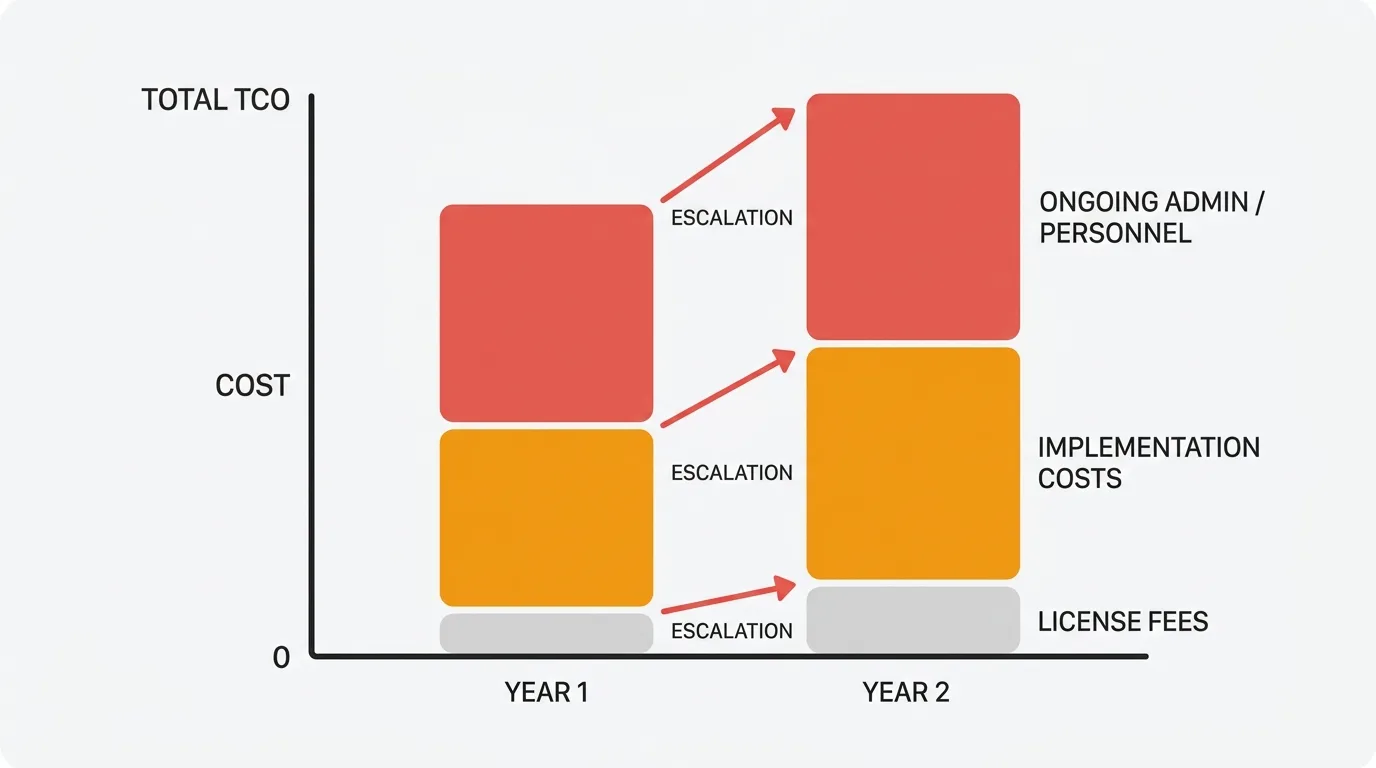
Implementation multiplier: 3-5x license cost. ServiceNow implementations are complex. They involve workflow design, integration with existing systems (Active Directory, email, monitoring tools, asset databases), data migration, user training, and change management. Industry data consistently shows implementation costs at 3-5x the first-year license fee. A $200,000 annual license translates to $600,000-$1,000,000 in implementation costs. Implementation partner fees range from $30,000 for basic setups to $450,000+ for full enterprise deployments.
First-year total for mid-market. A mid-market organization (50 fulfillers) licensing ITSM can expect $150,000-$400,000 in annual license fees and $500,000-$2,000,000 in total first-year costs when implementation is included. Here is a realistic cost breakdown:
| Cost Category | Mid-Market (50 fulfillers) | Enterprise (500 fulfillers) |
|---|---|---|
| ITSM License (annual) | $150,000-$400,000 | $420,000-$1,200,000 |
| Implementation | $150,000-$450,000 | $500,000-$2,000,000 |
| Admin Personnel (annual) | $100,000-$300,000 | $300,000-$750,000 |
| Training & Change Mgmt | $30,000-$75,000 | $100,000-$250,000 |
| First-Year Total | $430,000-$1,225,000 | $1,320,000-$4,200,000 |
| Annual Ongoing (Year 2+) | $250,000-$700,000 | $720,000-$1,950,000 |
Ongoing administration. ServiceNow is not a set-and-forget platform. Most organizations require 1-3 dedicated full-time ServiceNow administrators to manage the instance, build workflows, handle upgrades, and support users. Certified ServiceNow administrators command $120,000-$175,000 annually in the US market. If your admin leaves, replacing them takes time and often requires expensive contractors ($150-$200/hour) to bridge the gap.
Multi-year contracts with escalators. ServiceNow typically requires multi-year commitments (2-3 years). Annual price escalators of 3-7% are standard. On a $300,000/year contract with a 5% escalator, you pay $315,000 in year two and $330,750 in year three — an additional $45,750 over the contract without any changes to scope or usage.
How to negotiate ServiceNow pricing
ServiceNow pricing is always negotiable. Here are strategies that enterprise buyers use to reduce costs.
Start negotiations 6-12 months before renewal. ServiceNow's sales team gains leverage as your contract expiration approaches. Starting early gives you time to evaluate alternatives, benchmark pricing, and avoid being pressured into quick decisions. Do not let negotiations get squeezed into the final weeks.
Negotiate by module, not by bundle. ServiceNow will often propose bundled pricing that looks like a discount but hides unfavorable terms on individual modules. Negotiate pricing for each module separately. Industry data shows typical discounts of 40-50% off list for ITSM, 35-55% for ITOM, and 55-70% for HR Service Delivery.
Bring usage data to the table. Use ServiceNow's own analytics tools to identify unused licenses and underutilized modules. Showing data on actual versus purchased usage gives you leverage to right-size your contract. Unused licenses should be eliminated or converted.
Escalate strategically. Executive escalation can unlock deeper discounts. One documented case showed a CIO escalating and increasing the discount from 25% to 45% by clearly articulating budget constraints and the availability of alternatives.
Secure price protections. Negotiate future price caps, renewal rate protections, or swap rights for products and volumes you are not using. Without protections, the standard 3-7% annual escalator can add up to 20%+ over a three-year term.
Time purchases around fiscal quarters. ServiceNow's sales team is quota-driven. Deals closed at the end of a fiscal quarter or fiscal year often carry better discounts as reps push to hit their numbers.
Push back on ServiceNow Impact. ServiceNow Impact is a premium support and success offering that gets bundled into deals. Industry analysts note that ServiceNow needs Impact in your deal more than you need Impact. Negotiate for reduced percentages or connect Impact pricing to product pricing for better overall terms.
Hidden costs
Beyond the sticker price and implementation, there are costs that catch organizations off guard.
Module expansion tax. ServiceNow's platform is designed to pull you into additional modules over time. Each module you add is a new line item with its own per-fulfiller pricing. What starts as an ITSM deployment can grow into ITSM + ITOM + HR + CSM, with total license costs multiplying several times over. This land-and-expand model is intentional — ServiceNow's growth depends on it.
AI add-on uplift. Now Assist (the Pro Plus AI SKU) adds a 50-60% uplift on your base license cost. For an ITSM Enterprise customer paying $200/fulfiller/month, the AI add-on pushes costs to $300-$320/fulfiller/month. That is a significant premium for AI features that many competitors — like Freshservice (Freddy AI included on higher tiers) and Jira Service Management — include in their base pricing.
No free trial or self-serve signup. You cannot try ServiceNow before committing. The sales process requires discovery calls, demos, and contract negotiation. This is a significant barrier for mid-market organizations that want to evaluate the platform before signing a multi-year commitment.
No self-hosting option. ServiceNow is a cloud-only platform. There is no on-premises or self-hosted deployment. For organizations with strict data residency or sovereignty requirements, this limits your options.
Test environment fees. ServiceNow provides standard production and non-production environments, but additional test environments — often needed for larger implementations — carry extra fees.
Security add-ons are separate. Advanced encryption features and security modules (SecOps) are not included in base ITSM pricing. If your compliance requirements demand these capabilities, budget for them separately.
Customization lock-in. The more you customize ServiceNow — custom workflows, integrations, scripts, and configurations — the harder it becomes to migrate away. Heavy customization also complicates upgrades, which can require re-testing and re-validating custom code. This technical debt is a real cost that grows over time.
SSO is typically included at enterprise tier. Unlike some tools that gate SSO behind premium plans, ServiceNow generally includes SSO at the enterprise level. But you are already paying enterprise-tier pricing to get there.
ServiceNow alternatives
If ServiceNow's pricing and complexity do not match your organization's size or budget, there are alternatives worth evaluating. The cost difference can be dramatic.
| Tool | Starting Price | Best For |
|---|---|---|
| Jira Service Management | $19.04/agent/mo | Mid-market ITSM with Atlassian ecosystem |
| Freshservice | $19/agent/mo | Mid-market ITSM with simpler setup |
| Zendesk | $55/agent/mo | Help desk and customer support |
| ServiceNow ITSM Standard | $70-$100/fulfiller/mo (est.) | Enterprise ITSM at scale |
Jira Service Management
Atlassian's ITSM product. A free plan supports up to 3 agents. Standard starts at $19.04/agent/month. Premium is $47.82/agent/month. Jira Service Management covers incident management, change management, asset management, and SLA tracking. It lacks ServiceNow's depth in ITOM and HR but costs a fraction of the price for small-to-mid-size teams. At 50 agents on Standard, you pay roughly $11,424/year — compared to $42,000-$60,000/year for ServiceNow ITSM Standard at the same scale. The Atlassian ecosystem (Confluence, Jira Software) provides tight integration.
Freshservice
Freshworks' ITSM product. Starter begins at $19/agent/month, Growth is $49/agent/month, and Pro is $99/agent/month (billed annually); Enterprise is custom-quoted. Freshservice covers the core ITSM workflows with a simpler setup process and lower implementation costs. Freddy AI is a paid add-on rather than the 50-60% platform-wide uplift ServiceNow's Now Assist carries. A strong option for mid-market organizations that need ITSM without ServiceNow's complexity or cost. At 50 agents on Growth, you pay roughly $29,400/year.
Zendesk
Primarily a customer support platform, but Zendesk's Suite plans ($55-$115/agent/month) cover ticket management, knowledge bases, and self-service portals that overlap with basic ITSM use cases. Not a full ServiceNow replacement, but sufficient for organizations whose primary need is a help desk rather than enterprise-grade ITSM.
Quackback for the feedback layer
ServiceNow handles IT service management, but it is not built for collecting product feedback from end users. If you need feature request boards, public voting, a customer-facing roadmap, or changelogs, ServiceNow does not cover that workflow. Quackback is open source and self-hostable. It handles the feedback collection layer — boards, voting, roadmaps, changelogs, and 25 integrations — that enterprise ITSM platforms leave out. Run it free on your own infrastructure with self-hosting, or use the managed Quackback Cloud if you would rather not operate it yourself.
Try Quackback — open source with a managed cloud option. Start free. Get started | View on GitHub
Frequently asked questions
Does ServiceNow publish its pricing?
No. ServiceNow does not have a public pricing page. All pricing is custom and requires a conversation with their sales team. The estimates in this guide are based on industry data and publicly available contract information. This opacity is intentional — it gives ServiceNow maximum flexibility in negotiations.
How much does ServiceNow cost per year?
It varies widely. Mid-market organizations (50 fulfillers) typically pay $150,000-$400,000 annually for ITSM licensing. Enterprise organizations (500+ fulfillers) with multiple modules can pay $1M-$3M+ annually. Total first-year costs including implementation run 3-5x higher than the license fee alone. The average annual contract value from public data is approximately $130,000.
What is a fulfiller in ServiceNow?
A fulfiller is a licensed user who works within the ServiceNow platform — agents who resolve tickets, admins who configure workflows, and managers who use reporting. End users who submit requests through a self-service portal are generally not counted as fulfillers. The distinction matters for budgeting: a 5,000-employee company might only license 50-100 fulfillers.
How much does Now Assist (AI) cost?
Now Assist is ServiceNow's generative AI add-on, sold as the Pro Plus SKU. It adds an estimated 50-60% uplift on top of your base tier pricing. For an ITSM Professional customer at $135/fulfiller/month, the AI add-on brings the total to approximately $200-$215/fulfiller/month. In 2026, ServiceNow is also introducing consumption-based pricing for some AI features with token caps and potential overages.
Can I self-host ServiceNow?
No. ServiceNow is a cloud-only platform with no self-hosting or on-premises deployment option.
What is the average ServiceNow contract value?
Public data puts the average annual contract value at approximately $130,000. This reflects a wide distribution — smaller deals in the $50,000-$100,000 range and large enterprise contracts well above $1M annually.
What discounts can I negotiate?
Enterprise buyers routinely secure 40-50% off list prices for core ITSM modules. Newer modules like HR Service Delivery may carry discounts of 55-70%. Timing matters — end-of-quarter deals tend to carry better discounts. Start negotiations 6-12 months before contract expiration for maximum leverage.
How does ServiceNow compare to Jira Service Management on cost?
At 50 agents, Jira Service Management Standard costs roughly $11,424/year. ServiceNow ITSM Standard at the same scale costs an estimated $42,000-$60,000/year — 4-5x more. Jira Service Management also includes a free plan (3 agents) and has a simpler implementation process. ServiceNow's advantage is depth: it handles ITOM, HR, and CSM in ways that Jira does not. The question is whether that depth justifies the cost difference for your organization.
Is ServiceNow worth the cost?
For large enterprises with complex ITSM requirements, hundreds of agents, and the budget for proper implementation, ServiceNow is the market leader for a reason. The platform is deep, the ecosystem is mature, and it scales to very large organizations. For mid-market companies or teams with simpler requirements, the total cost of ownership — license fees, implementation, ongoing administration — may be difficult to justify when alternatives like Jira Service Management or Freshservice cover the core workflows at a fraction of the cost.

Authored by James Morton
Founder of Quackback. Building open-source feedback tools.
Try Quackback
The open-source feedback platform. Boards, voting, and roadmaps.
Get startedStar on GitHub262