
Zendesk is the most widely used customer support platform in the world. Millions of support agents use it daily across companies of every size, from early-stage startups to large enterprises. The product has been around since 2007 and has grown into a broad suite covering ticketing, live chat, phone, email, a help center, and AI-powered automation.
The pricing reflects that scale. Zendesk's Suite plans are priced per agent per month, billed annually. Costs grow linearly with your team size, and a range of add-ons can meaningfully increase what you pay.
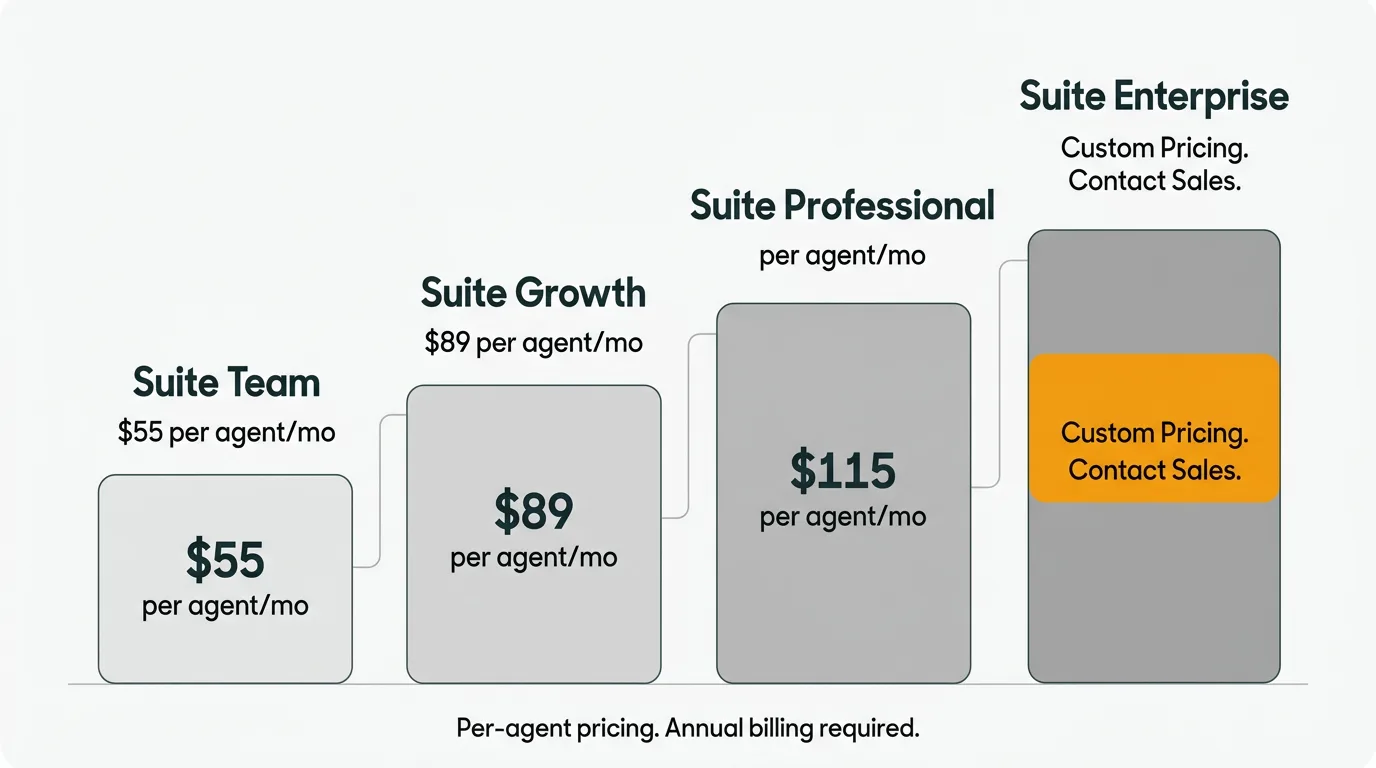
Zendesk Suite starts at $55/agent/month billed annually and scales to $115/agent/month for Professional, with Enterprise priced through sales. Add-ons — Advanced AI, Workforce Management, Quality Assurance — can each add $35 to $50/agent/month on top. Zendesk handles support tickets well, but feature request tracking, public voting boards, and product roadmaps need a separate tool. Quackback integrates directly with Zendesk and is free to self-host.
Pricing last verified February 2026. Vendors may change plans and pricing without notice. Check Zendesk's pricing page for the latest figures.
Zendesk Suite pricing plans
Zendesk's main offering is the Suite — a bundle that combines ticketing, messaging, live chat, voice, a help center, and AI features in one package. In 2026, Zendesk offers four Suite tiers.
| Plan | Price | Key Features |
|---|---|---|
| Suite Team | $55/agent/mo (annual) | Ticketing, email, chat, social messaging, help center, basic reporting, 1 AI agent |
| Suite Growth | $89/agent/mo (annual) | Everything in Team + self-service portal, customer satisfaction ratings, multilingual support, multiple ticket forms |
| Suite Professional | $115/agent/mo (annual) | Everything in Growth + custom reporting, SLAs, CSAT surveys, skills-based routing, community forums |
| Suite Enterprise | Custom (sales) | Everything in Professional + custom roles, sandbox, advanced AI, dedicated support |
Suite Team is the entry point. It covers the essentials: a shared inbox, email ticketing, live chat, social messaging channels, a basic help center, and standard reporting. One AI agent is included. For small support teams that need a centralized place to handle customer requests, it delivers what you need.
Suite Growth adds self-service features: a customer portal, customer satisfaction (CSAT) ratings, multiple ticket forms, and multilingual support. If you support customers in more than one language or want customers to manage their own requests without involving an agent, Growth is the minimum viable tier.
Suite Professional is where custom reporting and SLA management arrive. Skills-based routing lets you direct tickets to agents based on expertise or language. Community forums give your users a place to ask questions publicly. This tier is common among teams with dedicated support operations and formal service level commitments.
Suite Enterprise is custom-priced through sales. It adds custom agent roles, a staging sandbox, advanced AI capabilities, and dedicated support from Zendesk.
Per-agent pricing explained
Every support agent who handles tickets needs a paid seat. Zendesk's per-agent model means your costs scale directly with your team size.
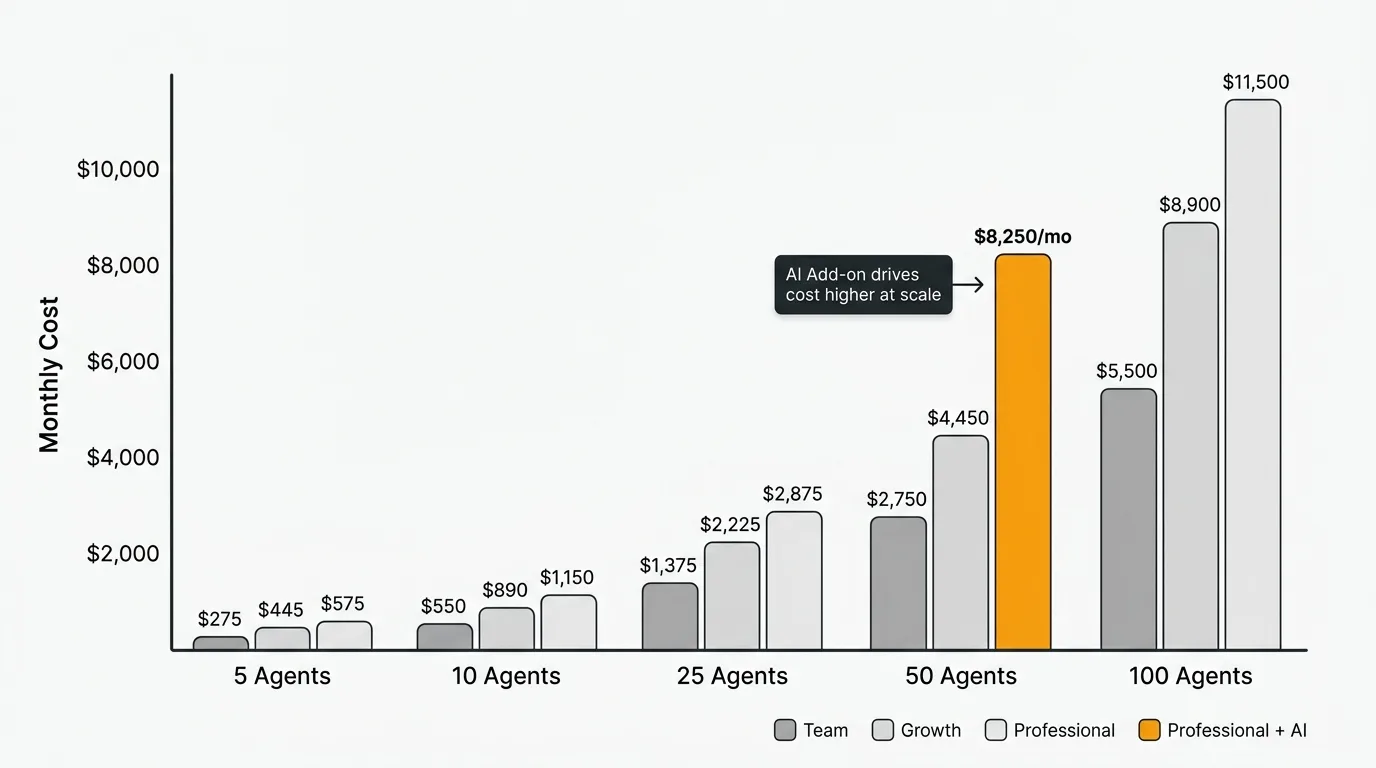
At $55/agent/month on Suite Team, a team of 10 agents costs $550/month, or $6,600/year. At $115/agent/month on Suite Professional, the same team costs $1,150/month, or $13,800/year. There is no volume discount published on lower tiers — the price per agent stays flat regardless of how many seats you add.
| Team Size | Suite Team ($55) | Suite Growth ($89) | Suite Professional ($115) |
|---|---|---|---|
| 5 agents | $275/mo | $445/mo | $575/mo |
| 10 agents | $550/mo | $890/mo | $1,150/mo |
| 25 agents | $1,375/mo | $2,225/mo | $2,875/mo |
| 50 agents | $2,750/mo | $4,450/mo | $5,750/mo |
| 100 agents | $5,500/mo | $8,900/mo | $11,500/mo |
Zendesk also offers Light Agents — collaborators who can view and comment on tickets internally but cannot respond to customers directly. Light Agents are included at no additional cost on Suite plans, which is useful for product managers, engineers, or account managers who need visibility into support without taking a full agent seat.
All Suite pricing is billed annually. Month-to-month pricing is available but at a higher per-agent rate. Zendesk does not publish the exact month-to-month premium publicly — plan for at least 20–30% more if you need flexibility.
Add-on costs
Zendesk's base Suite plans cover the core support workflow, but several high-value capabilities require separate add-ons. These are the ones that most commonly appear in renewal conversations.
Advanced AI — $50/agent/month. Zendesk's Advanced AI add-on includes intelligent triage (automatic intent, sentiment, and language detection), agent copilot (suggested replies, conversation summaries, next-step recommendations), and enhanced macro suggestions. This is separate from the basic AI agent included in Suite Team. For teams that want AI-assisted triage and drafting, this is the relevant add-on.
Workforce Management — $35/agent/month. Forecasting, scheduling, and real-time adherence tools for managing agent capacity. Relevant for teams large enough to need formal workforce planning — typically 25+ agents.
Quality Assurance — $35/agent/month. Automated conversation review, CSAT scoring analysis, and agent coaching workflows. Helps support managers identify quality issues without manually reviewing every ticket.
Zendesk Voice. Phone support is available as a consumption-based add-on within Zendesk Talk. You pay per minute for inbound and outbound calls in addition to your Suite subscription. Costs depend heavily on call volume and geography.
If a 25-agent team on Suite Professional adds Advanced AI and Quality Assurance, the all-in cost is $115 + $50 + $35 = $200/agent/month — $5,000/month total, or $60,000/year. Add Workforce Management and it reaches $235/agent/month, or $70,500/year for 25 agents.
Zendesk pricing at scale
The table below shows monthly costs across plan tiers at common team sizes, without add-ons.
| Team Size | Suite Team | Suite Growth | Suite Professional |
|---|---|---|---|
| 10 agents | $550/mo | $890/mo | $1,150/mo |
| 25 agents | $1,375/mo | $2,225/mo | $2,875/mo |
| 50 agents | $2,750/mo | $4,450/mo | $5,750/mo |
| 100 agents | $5,500/mo | $8,900/mo | $11,500/mo |
These are the base costs before add-ons. Most teams at 25+ agents operating a serious support function end up on Professional or higher. Teams that adopt Advanced AI add $50/agent/month on top of that. At 50 agents on Professional with Advanced AI, the monthly cost is $8,250 — nearly $100,000/year.
What Zendesk does well
Zendesk's strength is omnichannel support. It handles email, live chat, social messaging (Twitter/X, Facebook, Instagram, WhatsApp), phone, and web forms through a single agent workspace. Agents see the full conversation history across channels in one place without switching between tools.
The help center is a full knowledge base with multilingual support, article versioning, and a customer-facing portal. Community forums are available on Professional and higher. The reporting suite is solid, and custom dashboards on Professional let you build exactly the views your team needs.
Zendesk's marketplace has over 1,500 integrations. Salesforce, HubSpot, Jira, Slack, Shopify, and nearly every major SaaS tool has a native connector or a well-maintained third-party app. This makes Zendesk a reliable anchor for a broader customer operations stack.
For teams whose primary workflow is resolving customer support tickets — handling volume, routing requests to the right agent, tracking resolution time, and measuring customer satisfaction — Zendesk does this better than almost any competing platform.
What Zendesk doesn't cover
Zendesk is a support platform. It is not a product feedback tool.
There is no native feature request board. Customers cannot submit and vote on product ideas. There is no public-facing roadmap for sharing what you're building next. There is no changelog for announcing what just shipped.
This is by design, not an oversight. Zendesk's job is to help your support team resolve tickets efficiently. The workflow ends when the ticket closes. What happens to the underlying product feedback — the feature request buried in a conversation, the bug report that three different customers mentioned this month — is not something Zendesk tracks or organizes.
For support teams, this gap shows up in a specific way. Agents know which feature requests come up repeatedly, but there is no structured place to capture that signal. The information lives in ticket comments, internal notes, or spreadsheets someone maintains manually. It does not flow to product teams in any systematic form.
This is where a dedicated feedback tool becomes relevant — not as a replacement for Zendesk, but as an addition to it. For a full rundown of the tools built for this job, see Best Zendesk Alternatives for Customer Feedback in 2026.
Pairing Zendesk with a feedback tool
Quackback is built to work alongside Zendesk, not replace it.
Support stays in Zendesk. Feature requests, voting, roadmaps, and changelogs live in Quackback. The integration connects the two so the feedback signal that surfaces in support tickets has a place to go.
In practice, the Quackback sidebar widget appears inside the Zendesk agent interface. When a customer mentions a feature request in a support conversation, the agent can search Quackback directly, find the relevant feature request, and vote on the customer's behalf without leaving Zendesk. The customer's vote is attributed to them in Quackback, and the support ticket can be linked to the feature request for context.
On the product team's side, Quackback shows which feature requests have the most support, with each vote tied to a real customer. When a request ships, Quackback's changelog notifies every customer who voted. The loop closes without any manual coordination between support and product.
This is a different workflow from trying to track feature requests inside Zendesk with tags or custom fields. Tags tell you a topic came up — they do not give you a ranked list of what customers most want, tied to the customers who asked for it.
Quackback is free to self-host (open source, AGPL-3.0) and covers feedback boards, voting, a public roadmap, changelogs, and integrations including Zendesk. Unlike Zendesk's per-agent model, everyone on your team can read and triage feedback. An MCP server lets you query and update feedback from Claude or any AI client. A managed Quackback Cloud is also available if you would rather not host it yourself.
For a broader look at the feedback tool category, see Best Customer Feedback Tools in 2026, Best Feature Request Tools, and Feedback Tool Pricing Comparison.
Try Quackback — open source with a managed cloud option. Start free. Get started | View on GitHub
Frequently asked questions
How much does Zendesk cost per month?
Zendesk Suite starts at $55/agent/month billed annually, scaling to $115/agent/month on Professional. A team of 10 agents costs $550/month on Suite Team or $1,150/month on Professional. Add-ons such as Advanced AI ($50/agent/mo) are billed separately, and Enterprise pricing is quoted through sales.
Does Zendesk have a free plan?
Zendesk does not offer a permanent free plan for its Suite product. A free trial is available. The entry-level paid plan is Suite Team at $55/agent/month billed annually. There is no self-serve free tier. If you are looking for a free tool for collecting feature requests and managing a product roadmap alongside Zendesk, Quackback is free to self-host and integrates with Zendesk.
Does Zendesk handle feature requests and roadmaps?
Zendesk is a support platform, not a product feedback tool. It does not have native feature request boards, public voting, or product roadmaps. Support agents can tag tickets and add internal notes, but there is no structured system for capturing and prioritizing product feedback. Teams that need feature request tracking alongside Zendesk typically add a dedicated tool. Quackback integrates with Zendesk and is built specifically for this workflow.
Is Zendesk worth the price?
For teams whose primary need is omnichannel customer support at scale, Zendesk's pricing is competitive relative to its capabilities. The breadth of channel support, the quality of the agent workspace, and the depth of the integration marketplace are genuine strengths. The cost adds up fast for larger teams, and add-ons like Advanced AI can push per-agent costs to $165–$200/month. Whether it is worth it depends on your team size, the volume and complexity of your support operations, and which features you actually use.

Authored by James Morton
Founder of Quackback. Building open-source feedback tools.
Try Quackback
The open-source feedback platform. Boards, voting, and roadmaps.
Get startedStar on GitHub305