
Product strategy is the bridge between your company vision and your daily execution. It answers one question: why are we building this and not something else?
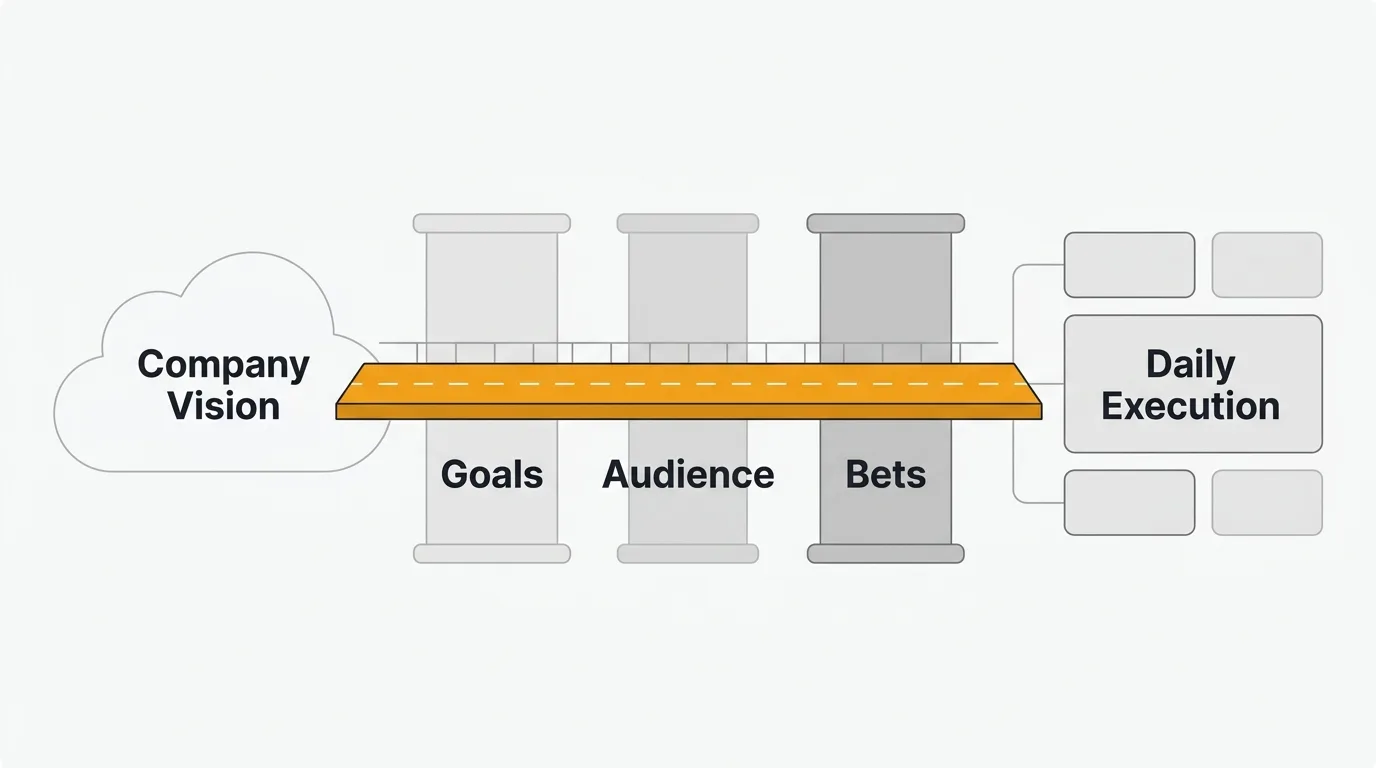
Without a product strategy, teams build features that don't compound. Engineers ship what's loudest in the backlog. Designers solve problems in isolation. Product managers spend their days reacting to requests instead of directing effort toward outcomes that matter. Everyone stays busy, but the product drifts.
A good product strategy gives your team a framework for saying no. It connects the features you ship today to the business outcomes you need this quarter and the vision you are working toward over the next few years. It turns a pile of feature requests into a coherent plan.
What is a product strategy
A product strategy is a set of deliberate choices about who your product serves, what problems it solves, and how it wins against alternatives. It defines the direction, not the details. The details come later in your roadmap and backlog.
Roger Martin's "Playing to Win" framework distills strategy down to five choices: winning aspiration, where to play, how to win, capabilities required, and management systems. Product strategy follows the same logic. You choose a market, define how your product wins in that market, and align your team around those choices.
This distinction matters because teams regularly confuse a product strategy with adjacent artifacts:
- A roadmap is not a product strategy. A roadmap describes what you plan to build and roughly when. It is an output of your strategy, not the strategy itself.
- A backlog is not a product strategy. A backlog is a prioritized list of tasks. It is a tool for execution. If your strategy is just your backlog, you are letting urgency drive direction.
- A business plan is not a product strategy. A business plan covers revenue models, market sizing, and financial projections. Your product strategy should support your business plan, but it operates at a different level — closer to the product, closer to the user.
A product strategy sits above all three. It is the reasoning that explains why your roadmap looks the way it does, why certain backlog items rank higher than others, and why your product decisions support the business model.
Here is a concrete example. A B2B feedback tool might set its product strategy as: "Win mid-market SaaS teams (50-500 employees) by being the only feedback platform that connects feature requests directly to a public roadmap, with AI that reduces triage time by 80%." That single statement defines the audience (mid-market SaaS), the differentiator (feedback-to-roadmap connection plus AI), and the measurable claim (80% triage reduction). Every roadmap decision flows from it.
The components of a product strategy
Every product strategy worth the name includes five components. You don't need a 40-page document. You need clear answers to five questions.
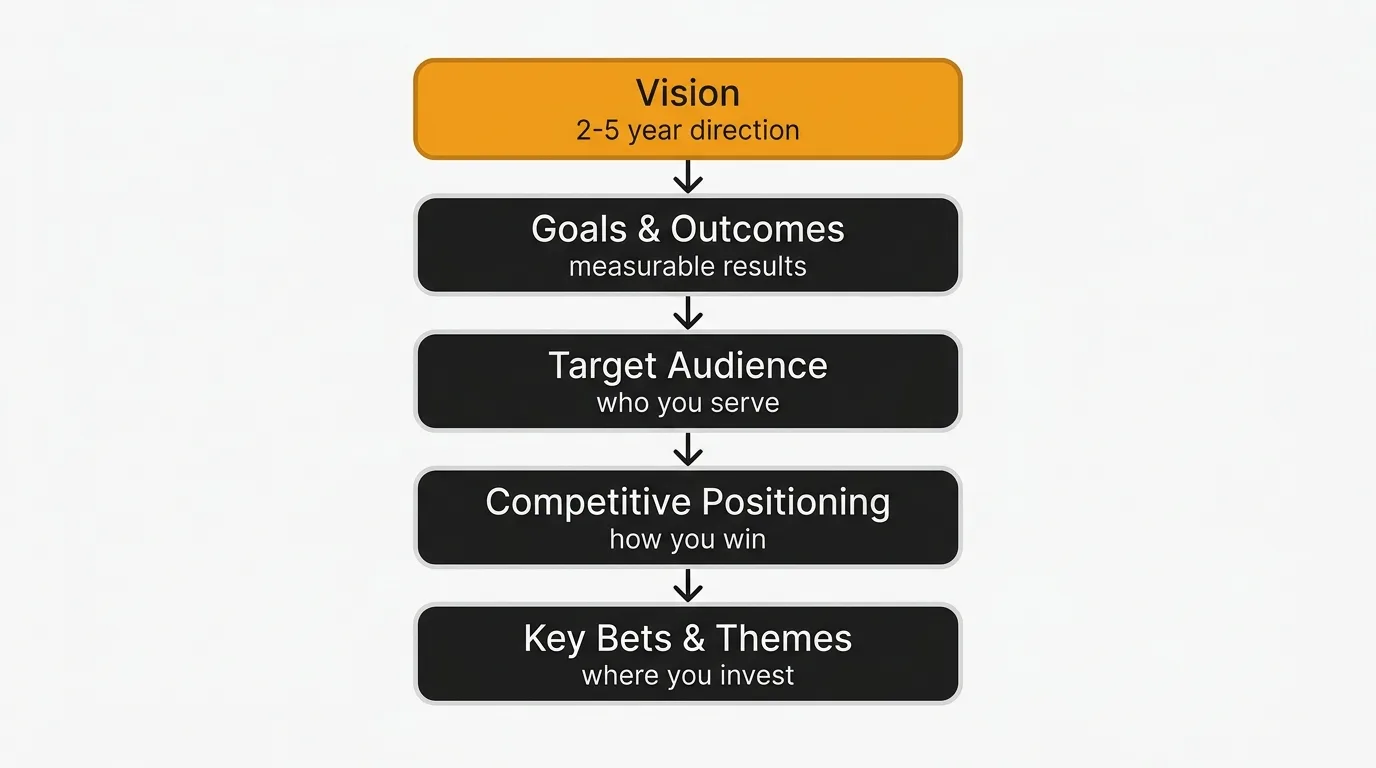
Vision. Where is the product going in 2-5 years? This is your north star. It should be specific enough to guide decisions and ambitious enough to motivate the team. "Become the default way teams collect and act on user feedback" is a vision. "Make customers happy" is not.
Test your vision with this question: does it help you decide what not to build? If the answer is no, the vision is too broad. Slack's early vision was not "improve workplace communication." It was "replace internal email." That constraint made every feature decision clearer.
Goals and outcomes. What measurable results will tell you the strategy is working? Good goals are outcomes, not outputs. "Reduce time-to-first-value from 3 days to 30 minutes" is an outcome. "Ship onboarding redesign" is an output. The outcome is what you care about. The output is one possible way to get there.
Use OKRs (Objectives and Key Results) to structure this. The objective is qualitative and directional: "Make onboarding effortless for new teams." The key results are measurable: "Activation rate from 30% to 50%," "Median time-to-value from 72 hours to 4 hours," "Support tickets about setup reduced by 60%." Three key results per objective is usually enough.
Target audience. Who are you building for, specifically? Not "everyone." The more precisely you define your target user, the easier every downstream decision becomes. Knowing that your primary user is a product manager at a 20-100 person SaaS company makes design, pricing, positioning, and prioritization dramatically simpler.
Write a one-paragraph user profile for your primary persona. Include their role, company size, daily workflow, biggest frustration, and what success looks like for them. Here is an example: "Sarah is a PM at a 60-person SaaS company. She spends 3 hours per week manually aggregating feedback from Slack, Intercom, and email into a spreadsheet. She needs a single place where her team can see what users are asking for, ranked by demand, so she can justify roadmap decisions to her VP of Product."
Competitive positioning. How does your product win against alternatives? This includes direct competitors, adjacent tools, and the spreadsheet or manual process your users rely on today. You need a clear answer to why someone should choose your product over their current solution.
Map your competitive landscape into three categories: direct competitors (same problem, same audience), adjacent tools (overlapping features, different core), and non-consumption (the spreadsheet, the Slack channel, doing nothing). Your positioning should articulate a clear wedge — the one dimension where you are unambiguously better. Price, speed, integration depth, and data ownership are common wedges.
Key bets and themes. What are the 2-4 big areas you are investing in this quarter or half? These are the strategic themes that translate your vision into action. "Expand self-serve onboarding," "Build integrations with support tools," or "Improve feedback-to-roadmap workflow" are themes. They give your team focus without prescribing specific features.
Each theme should have a hypothesis attached: "We believe that building Slack and Intercom integrations will reduce manual feedback collection by 70%, leading to a 15% increase in weekly active usage among PMs." This makes the bet testable. At the end of the quarter, you can evaluate whether the hypothesis held.
How feedback shapes product strategy
User feedback is the most underused input to product strategy. Teams collect it, file it, and occasionally reference it during planning. But feedback should be a continuous signal that shapes which bets you make and how you prioritize within those bets.
There are three ways feedback improves your product development strategy:
Feedback tells you what to prioritize. When 200 users ask for a Slack integration and 12 ask for a Microsoft Teams integration, you have a signal. Not a mandate — you still apply judgment — but a data point that is hard to get any other way. Vote counts on feature requests quantify demand in a way that gut feeling cannot.
Consider a real scenario: your strategy says "invest in integrations" as a theme. You have bandwidth for two integrations this quarter. Without feedback data, the team debates based on opinions. With a feedback board showing 340 votes for Slack, 180 for Jira, 45 for Teams, and 30 for Asana, the first two bets are obvious. You still validate the decision (maybe the Jira voters are all enterprise accounts worth 10x the revenue), but you start from evidence.
Feedback reveals problems you didn't anticipate. Your strategy might focus on acquisition, but feedback from existing users reveals a churn problem you hadn't scoped. The best product strategies are feedback-informed. They absorb new information and adjust.
Here is how this works in practice. A team launches a new pricing tier expecting it to drive expansion revenue. Within two weeks, their feedback board fills with posts about confusion around feature limits, unexpected billing changes, and lost access to tools they were using. The strategy assumed pricing was an acquisition lever. Feedback revealed it was creating a retention problem. The team pivots their Q2 theme from "launch enterprise tier" to "simplify pricing and restore trust." Without the feedback loop, this shift would have taken two quarters to surface through churn metrics.
Feedback validates or challenges your bets. You bet on "improve onboarding" as a strategic theme. Three months in, feedback data shows that onboarding is no longer the top pain point — users are now asking for better reporting. A feedback-informed strategy surfaces this shift early instead of waiting for quarterly metrics to reveal it.
The key distinction: the best strategies are feedback-informed, not feedback-driven. You don't build everything users ask for. You use feedback as one input alongside business goals, technical constraints, and your own product judgment. But ignoring it is worse than over-indexing on it.
A useful framework: weight feedback by strategic alignment. When a feature request maps directly to one of your strategic themes, it gets priority attention. When it falls outside your current themes, it goes into a "future consideration" bucket — valuable signal for the next strategy cycle, but not something that pulls the team off their current bets.
Building a product strategy step by step
Here is a practical process for building a product strategy from scratch or revising one that has gone stale. This works whether you are a solo PM at a startup or a product leader managing multiple teams.
1. Define your vision (30 minutes). Write a 1-2 sentence description of where your product is headed. It should be specific, opinionated, and durable. Test it by asking: does this help me decide what not to build?
Template: "In [time horizon], [product name] will be [specific position] for [specific audience] by [key differentiator]."
Example: "In 3 years, Quackback will be the default feedback platform for product-led SaaS teams by connecting every user voice directly to the roadmap through AI-powered triage."
2. Set measurable outcomes (1 hour). Pick 3-5 outcomes for the next quarter. Each should be measurable, tied to a user or business result, and achievable within the time frame. Avoid vanity metrics. Focus on retention, activation, time-to-value, or revenue per user.
Format each outcome as: "[Metric] from [current baseline] to [target] by [date]."
- Activation rate from 30% to 50% by end of Q2
- Median time-to-first-value from 72 hours to 4 hours by end of Q2
- Net revenue retention from 95% to 105% by end of Q3
3. Gather user signal (2-3 hours). Review your feedback boards, support tickets, sales call notes, and churn surveys. Look for patterns, not individual requests. What problems appear repeatedly? What workarounds are users building? Where is the highest concentration of unmet need?
Pull data from these sources:
- Feature request boards (vote counts and request frequency)
- Support tickets (tag by category, count by theme)
- Sales call notes (lost deal reasons, feature gaps mentioned)
- Churn surveys (reasons for leaving)
- Session recordings (where users get stuck)
- NPS verbatim responses (what drives promoters vs detractors)
4. Identify themes (1 hour). Group the patterns into 2-4 strategic themes. A theme is a problem space, not a solution. "Users struggle to share insights with their team" is a theme. "Build a Slack integration" is a solution that might fall under that theme.
Use affinity mapping: write each feedback pattern on a sticky note (or digital equivalent), cluster similar patterns, and name the clusters. Those names become your themes. If you end up with more than four, force-rank them using a prioritization framework and cut the bottom ones.
5. Make bets (1 hour). For each theme, decide how much of your team's capacity to allocate. This is where strategy gets real. Saying "we will invest 40% of engineering effort in onboarding improvements" is a bet. It means you are choosing not to invest that capacity elsewhere.
Write each bet as a hypothesis: "We believe [action] will result in [outcome] because [evidence]." Example: "We believe adding a guided setup wizard will increase activation from 30% to 50% because 65% of churned users never completed initial configuration, and our top competitor with a wizard sees 3x our activation rate."
6. Communicate via roadmap. Translate your themes and bets into a roadmap that shows what comes first, what comes next, and what you are considering for later. Use a Now/Next/Later format rather than rigid dates — it gives stakeholders visibility without creating false precision.
The roadmap is the public expression of your strategy. A public roadmap takes this further by letting users see your direction and vote on what matters to them, feeding signal back into your next strategy cycle.
7. Iterate. Review your strategy every quarter. Check outcomes against targets. Review fresh feedback data. Adjust themes and bets based on what you learned. A strategy that never changes is a strategy that ignores reality.
Build a simple scorecard: for each bet, track the hypothesis, the outcome metric, the baseline, the target, and the actual result. After one quarter, you will have a clear picture of which bets paid off and which need adjustment.
Product strategy vs product roadmap
This is the most common confusion in product management, and it leads to real problems.
Your product strategy is the why. Why are you focused on these problems? Why are you targeting this audience? Why are these the right bets for this quarter?
Your product roadmap is the what and when. What are you building? What comes first? When can stakeholders expect to see results?
The two should be connected. Every item on your roadmap should trace back to a strategic theme. If it doesn't, you are either missing a theme or building something that doesn't support your strategy.
Here is a practical test: pick any item on your current roadmap. Can you answer these three questions about it?
- Which strategic theme does this support?
- Which outcome will this move?
- What user evidence supports building this now?
If you cannot answer all three, the item is either missing strategic context or should not be on the roadmap. Run this test on your top 10 roadmap items. The results will tell you how well your strategy and roadmap are connected.
When teams skip the strategy and jump straight to the roadmap, the roadmap becomes a feature list driven by whoever is loudest. There is no way to evaluate trade-offs because there is no framework for what matters. A digital product strategy provides that framework.
When teams write a strategy but disconnect it from the roadmap, the strategy becomes a document that lives in a slide deck and gets referenced once a quarter. It has no operational impact.
The fix is simple: your roadmap should be organized by strategic themes. Each theme maps to an outcome from your strategy. Features and initiatives within each theme are the specific bets you are making to achieve that outcome. See our guide on product roadmap examples for concrete templates that use this theme-based structure.
| Strategy | Roadmap | |
|---|---|---|
| Answers | Why are we building this? | What are we building and when? |
| Time horizon | 1-3 years (revisited quarterly) | 1-3 quarters (updated continuously) |
| Audience | Leadership, product org, cross-functional | Engineering, design, stakeholders, users |
| Format | Document or single page | Kanban board, timeline, or Now/Next/Later |
| Changes when | Market shifts, new data invalidates bets | Sprint planning, reprioritization |
Common product strategy frameworks
Several established frameworks can help structure your strategic thinking. Choose one that fits your context rather than trying to combine all of them.
Playing to Win (Lafley & Martin). Five cascading choices: winning aspiration, where to play, how to win, capabilities required, and management systems. Best for teams that need to make clear market positioning decisions. Start by defining where you will not play — the constraints are more useful than the aspirations.
Jobs to Be Done (Christensen). Define strategy around the jobs your users are hiring your product to do. "When [situation], I want to [motivation], so I can [expected outcome]." This framework keeps strategy anchored to user needs rather than competitive moves. It pairs well with voice of customer data.
Lean Product Strategy. Start with a value hypothesis ("Does this solve a real problem?") and a growth hypothesis ("How will users discover this?"). Validate both before investing heavily. Best for early-stage products or new product lines where assumptions outnumber facts.
Now/Next/Later Themes. Organize your strategic themes by time horizon. "Now" themes get 60% of capacity. "Next" themes get 30% (research and early prototyping). "Later" themes get 10% (monitoring and signal collection). This maps directly to a roadmap format your stakeholders already understand.
Communicating your product strategy
A product strategy that only lives in your head or in a document your team has never read is not a strategy. It is a thought exercise. Communication is where strategy becomes operational.
Internally, share your strategy with the entire product and engineering organization. Use it to explain why certain projects are prioritized and others are not. Reference it in sprint planning, design reviews, and roadmap discussions. The strategy should be the answer to "why are we building this?"
Create a one-page strategy brief that every team member can reference. Include: vision (2 sentences), target user (1 paragraph), three outcomes for this quarter, and 2-3 strategic themes with their hypotheses. Post it where your team works — in your project management tool, on a wiki page, in your team channel. If someone has to search for the strategy, they will not use it.
With stakeholders, translate the strategy into language that connects to their concerns. Executives care about business outcomes. Sales cares about competitive positioning and feature gaps. Support cares about which user problems are being addressed. Frame your strategy in terms each audience cares about.
| Audience | Frame strategy as | Example |
|---|---|---|
| CEO/Board | Revenue and market impact | "This theme drives $2M ARR expansion by Q4" |
| Sales | Competitive wins and deal unblocks | "Slack integration closes the #1 lost-deal gap" |
| Engineering | Technical direction and debt trade-offs | "We are investing in API infrastructure before new features" |
| Support | User problems being solved | "Top 3 ticket categories will drop 40% by Q3" |
| Users | What is coming and why | "You asked for integrations — here is what is next" |
With users, a public roadmap is the most effective way to communicate your product launch strategy and ongoing direction. It shows users what you are working on, what comes next, and what you have shipped. A public roadmap turns your strategy into a conversation. Users vote on what matters to them, leave feedback on planned features, and see that their input shapes your direction.
Feedback boards close the loop in the other direction. They give users a structured way to tell you what they need, and they give you a continuous stream of signal that feeds back into your strategy.
Frequently asked questions
How often should you revisit your product strategy?
Review it quarterly. A lightweight check every month helps you catch early signals that a bet is not working. A deeper review each quarter lets you adjust themes, update outcomes, and incorporate what you learned from the previous cycle. Strategies that only get revisited annually tend to drift from reality.
Use a simple quarterly review checklist: (1) Score each bet's hypothesis against actual outcomes. (2) Review new feedback data for emerging patterns. (3) Check if target audience assumptions still hold. (4) Decide what to double down on, what to pivot, and what to stop.
What is the difference between a product strategy and a go-to-market strategy?
A product strategy defines what you build and why. A go-to-market strategy defines how you bring it to market — pricing, positioning, channels, launch tactics. They should be aligned. Your go-to-market strategy should reflect the same target audience and competitive positioning defined in your product strategy.
How do you get buy-in for a product strategy from leadership?
Start with outcomes, not features. Executives care about business results. Frame your strategy around the outcomes it will drive — retention improvement, expansion revenue, reduced churn — and explain why your chosen themes are the best bets to achieve those outcomes. Use feedback data to support your case. Vote counts and request volumes make prioritization decisions concrete rather than subjective.
Present a "strategy on a page" with four sections: the outcome you are targeting, the user evidence supporting your bets, the capacity allocation across themes, and the risks if you do not act. One page, four sections, ten minutes. That is enough for most leadership reviews.
Can a small team benefit from a formal product strategy?
Yes. A small team benefits more, not less. When you have limited capacity, every decision about what to build carries more weight. A clear strategy helps a small team avoid spreading effort across too many priorities. Even a one-page document with a vision, three outcomes, and two themes is enough to align a team of five.
How do you prioritize within a strategic theme?
Once you have chosen your themes, use a scoring framework like RICE (Reach, Impact, Confidence, Effort) or MoSCoW to rank initiatives within each theme. The strategy tells you which problem spaces to invest in. The prioritization framework tells you which specific solutions to build first within those spaces.
What tools support product strategy execution?
Your strategy should connect to three operational tools: a feedback system to gather continuous user signal, a roadmap tool to communicate direction, and a prioritization framework to evaluate trade-offs. Feature voting boards quantify demand. A public roadmap communicates direction. And frameworks like RICE or MoSCoW structure the ranking decisions within your themes.

Authored by James Morton
Founder of Quackback. Building open-source feedback tools.
Try Quackback
The open-source feedback platform. Boards, voting, and roadmaps.
Get startedStar on GitHub305