
Pendo bundles product analytics, in-app guides, and feedback into one enterprise platform. The price reflects that scope. If you mainly need feedback collection, feature voting, and roadmapping, you're paying for capabilities you don't use.
Pendo's analytics-first design shapes everything in the product. The feedback module — Pendo Listen — sits alongside session replay, NPS surveys, funnel analysis, and guide building. For teams that need all of that, Pendo makes sense. For teams that just want users to submit ideas, vote on them, and see a public roadmap, it's significant overhead.
The pricing model reinforces this. Pendo operates on MAU-based billing. Costs grow as your active user count grows, which means a successful product launch can trigger a significant price increase. Most teams don't discover the actual cost until they're already in a sales conversation, as Pendo does not publish pricing publicly.
Seven focused alternatives handle feedback collection and roadmapping without the analytics platform overhead.
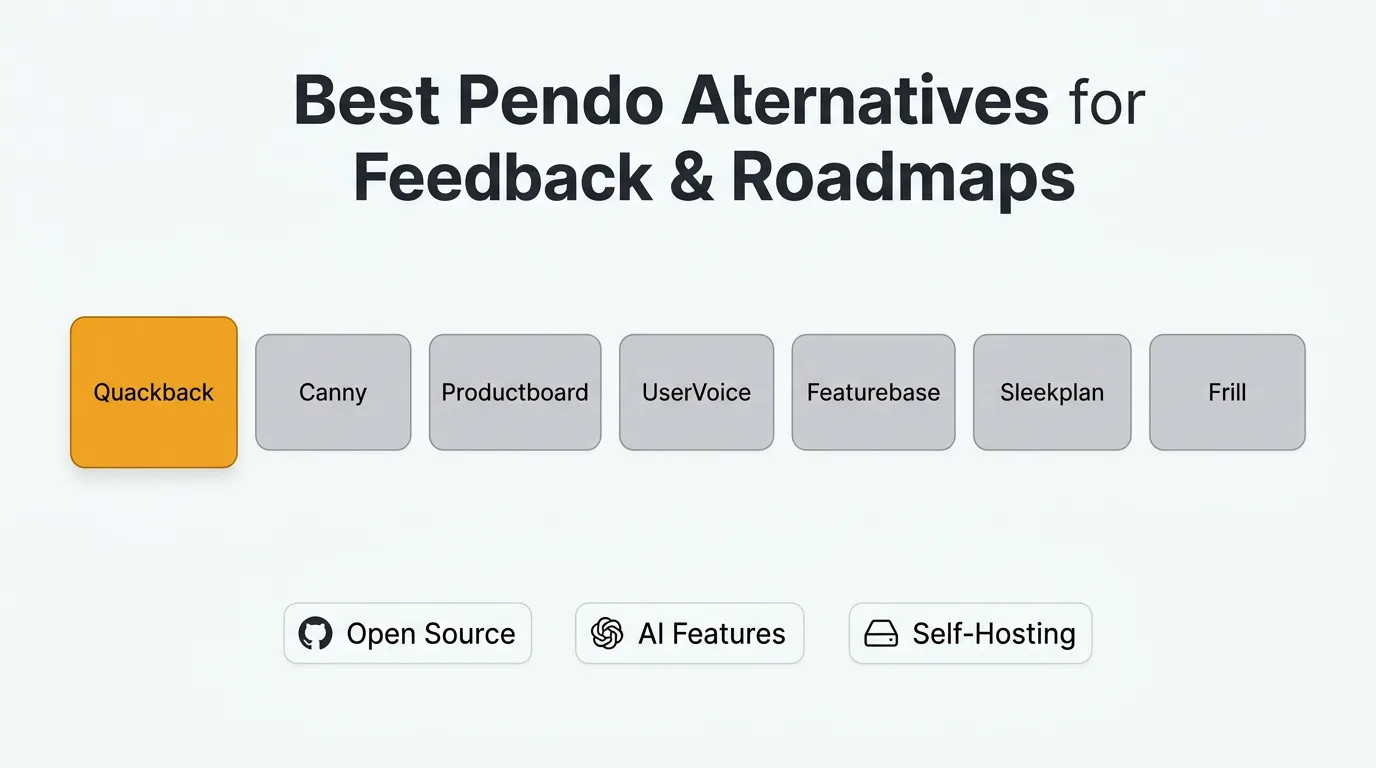
TLDR: The best Pendo alternatives ranked:
Pricing last verified February 2026. Vendors may change plans and pricing without notice. Check each vendor's pricing page for the latest figures.
- Quackback — Open source and self-hosted. Full feedback, roadmap, and changelog with AI and MCP server included.
- Canny — Established feedback tool with boards, voting, and roadmaps. From $19/mo.
- Productboard — Enterprise PM suite with strategy, prioritization, and feedback. From $19/maker/mo.
- UserVoice — Enterprise feedback platform built for large support and product teams. From $16k/year.
- Featurebase — Lightweight feedback and changelog tool with a free plan.
- Sleekplan — Widget-first feedback with built-in NPS and CSAT surveys. From $13/mo.
- Frill — Simple, focused feedback boards for small teams. From $25/mo.
Why teams look for Pendo alternatives
The most common reasons teams look beyond Pendo when their primary need is feedback:
- Enterprise pricing starts at $10k+/year. Pendo does not publish pricing. Most customers report starting costs of $10,000–$20,000 per year for the full platform. That's difficult to justify if you're using 20% of the product.
- Feedback is secondary to analytics. Pendo was built as a product analytics and in-app guide platform. Feedback collection was added later. The experience reflects that — the feedback workflow is less polished than tools built for that purpose specifically.
- MAU-based billing is unpredictable. Costs scale with your monthly active users. A product launch or seasonal traffic spike can push you into a higher pricing tier without warning.
- Implementation takes weeks. Deploying Pendo requires installing the agent across your app, configuring feature tagging, training your team on the data model, and integrating with your stack. Simple feedback tools take hours, not weeks.
- No self-hosting option. Pendo is SaaS-only. Your data lives on Pendo's infrastructure. Teams with data residency requirements, compliance constraints, or a preference for infrastructure control have no alternative.
For a detailed breakdown of what Pendo actually costs, see our Pendo pricing analysis.
1. Quackback
Quackback is open source (AGPL-3.0), self-hosted, and free. No feature gates based on pricing tiers.
You get the full feedback workflow in a single product: feedback boards with voting, a public roadmap, a changelog, SSO/OIDC, custom branding, and 25 integrations including Slack, Jira, Linear, GitHub, Intercom, Zendesk, and Salesforce. There's no analytics module and no in-app guide builder — Quackback does feedback, roadmaps, and changelogs, and does them well.
The AI features set Quackback apart from most tools in this category. Duplicate detection catches redundant posts before they pile up. Merge suggestions identify related requests with reasoning your team can accept or dismiss in one click. Sentiment analysis runs on every post. Summaries pull out key quotes and next steps.
The MCP server is something no other feedback tool offers. It implements the Model Context Protocol, the standard that Claude, Cursor, and Windsurf support. Connect an AI agent and it gets full access to your feedback data: search posts, triage requests, write responses, create changelog entries, and merge duplicates. Every action is attributed and auditable.
Key features:
- Feature request boards with voting, status tracking, and nested comments
- Public roadmap and changelog with automatic voter notifications
- Built-in AI: duplicate detection, merge suggestions, sentiment analysis, post summaries
- MCP server for AI agents (search, triage, respond, create, merge)
- 25 integrations: Slack, Linear, Jira, GitHub, Intercom, Zendesk, Salesforce, and more
- SSO/OIDC, webhooks, full REST API
- Custom branding with themes, custom CSS, and your own domain
Pricing: Free and open source. Self-host with Docker or deploy on Railway at no cost.
Pros:
- Full-featured feedback, roadmap, and changelog in one product
- AI included at no extra cost when self-hosted (bring your own model key)
- MCP server for AI agent access
- Open source — audit the code, fork it, own your data
- 25 integrations, SSO, and custom branding included on every self-hosted installation
Cons:
- Self-hosted only — no managed cloud option
- You manage your own infrastructure (Docker or Railway)
- Newer project with a smaller community than Pendo
Best for: Teams that want open-source, self-hosted feedback with AI built in.
For a detailed side-by-side breakdown, see the full Quackback vs Pendo comparison.
Try Quackback — open source and self-hosted. Deploy in under five minutes with Docker. Get started free | View on GitHub
2. Canny
Canny is one of the most established dedicated feedback tools on the market. It covers the standard workflow: feature request boards, voting, roadmaps, and changelogs. Teams migrating from Pendo often find Canny familiar — it handles feedback well without the analytics overhead.
The Core plan starts at $19/mo (billed annually) for 100+ tracked users. Canny moved to tracked-user pricing in May 2025, which means costs grow as more of your users submit posts, vote, or comment. Autopilot — Canny's AI layer for deduplication, categorization, and summarization — is included across all plans. PM integrations like Jira, Linear, and ClickUp require the Pro plan ($79/mo).
Canny is closed source with no self-hosting option. For teams switching from Pendo specifically because of vendor lock-in or data sovereignty concerns, that's worth noting. But for teams that want a polished hosted tool with a known brand and a track record, Canny is a solid step down from Pendo's complexity and price.
Key features:
- Feedback boards with voting, tags, and custom statuses
- Public roadmap with status-based filtering
- Changelog with scheduled posts and email notifications
- Autopilot AI for deduplication, categorization, and summarization (all plans)
- Integrations: Jira, Linear, GitHub, Intercom, Zendesk, Salesforce, Slack (Pro+)
Pricing: Free (25 tracked users). Core at $19/mo. Pro at $79/mo. Business is custom.
Pros:
- Established product with a long track record
- Autopilot AI included on all plans
- Polished UI with a clean public-facing board
- Well-documented and easy to set up
Cons:
- Tracked-user billing can be unpredictable at scale
- Free plan caps at 25 tracked users
- PM integrations require the Pro plan ($79/mo)
- No self-hosting, no open source
Best for: SaaS teams wanting a polished, hosted feedback tool without Pendo's analytics overhead.
See how it compares: Quackback vs Canny.
3. Productboard
Productboard is a product management platform, not just a feedback tool. It connects customer insights to product strategy through opportunity scoring, prioritization matrices, and driver-based roadmaps. Teams coming from Pendo that want to retain some of the strategic product tooling — but without the in-app guide and analytics components — often consider Productboard as a middle ground.
Where Pendo leans on behavioral analytics to inform product decisions, Productboard leans on structured insight capture and prioritization frameworks. Deep integrations with Jira, Salesforce, Zendesk, and Intercom let you pull feedback from across your stack and link it to features and objectives. The Spark plan costs $15/maker/month (annual) or $19/maker/month (monthly).
The trade-off is complexity. Productboard has a steeper learning curve than most tools on this list. For teams that just want a feedback board and a roadmap, it's overkill. But for product organizations that need to align multiple teams around priorities, score features by business impact, and tie roadmaps to company objectives, it's a well-designed platform.
Key features:
- Insights portal for collecting and organizing customer feedback
- Feature prioritization with custom scoring frameworks
- Driver-based roadmaps tied to company objectives
- Deep Jira, Salesforce, Zendesk, and Intercom integrations
- AI included via credits (250/maker/month) for summarization and insight extraction
Pricing: Spark at $15/maker/month (annual) or $19/maker/month (monthly). Enterprise is custom.
Pros:
- Deep product management features beyond feedback
- Strategy-level roadmapping tied to business objectives
- Strong integrations with enterprise tools
- AI included in the base plan via credits
- Established company with a large customer base
Cons:
- Steep learning curve
- AI credits (250/maker/month) may be limiting for heavy users
- Overkill for simple feedback collection
- No self-hosting
- Per-maker pricing grows with team size
Best for: Product organizations that need strategy, prioritization, and roadmapping tools beyond basic feedback.
See how it compares: Quackback vs Productboard.
4. UserVoice
UserVoice is the enterprise-tier alternative on this list. It's built for large organizations with dedicated support teams, product managers, and complex internal workflows. Like Pendo, it sells through a sales process with custom pricing — starting around $16,000/year — and targets the same enterprise buyer profile.
Where Pendo emphasizes analytics and in-app guidance, UserVoice emphasizes structured feedback capture at scale. Customer feedback comes in from multiple channels — support tickets, sales calls, direct submission — and gets organized, tagged, and linked to product ideas. Internal stakeholders can submit feedback on behalf of customers. Product managers use built-in prioritization tools to evaluate which requests to build.
The platform is deeply integrated with Salesforce and Zendesk, making it popular with enterprise support organizations. Implementation takes time — similar to Pendo — and the per-year pricing puts it out of reach for smaller teams. If budget is the reason you're leaving Pendo, UserVoice is not a downgrade in cost.
Key features:
- Multi-channel feedback capture (portal, widget, API, internal submission)
- Idea management with voting, prioritization scoring, and status tracking
- Internal stakeholder collaboration on feature requests
- Salesforce and Zendesk integrations
- NPS and satisfaction surveys
- Custom reporting and analytics dashboards
Pricing: Starts at approximately $16,000/year. Custom pricing based on users and features.
Pros:
- Built for enterprise-scale feedback workflows
- Strong support team integrations (Salesforce, Zendesk)
- Internal stakeholder feedback capture
- Mature platform with a long track record
Cons:
- Very expensive — starts around $16k/year
- No self-hosting, no open source
- Implementation is slow (similar to Pendo)
- Overkill for most non-enterprise teams
- No public pricing transparency
Best for: Large enterprises with dedicated product and support teams managing feedback at scale.
See how it compares: Quackback vs UserVoice.
5. Featurebase
Featurebase bundles feedback boards, a changelog, a roadmap, help docs, and a support inbox into one product. It has a free plan — one seat, limited features — which makes it an accessible starting point for smaller teams that don't want to self-host and aren't ready for a paid subscription.
The contrast with Pendo is stark. Featurebase is focused, fast to set up, and transparent about pricing. You don't need to sit through a sales call to get started. The tradeoff is depth — Featurebase doesn't offer product analytics, in-app guides, or the kind of strategic prioritization tooling that Pendo provides.
The AI agent, Fibi, auto-resolves customer questions using context from your help center, feedback posts, and past conversations. It can also submit feature requests on behalf of users. Fibi charges $0.49 per resolution on top of your plan, which adds up at volume. Per-seat pricing ($29–99/seat/month on paid plans) means costs grow with your team size.
Key features:
- Feedback boards with voting, status tracking, and user segmentation
- Changelog, public roadmap, and surveys (NPS, CSAT)
- Unified support inbox with live chat and email
- Fibi AI Agent for auto-resolving questions ($0.49/resolution)
- 12 integrations: Linear, Jira, GitHub, Slack, Intercom, Zendesk, and more
Pricing: Free (1 seat, limited). Growth at $29/seat/month. Professional at $59/seat/month. Enterprise at $99/seat/month.
Pros:
- Free tier available for getting started
- All-in-one: feedback, support, help docs in one product
- Surveys (NPS, CSAT) included
- Fast to set up — no sales process required
Cons:
- Per-seat pricing adds up for larger teams
- AI resolutions are usage-based ($0.49 each)
- No self-hosting, no open source
- Post merging locked to Business tier
Best for: Small teams wanting a free hosted option with feedback, support, and changelog combined.
See how it compares: Quackback vs Featurebase.
6. Sleekplan
Sleekplan takes a widget-first approach to feedback. Instead of directing users to a separate portal, Sleekplan embeds directly into your app as an in-app widget. Users submit feedback, vote on ideas, read your changelog, and respond to satisfaction surveys without leaving your product.
Teams leaving Pendo for Sleekplan are typically trading the analytics depth for simplicity and lower cost. Sleekplan doesn't do session replay, funnel analysis, or feature tagging. It handles in-app feedback collection and satisfaction measurement — the two things most teams actually use in Pendo's feedback module.
The built-in NPS and CSAT surveys are a differentiator. Most dedicated feedback tools treat surveys as a separate concern. Sleekplan includes them natively alongside the feedback board and changelog. The free Indie plan is limited (one seat, no roadmap, no surveys, no AI). The Starter plan at $13/mo unlocks the roadmap, surveys, and AI features.
Key features:
- Feedback board with voting, status updates, and impact scoring
- Changelog with scheduled posting and subscriber notifications
- Roadmap (Starter plan and above)
- Built-in NPS and CSAT surveys
- Embeddable in-app widget, standalone site, or iframe
- 12 integrations: Jira, Linear, Slack, Intercom, GitHub, Zapier, and more
Pricing: Free Indie plan (1 seat, limited). Starter at $13/mo. Business at $38/mo. Enterprise is custom.
Pros:
- In-app widget reduces friction for feedback submission
- Built-in NPS/CSAT surveys included natively
- Affordable paid plans starting at $13/mo
- Free tier available
Cons:
- Free plan is very limited (no roadmap, no surveys, no AI)
- Widget-first means the standalone portal is less polished
- Post merging requires Business plan ($38/mo)
- No self-hosting, no open source
- Much narrower scope than Pendo
Best for: Teams that want in-app feedback collection and satisfaction surveys without a full analytics platform.
See how it compares: Quackback vs Sleekplan.
7. Frill
Frill is a simple, focused feedback board tool. You get a public board where users submit and vote on ideas, a basic roadmap view, and a changelog. There are no AI features, no in-app analytics, and no complex prioritization frameworks. It does one thing and keeps it straightforward.
For indie developers, solo founders, or very small teams, Frill is one of the easiest tools to get running. Setup takes minutes. The pricing is flat: $25/mo for the Startup plan, $49/mo for the Business plan. No per-user billing, no MAU-based tiers, no sales process. You know exactly what you're paying.
The limitation is scope. Frill doesn't offer integrations with tools like Jira, Linear, or Zendesk on the entry plan. The changelog is basic. There are no AI features for duplicate detection or sentiment analysis. If you're coming from Pendo, you'll notice what's missing. But if Pendo was overkill, Frill may be exactly the right size.
Key features:
- Feedback board with voting and custom statuses
- Public roadmap view
- Changelog
- SSO on Business plan and above
- Integrations: Zapier, webhooks (Startup). Jira, Slack, and more on Business.
- Custom domain and branding
Pricing: Startup at $25/mo (50 ideas). Business at $49/mo (unlimited). Growth at $149/mo. Enterprise from $349/mo.
Pros:
- Flat-rate pricing — no per-user surprises
- Simple to set up and operate
- Clean, uncluttered UI
- No sales process required
Cons:
- Limited integrations on the entry plan
- No AI features
- No self-hosting, no open source
- Less active development compared to alternatives
- No duplicate detection or post merging
Best for: Indie hackers and small teams that want a simple, flat-rate feedback board with no complexity.
See how it compares: Quackback vs Frill.
Comparison table
Here's how all seven alternatives stack up against Pendo on the features that matter for feedback workflows.
| Pendo | Quackback | Canny | Productboard | UserVoice | Featurebase | Sleekplan | Frill | |
|---|---|---|---|---|---|---|---|---|
| Starting price | ~$10k+/year | Free | Free (25 tracked users) | $15/maker/mo | ~$16k/year | Free (1 seat) | Free (1 seat) | $25/mo |
| Open source | No | Yes (AGPL-3.0) | No | No | No | No | No | No |
| Self-hosting | No | Yes | No | No | No | No | No | No |
| AI features | Yes (analytics-focused) | Yes (built in) | Autopilot (all plans) | Credits (250/maker/mo) | Limited | Fibi ($0.49/resolution) | Starter plan+ | No |
| Changelog | No | Yes | Yes | No | No | Yes | Yes | Yes |
| Public pricing | No | Yes (free) | Yes | Yes | No | Yes | Yes | Yes |
| MAU/user limits | MAU-based billing | None | 25 tracked (Free) | None (Spark) | Custom | None on free | None | None |
How to choose
Start with your actual requirements. Most teams switching from Pendo are doing so because the price-to-value ratio is off — they're using the feedback module and not much else.
If cost is the priority: Quackback is free to self-host with no MAU limits. Among hosted options, Sleekplan ($13/mo) and Frill ($25/mo) are the most affordable. Both have transparent, flat-rate pricing with no sales process.
If you want open source: Quackback is your option. It covers the full feedback workflow — boards, roadmap, changelog, 25 integrations, AI, MCP server — and deploys with Docker. You own your data and your infrastructure.
If you need enterprise-scale feedback: UserVoice is the closest enterprise equivalent to Pendo's feedback module, without the analytics overhead. It's expensive, but it handles the complexity of large-scale feedback programs. Productboard is a better fit if you need strategic roadmapping tied to company objectives.
If you want quick setup: Featurebase, Sleekplan, and Frill all get you running in under an hour with no sales process. Canny is also fast and has the most polished onboarding among the established tools.
If you need in-app feedback: Sleekplan's widget-first design is the best choice for collecting feedback inside your product. Pendo's in-app approach is one of its genuine strengths — Sleekplan provides a focused version of that without the analytics platform.
If you're migrating from Pendo: The most common reasons teams leave Pendo are MAU-based pricing, analytics-first complexity, and long implementation timelines. Quackback addresses all three — it's free, focused on feedback, and deploys in under five minutes.
For a broader view of the feedback tool landscape, see Best Customer Feedback Tools in 2026, Open Source Feedback Tools, and our feedback tool pricing comparison.
Frequently asked questions
What is the best free alternative to Pendo for feedback?
Quackback is the most full-featured free alternative for feedback and roadmapping. It's open source (AGPL-3.0), self-hosted, and includes feedback boards, voting, a public roadmap, a changelog, 25 integrations, SSO/OIDC, and built-in AI features. Among hosted tools, Featurebase and Sleekplan both offer limited free tiers that cover the basics.
Is Pendo worth it for teams that only need feedback?
Rarely. Pendo's value comes from combining product analytics, in-app guides, and feedback in one platform. If you only use the feedback module, you're paying for two-thirds of the product you don't use. Most dedicated feedback tools — Canny, Featurebase, Quackback — cover feedback, voting, roadmaps, and changelogs at a fraction of the cost and with a simpler setup.
Can I replace Pendo's in-app guides with a cheaper tool?
Pendo's in-app guide builder is a distinct product category from feedback tools. If you need in-app guides — onboarding flows, tooltips, announcements — you'll need a separate tool after leaving Pendo. Tools like Appcues or Userflow specialize in in-app guidance. The alternatives on this list focus on feedback collection and roadmapping, not in-app guide creation.
How long does it take to switch from Pendo to a feedback-focused tool?
Most dedicated feedback tools — Canny, Featurebase, Sleekplan, Frill — take a day or less to set up. Quackback self-hosting takes under an hour with Docker. The main migration work is exporting your existing feedback data from Pendo and re-importing it. Pendo allows data export, though the process varies depending on your contract. The longer your Pendo history, the more data you'll need to move.

Authored by James Morton
Founder of Quackback. Building open-source feedback tools.
Try Quackback
The open-source feedback platform. Boards, voting, and roadmaps.
Get startedStar on GitHub305