
Feature requests are the lifeblood of product development. Every product team knows this. But most teams still collect them across Slack threads, support tickets, emails, and spreadsheets. Requests get lost. Duplicates pile up. The loudest voices win, not the most important ones.
A feature request tool gives your users a dedicated place to submit ideas and vote on what matters. Your team gets a structured view of demand, tied to statuses, roadmaps, and development workflows. The right tool makes it easy to collect, organize, and prioritize feature requests without drowning in manual triage.
Here are seven feature request tools in 2026, compared by features, pricing, and trade-offs.
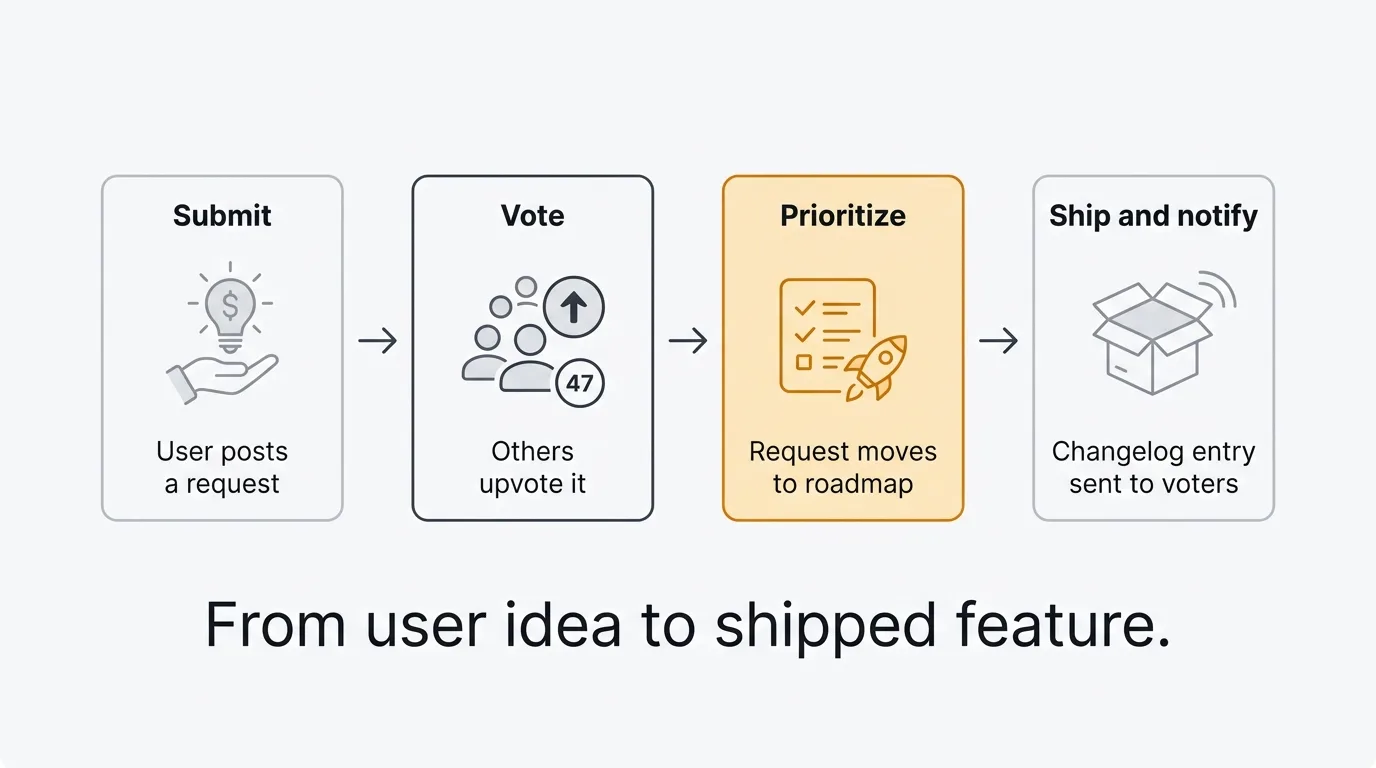
If you need to collect and organize feature requests at scale, Quackback is the best feature request tool: open source, free to self-host (with a managed cloud option), and AI duplicate detection and triage built in. Canny is the strongest hosted alternative for teams that want to capture requests from support tools. Productboard suits enterprise orgs that need strategic prioritization frameworks. Here are all seven ranked:
Pricing last verified March 2026. Vendors may change plans and pricing without notice. Check each vendor's pricing page for the latest figures.
- Quackback — Open source and self-hosted. AI triage, duplicate detection, and MCP server included.
- Canny — Hosted request boards with AI that extracts feature requests from support conversations.
- Productboard — Enterprise product management with request prioritization scoring and driver-based roadmaps.
- Featurebase — Captures feature requests from support inbox and feedback boards in one tool.
- Fider — Open source, minimal request board. Basic collection with no triage tools.
- Nolt — Simple request board with flat-rate pricing. No duplicate detection or changelog.
- Upvoty — Affordable request boards with roadmap and changelog from $15/mo.
1. Quackback
Best for: Teams that want an open-source tool to collect, organize, and prioritize feature requests with AI triage.
Quackback is an open-source feature request platform licensed under AGPL-3.0. Users submit requests through feedback boards, organized by category and status. Each request collects votes, nested comments, and sentiment data so your team can see exactly what users want and why. Requests flow through statuses from open to planned to shipped, visible on the public roadmap and announced via the changelog.
The biggest challenge with feature requests is triage. Quackback's AI layer handles the work that buries most teams. Duplicate detection catches redundant requests before they pile up. Merge suggestions identify related posts with reasoning your team can accept or dismiss in one click. Sentiment analysis flags frustrated users. Summaries pull out key quotes and suggest next steps.
The MCP server is unique among feature request tools. It implements the Model Context Protocol, the standard that Claude, Cursor, and Windsurf support. Connect an AI agent and it can search requests, triage incoming posts, write responses, create changelog entries, and merge duplicates. Every action is attributed and auditable.
Self-host with Docker or deploy on Railway. Your data stays in your PostgreSQL database. With 25 integrations including Slack, Linear, Jira, GitHub, Intercom, Zendesk, and Salesforce, feature requests flow directly into your development workflow.
Key features:
- Dedicated request submission with categories, tags, and nested comments
- AI duplicate detection and merge suggestions to reduce request sprawl
- Sentiment analysis and automated summaries for faster triage
- Feature voting so users can upvote requests that matter to them
- Status tracking from open through planned to shipped
- MCP server for AI agents to search, triage, respond, and merge requests
- 25 integrations: Slack, Linear, Jira, GitHub, Intercom, Zendesk, Salesforce, and more
- User segments, SSO/OIDC, webhooks, and full REST API
Pricing: Free and open source (AGPL-3.0). Self-host at no cost, or use Quackback Cloud for a managed option from $29/mo, with a 14-day free trial.
Pros:
- Covers the full request lifecycle: collection, triage, prioritization, and shipping
- AI triage included
- MCP server enables AI agent access, something no other feature request tool offers
- Open source means no surprise pricing changes
Cons:
- Self-hosting requires running your own infrastructure (the managed cloud removes this)
- Newer than incumbents like Canny and Productboard
Try Quackback — open source with a managed cloud option. Start free. Get started | View on GitHub
2. Canny
Best for: Mid-size SaaS teams that want a hosted tool to capture feature requests from multiple channels.
Canny has been in the feature request space since 2017. Users submit requests through a dedicated board, and your team tracks them with statuses, categories, and internal comments. The AI suite, Autopilot, is the standout for request collection: it discovers feature requests buried in support conversations across Intercom, Zendesk, Help Scout, and Gong, then creates posts automatically. Requests that would otherwise stay trapped in support tickets surface on your board.
The pricing model changed in May 2025. Canny moved from per-admin to tiered pricing based on tracked users. A "tracked user" is anyone with a post, vote, or comment attributed to them. Costs increase as you cross tracked user thresholds, with auto-upgrades to the next tier. Canny offers a free plan (25 tracked users) but most teams outgrow it quickly. The first paid tier is Core at $19/mo.
Canny is a solid option if you want a hosted solution and can absorb the scaling costs. The concern is predictability. As your product grows and more users submit requests, your bill grows with them. Several customers have reported unexpected cost increases after the billing model change.
Key features:
- Dedicated request boards with categories, statuses, and internal notes
- Autopilot AI discovers requests from support conversations automatically
- Smart replies and comment summarization for faster triage
- Public and private roadmaps linked to requests
- Integrations with Jira, Linear, Slack, HubSpot, and others
Pricing: Free plan (25 tracked users). Core from $19/mo. Pro from $79/mo. Business is custom pricing.
Pros:
- Mature product with a large user base
- AI extracts feature requests from support tools automatically
- Good integration ecosystem for routing requests to dev teams
Cons:
- Tracked-user pricing makes costs unpredictable at scale
- Tiered pricing with auto-upgrades when you exceed tracked user limits
- Jira integration requires Pro ($79/mo)
- No self-hosting option
- Removing "Powered by Canny" branding requires Business plan
For a detailed breakdown, see our Quackback vs Canny comparison.
3. Productboard
Best for: Enterprise product organizations that need to connect feature requests to strategic prioritization frameworks.
Productboard is a product management platform built around a concept it calls "insights." Feature requests from Intercom, Zendesk, Salesforce, email, and Slack are captured as notes and linked to features. The insights portal aggregates requests across channels, so your team can see every customer who asked for the same thing in one place.
Where Productboard differs from dedicated request tools is prioritization. You can score requests against custom drivers (revenue impact, user reach, effort), build roadmaps tied to company objectives, and align cross-functional teams around what to build. If your org needs to connect raw feature requests to a formal prioritization process, Productboard provides that layer.
The trade-off is cost and complexity. Productboard's Spark plan costs $15/maker/month (annual) or $19/maker/month (monthly). AI is included via credits (250 per maker per month). Enterprise pricing for SSO and advanced features is custom. For teams that just need to collect and organize feature requests, Productboard is more than you need.
Key features:
- Insights portal captures requests from support, sales, and email channels
- Feature prioritization with custom scoring frameworks (RICE, weighted, custom)
- Integrations with Jira, Azure DevOps, Slack, Salesforce, Zendesk, and Intercom
- AI included via credits (250/maker/month) for request summarization and semantic search
Pricing: Spark at $15/maker/month (annual) or $19/maker/month (monthly). Enterprise is custom.
Pros:
- Connects feature requests to strategic prioritization and scoring
- Aggregates requests across support, sales, and email into one view
- AI included in the base plan via credits
- Enterprise-grade security and compliance
Cons:
- AI credits (250/maker/month) may be limiting for heavy users
- Steep learning curve for teams that just need request collection
- No self-hosting
- Overkill if you only need feature request tracking
See our Quackback vs Productboard comparison for a full feature-by-feature breakdown.
4. Featurebase
Best for: Startups that want to capture feature requests from support conversations and feedback boards in one tool.
Featurebase bundles feature request boards with a support inbox, help center, and live chat. The premise is that many feature requests start as support tickets. A customer asks "can I do X?" and your team realizes X does not exist yet. Featurebase keeps the support conversation and the resulting feature request connected.
Their AI agent, Fibi, resolves customer questions using context from your workspace and can submit feature requests to your boards on behalf of customers. This means requests get captured even when users contact support instead of visiting your feedback board.
The free plan gives you one seat and basic boards. Growth starts at $29/seat/month. Fibi AI resolutions cost $0.49 each, which adds up at volume. Post merging and user segmentation, both important for managing request volume, are locked to higher tiers.
Key features:
- Feedback boards with categories, statuses, and user segmentation
- AI agent captures feature requests from support conversations ($0.49/resolution)
- Post merging to consolidate duplicate requests (paid tiers)
- Unified support inbox with live chat, email, and ticketing
- 12 integrations: Linear, Jira, GitHub, ClickUp, Slack, Intercom, Zendesk, HubSpot
Pricing: Free plan (1 seat, limited features). Growth at $29/seat/month. Professional at $59/seat/month. Enterprise at $99/seat/month.
Pros:
- Captures feature requests from support conversations automatically
- Keeps the support-to-request pipeline in one product
- Modern, clean interface
Cons:
- Per-seat pricing adds up for larger teams
- AI resolutions at $0.49 each are usage-based
- No self-hosting or open source
- Post merging and segmentation locked to higher tiers
For more detail, see our Quackback vs Featurebase comparison.
5. Fider
Best for: Developers who want a minimal, open-source place for users to submit feature requests.
Fider is the other open-source option for feature request collection. Built with Go and PostgreSQL, it gives you a single board where users submit requests, vote on them, and discuss in comments. Tags and custom statuses help you organize requests. It deploys with Docker and runs on minimal resources.
Fider has been around since 2017 and has a stable codebase. If all you need is a submission board where users can post requests and your team can tag and triage them, Fider covers it.
The limitation is everything beyond basic collection. There is no duplicate detection, so the same request appears under different titles and you merge manually. No changelog means you cannot notify requesters when their feature ships. No roadmap view, no AI features, and integrations are limited to webhook-based connections with Slack, Discord, and Teams. The project moved to an open-core model in v0.33.0, putting content moderation and SEO indexing behind the paid cloud tier. Development has slowed.
Key features:
- Single request board with voting, comments, and rich text editor
- Tags, filters, and customizable statuses for organizing requests
- REST API and webhooks (4 event types) for custom workflows
- Multi-language support (10+ languages, including RTL)
- SSO with OAuth providers
Pricing: Free and open source for self-hosting. Cloud free tier limited to 250 feedback items. Cloud Pro at $49/month.
Pros:
- Lightweight and fast to deploy
- Simple request collection with no learning curve
- Open source (AGPL-3.0)
- Multi-language support
Cons:
- No duplicate detection; requests fragment across similar posts
- No changelog, no roadmap, no AI features
- No native Jira, Linear, or GitHub integrations
- Development has slowed
See our Quackback vs Fider comparison for a side-by-side breakdown.
6. Nolt
Best for: Small teams that want a simple board for collecting feature requests with predictable pricing.
Nolt gives you a clean board where users submit feature requests, vote, and leave comments. Statuses track each request through your process. A basic roadmap view groups requests by status. Setup takes minutes.
The flat pricing is appealing. Essential is $25/month for one board. No tracked-user billing, no per-seat scaling. You know what you will pay regardless of how many users submit requests.
The concern with Nolt in 2026 is stagnation. The product has seen minimal updates since 2022. There is no duplicate detection, so similar requests pile up without consolidation. No changelog means you cannot notify requesters when features ship. No bulk editing, no comment threading, no AI. If your request volume grows beyond what one person can manually triage, you will outgrow Nolt.
Key features:
- Request board with voting, custom statuses, and comments
- Roadmap view grouped by request status
- SSO, private boards, and password-protected boards
- Integrations: Slack, Discord, Jira, Linear, Asana, Trello, GitHub, Zapier (Pro plan)
- Custom domain and branding
Pricing: Essential at $25/month for 1 board. Pro at $69/month for 5 boards with moderation, webhooks, and more integrations. Enterprise is custom.
Pros:
- Simple and quick to set up
- Flat pricing regardless of request volume
- Clean, user-friendly interface
Cons:
- No duplicate detection; similar requests pile up
- No changelog to notify requesters when features ship
- Minimal product updates since 2022
- Per-board pricing multiplies costs across products
- No self-hosting or AI features
For more, see our Quackback vs Nolt comparison.
7. Upvoty
Best for: Budget-conscious teams that need a basic request board at a low price point.
Upvoty offers feature request boards with voting, a public roadmap, and a changelog starting at $15/month. Users submit requests, vote on ideas, and get notified when statuses change. Boards can be embedded in your app or accessed via a custom domain.

For basic request collection, Upvoty works. Users submit ideas, your team assigns statuses, and a roadmap shows what is planned. The changelog announces shipped features.
The trade-off is triage tooling. There is no duplicate detection, so similar requests accumulate without consolidation. No user segmentation means you cannot filter requests by customer plan or revenue. Integrations are limited compared to Canny or Quackback. If your request volume is low and your needs are simple, Upvoty covers the basics at a fair price.
Key features:
- Request boards with voting, statuses, and tags
- Public roadmap and changelog
- Custom domain and embeddable boards
- SSO support
- Integrations with Slack, Jira, and Zapier
Pricing: Starts at $15/month. Higher tiers available for more boards and features.
Pros:
- Most affordable hosted request tool on this list
- Covers collection, roadmap, and changelog in one product
- Simple to set up
Cons:
- No duplicate detection or request merging
- No user segmentation to filter requests by customer value
- Limited integrations
- No self-hosting or open source
See our Quackback vs Upvoty comparison for a full breakdown.
Comparison table
| Feature | Quackback | Canny | Productboard | Featurebase | Fider | Nolt | Upvoty |
|---|---|---|---|---|---|---|---|
| Request submission | Board + API + integrations | Board + Autopilot from support | Insights portal + integrations | Board + AI agent from support | Board | Board | Board |
| Duplicate detection | AI (automatic) | AI (Autopilot) | Manual | No (paid merging) | No | No | No |
| Request merging | Yes (AI-suggested) | Yes | Manual | Paid tiers | No | No | No |
| Status tracking | Custom statuses | Custom statuses | Custom statuses | Custom statuses | Custom statuses | Custom statuses | Preset statuses |
| Requester notifications | Yes (status + changelog) | Yes (status + changelog) | Yes (email) | Yes (status + changelog) | No | Yes (status) | Yes (status + changelog) |
| User segmentation | Yes | Yes (Pro+) | Yes | Paid tiers | No | No | No |
| AI triage | Yes (sentiment, summaries, merge suggestions) | Yes (Autopilot) | Included via credits (250/maker/mo) | Fibi ($0.49/resolution) | No | No | No |
| MCP server | Yes | No | No | No | No | No | No |
| Dev tool integrations | Jira, Linear, GitHub + 20 more | Jira (Pro+), Linear, Slack | Jira, Azure DevOps, Slack | Jira, Linear, GitHub, ClickUp | Webhooks only | Jira, Linear, GitHub (Pro) | Jira, Slack, Zapier |
| Open source | Yes (AGPL-3.0) | No | No | No | Yes (AGPL-3.0) | No | No |
| Self-hosting | Yes | No | No | No | Yes | No | No |
| Starting price | Free | Free (25 tracked users) | $15/maker/mo (annual) | $29/seat/mo | $49/mo (cloud) | $25/mo | $15/mo |
What to look for in a feature request tool
Not every feature request tool fits every team. Here are the criteria that matter most when evaluating your options.
Submission and collection channels. Your users submit feature requests everywhere: in-app, through support, on Slack, in sales calls, and via email. A good tool consolidates these channels into one place. Look for native integrations with your support tools and the ability to submit requests on behalf of users. If requests stay scattered, you will never get an accurate picture of demand.
Duplicate detection and merging. The same feature request appears under five different titles. Without deduplication, your most-requested feature looks like five mediocre ones. AI duplicate detection catches this at submission time. Manual merging handles what AI misses. This is the single most impactful capability for high-volume request management.
Voting and prioritization. Users should be able to vote on requests. Look for tools that go beyond simple upvote counts. User segments, revenue data, and scoring frameworks help you distinguish between "many users want this" and "your highest-value customers need this."
Roadmap integration. Feature requests are only useful if they connect to what you are building. A built-in roadmap lets you show users what is planned, in progress, and shipped. It closes the feedback loop and reduces "when is this coming?" inquiries.
Notifications and status updates. When you ship a feature, every user who requested or voted for it should know. Automatic notifications turn your feature request board into a retention tool. Users who feel heard stay engaged.
API and integrations. Feature requests need to flow into your development workflow. Look for native integrations with your issue tracker (Jira, Linear, GitHub) and communication tools (Slack, Teams). A REST API or webhooks let you build custom workflows.
Pricing model. This matters more than most teams realize. Tiered tracked-user pricing (Canny) means costs increase as you cross user thresholds. Per-seat pricing (Featurebase, Productboard) scales with team size. Per-board pricing (Nolt) scales with products. Open-source self-hosting (Quackback, Fider) gives you a fixed infrastructure cost. Understand how your costs will grow before you commit.
Self-hosting and data ownership. If your organization has data residency requirements, compliance obligations, or simply wants to own its feedback data, self-hosting matters. Only Quackback and Fider offer this. Every other tool on this list stores your data on their servers.
AI capabilities. In 2026, AI is no longer optional for high-volume feature request management. Duplicate detection prevents the same request from appearing dozens of times. Sentiment analysis surfaces frustrated users. Summarization helps product managers process large volumes of feedback without reading every post. Look for tools where AI is built in, not bolted on as a per-use add-on.
How to manage feature requests effectively
Collecting feature requests is the easy part. The hard part is turning them into informed product decisions.
Give users a single place to submit requests. Consolidate feedback from Slack, email, support tickets, and sales calls into one tool. When requests live in multiple places, duplicates multiply and signal gets lost.
Use voting to surface demand, not to make decisions. Vote counts tell you what's popular, but popularity alone is not a prioritization strategy. Combine voting data with user segments, revenue impact, and strategic alignment. Use a framework like RICE (Reach, Impact, Confidence, Effort) to score requests objectively. Our RICE scoring calculator can help you apply this consistently.
Close the loop. When you ship a feature, notify every user who requested or voted for it. When you decline a request, explain why. Users who see their feedback acknowledged, even when the answer is no, are more likely to keep contributing.
Triage regularly. Set a cadence for reviewing new requests. Merge duplicates. Update statuses. Respond to questions. A feature request board that goes unmanaged is worse than having no board at all, because it signals to users that their feedback goes nowhere.
Connect requests to your development workflow. Link accepted feature requests to issues in Jira, Linear, or GitHub. This keeps your engineering team in their existing tools while maintaining a direct line from user feedback to shipped code.
Frequently asked questions
What is a feature request tool?
A feature request tool is software that helps you collect, organize, and prioritize product ideas from your users. Users submit requests, vote on ideas, and follow status updates. Your team uses voting data and integrations with tools like Jira or Linear to decide what to build next.
What is the best free feature request tool?
Quackback is the best free feature request tool. It is open source and free to self-host, including feature voting, a roadmap, changelog, and built-in AI. Fider is another free self-hosted option, but covers only voting boards and comments.
How do I prioritize feature requests?
Collect votes to gauge demand, then layer in customer segment, attached revenue, and strategic alignment. Frameworks like RICE (Reach, Impact, Confidence, Effort) score requests objectively rather than by gut feeling. Try our RICE scoring calculator. AI tools like Quackback automate triage by detecting duplicates and summarizing feedback.
Should I use a feature request tool or just a spreadsheet?
A dedicated tool wins once you pass a handful of requests. Spreadsheets cannot let users self-serve voting, surface duplicates, notify requesters, or connect to your dev workflow. Past a dozen requests or a few hundred users, a tool like Quackback saves significant time. See our best customer feedback tools guide for more.
What is the difference between a feature request tool and a bug tracking tool?
A feature request tool collects and prioritizes new product ideas from users, using public voting, roadmaps, and changelogs. A bug tracking tool like Jira or Linear manages defects and engineering tasks internally. Many teams pair both, linking accepted requests to bug-tracker issues via integrations.

Authored by James Morton
Founder of Quackback. Building open-source feedback tools.
Try Quackback
The open-source feedback platform. Boards, voting, and roadmaps.
Get startedStar on GitHub305