
Pendo is a product experience platform used by thousands of SaaS teams. Founded in 2013, it combines product analytics, in-app guides, and user feedback in a single platform. The appeal is consolidation: rather than running separate tools for analytics, onboarding, and feedback, you manage all three in one place.
That consolidation comes at a cost — literally. Pendo does not publish pricing publicly. Plans are quoted based on monthly active users (MAUs), and most teams report annual contracts in the range of $10,000 to $50,000+. For smaller teams or those primarily focused on feedback collection, this raises an obvious question: are you paying for features you'll actually use?
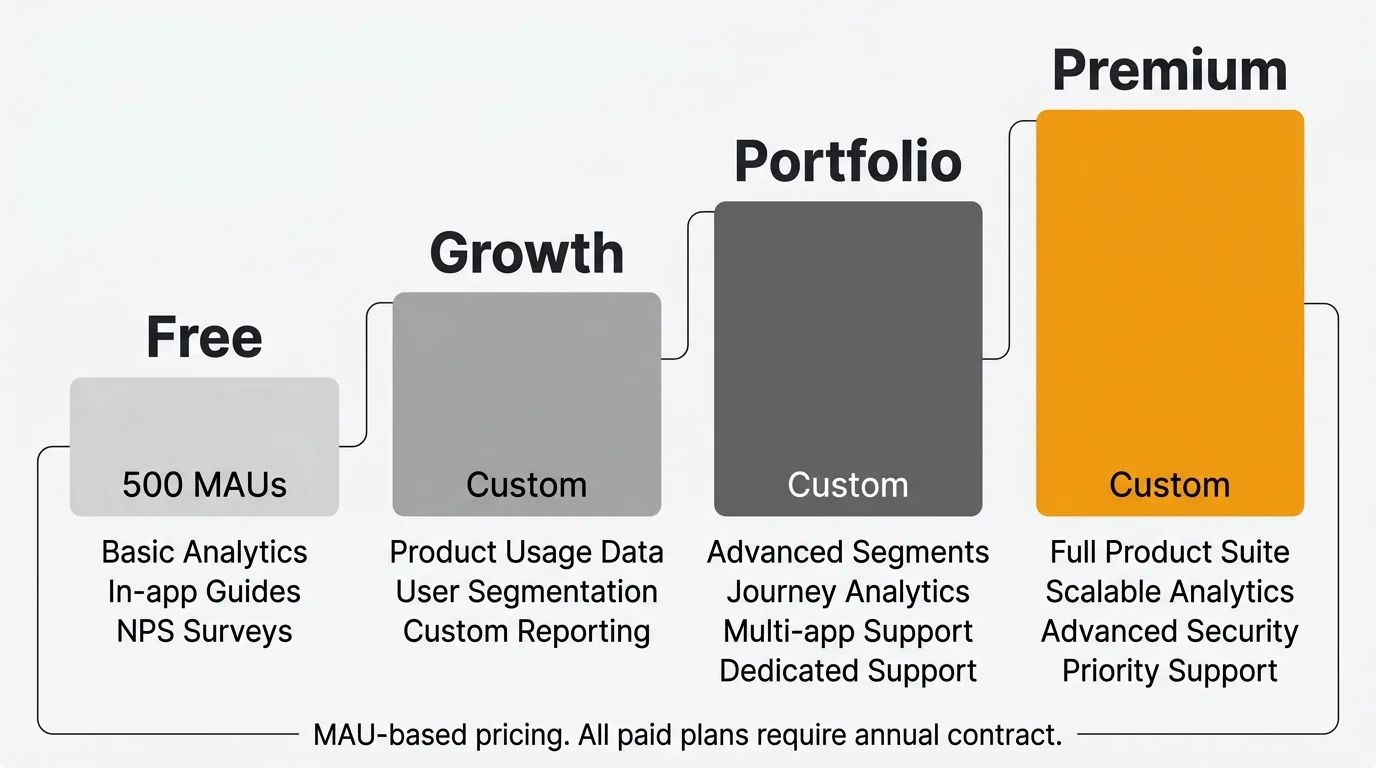
Pendo does not publish pricing publicly. Plans are based on monthly active users (MAUs), with most teams paying $10,000 to $50,000+ per year depending on MAU count and feature tier. A limited free plan covers up to 500 MAUs. If you mainly need feedback collection and roadmapping, focused alternatives like Quackback (free, open source) deliver that workflow without an MAU-based contract.
Pricing information based on publicly available data and user reports as of February 2026. Pendo does not publish pricing — contact their sales team for exact quotes.
Pendo's pricing plans
Pendo offers four plan tiers in 2026. One is free with limited features. The rest are custom-quoted through sales.
| Plan | Price | MAU Limit | Key Features |
|---|---|---|---|
| Free | $0 | 500 MAUs | Basic analytics, in-app guides (limited), NPS, 1 app |
| Growth | Custom | Custom | Full analytics, guides, feedback, roadmap, 1 app |
| Portfolio | Custom | Custom | Multiple apps, cross-product analytics, advanced segmentation |
| Premium | Custom | Custom | Session replay, data sync, advanced integrations, priority support |
The free plan covers up to 500 MAUs and is genuinely usable for small teams or internal tools. You get basic analytics, limited in-app guides, and NPS surveys. Once you exceed 500 MAUs or need features like the feedback module, public roadmaps, or integrations with your data warehouse, you move to a paid plan.
Growth is the first paid tier and covers the core product: full analytics, in-app guides, NPS, the feedback module, and roadmaps for a single app. Portfolio adds multi-app support and cross-product analytics — relevant for companies with multiple products or a platform with distinct modules. Premium adds session replay, advanced data sync, and dedicated support.
All paid plans are custom-priced through sales. You will not find a checkout button on Pendo's pricing page.
How Pendo pricing works
Pendo's billing model centers on monthly active users. An MAU is any user who interacts with your product in a given calendar month. If 3,000 people open your app in January, you have 3,000 MAUs that month.
MAU counts determine your pricing tier. Higher MAU counts mean higher costs, and Pendo uses your peak or average MAU count as the basis for annual contract pricing. Unlike tracked-user models (such as Canny's), where historical interactions accumulate, Pendo's MAU model resets each month — but your contract is set annually based on your expected MAU range.
Paid plans require annual contracts. There is no monthly billing option for Growth, Portfolio, or Premium. You negotiate a contract based on your current MAU count with some headroom built in, and renew (or renegotiate) at the end of the year. If your product grows significantly mid-contract, you may be required to upgrade your tier or pay overage fees.
Enterprise features — advanced security, SSO, dedicated infrastructure — are negotiated as part of the contract. Pendo's sales process is thorough: expect multiple meetings, a product demo, and a procurement cycle that can take several weeks.
Pendo pricing at scale
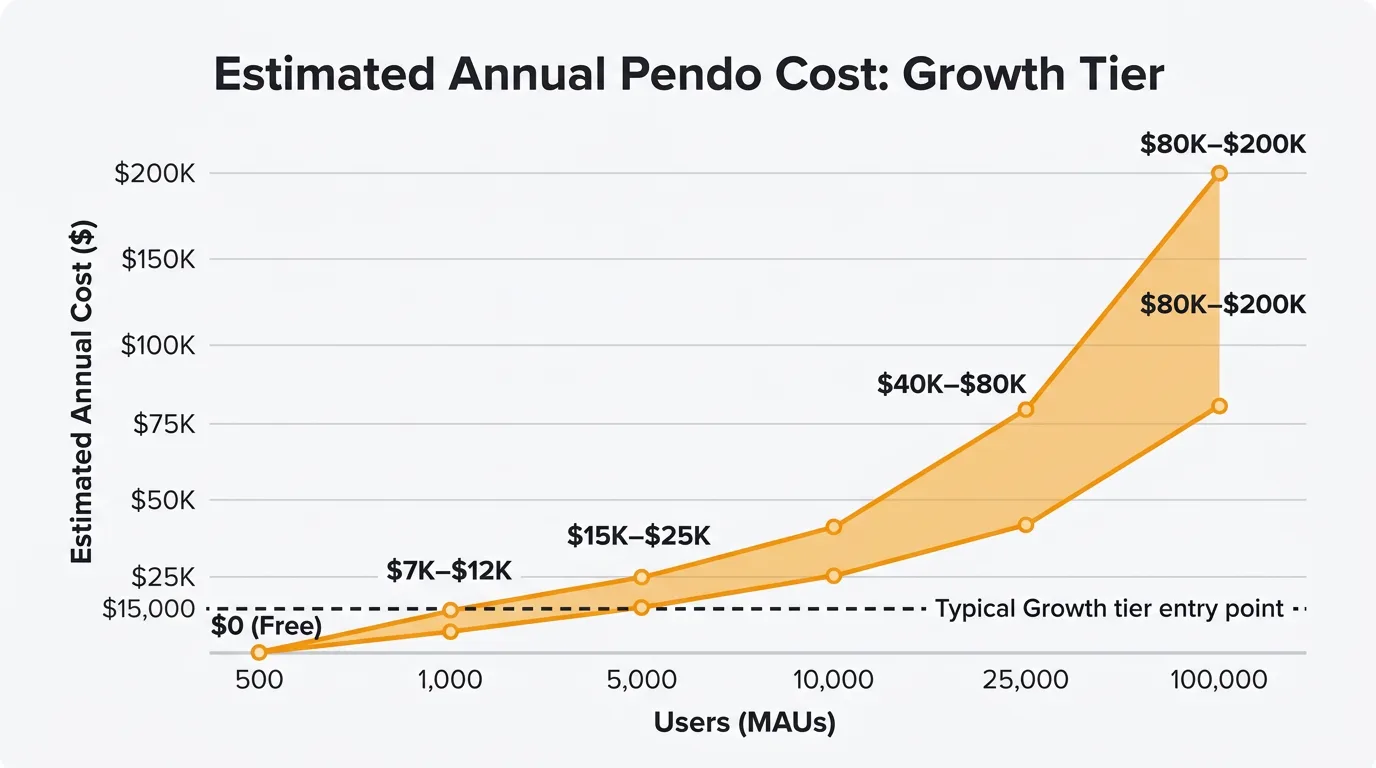
Pendo does not publish a pricing table, so the figures below are estimates based on publicly available user reports, G2 reviews, and industry data. Treat these as directional guidance, not official quotes.
| MAU Count | Estimated Annual Cost |
|---|---|
| 500 | Free |
| 1,000 | $7,000–$12,000 |
| 5,000 | $15,000–$25,000 |
| 10,000 | $25,000–$40,000 |
| 25,000 | $40,000–$80,000+ |
| 100,000+ | $80,000–$200,000+ |
These estimates are for the Growth tier with a single app. Portfolio and Premium tiers carry additional costs. Add-ons such as session replay or advanced data sync are priced separately on lower tiers.
The wide ranges reflect the variability in Pendo's negotiated pricing. Two companies with the same MAU count may pay significantly different amounts based on contract length, negotiation leverage, and which features they need.
What Pendo includes
Pendo is broad. The platform covers several distinct categories that most companies handle with separate tools.
Product analytics. Pendo tracks feature adoption, page views, session duration, retention cohorts, and funnel analysis. You can see which features users engage with, which they ignore, and how behavior differs across segments. This is the core of what Pendo does, and it does it well.
In-app guides. Walkthroughs, tooltips, lightboxes, and banners — all created with a no-code visual editor. You can trigger guides based on user behavior, segment, or lifecycle stage. This is how Pendo earns its "product experience" label.
NPS and polls. In-app surveys, NPS scoring, and targeted micro-surveys. Results feed back into Pendo's analytics so you can correlate sentiment with behavioral data.
Feedback module. A feedback board and voting system where users can submit and vote on feature requests. Feedback is visible to product managers alongside usage data. On paid plans, you can create a public roadmap.
Roadmaps. A visual roadmap linked to feedback votes. Product teams can prioritize based on vote counts and move items through planning, in-progress, and shipped stages.
Session replay. Available on Premium. You can watch recorded sessions to understand exactly how users navigate your product, including clicks, scrolls, and rage clicks.
Integrations. Salesforce, HubSpot, Zendesk, Slack, Jira, and others. Data sync with Snowflake and other data warehouses on higher tiers.
The breadth is genuine. Pendo is not padding a feature list — most of these capabilities work well. The question for each team is how many of them they actually need.
Hidden costs to consider
The MAU-based annual contract is only part of what Pendo costs.
Implementation takes weeks, not hours. Installing the Pendo snippet is straightforward. Getting value from analytics requires tagging every feature you care about, which takes engineering time. Setting up guides, configuring segments, and integrating with your CRM is a multi-week project. Most teams report 2–6 weeks before Pendo is fully operational. Factor in your team's time alongside the subscription cost.
MAU growth is unpredictable. Your contract is priced based on an MAU estimate. If your product grows faster than expected — a successful launch, a viral moment, a new enterprise customer with thousands of users — you may exceed your contracted MAU ceiling. Pendo will typically require you to upgrade or pay overage fees. You cannot easily dial usage back down.
Premium features are locked to higher tiers. Session replay is a Premium feature. Advanced data sync requires Portfolio or Premium. If your initial evaluation of Pendo was based on a feature that lives in a higher tier than you purchased, you'll face an upgrade conversation at renewal.
Annual contracts limit flexibility. You commit for a year upfront. If you decide Pendo isn't the right fit after three months — the analytics aren't being used, the guides are underutilized — you're still paying through the end of the contract. There is no monthly billing option and no standard pro-rata exit.
Professional services. Pendo offers implementation services, guide design, and training through its professional services team. These are not included in the subscription and carry their own costs. For teams without dedicated resources to manage Pendo, professional services can add thousands to the first-year total.
When Pendo makes sense
Pendo is well-suited to specific situations.
You are a mid-market or enterprise team that needs product analytics and feedback in one platform. The consolidation argument is strongest when you would otherwise pay for Mixpanel or Amplitude for analytics, Intercom or Appcues for in-app guides, and Canny or Productboard for feedback. Pendo collapses those subscriptions into one, which can be cost-effective at scale.
You have an existing Pendo investment. If your team already uses Pendo's analytics and guides, adding the feedback module is incremental. The data is already there; you're extending what you have rather than onboarding a new platform.
You need in-app guides alongside feedback. If your product requires guided onboarding, feature announcements, or contextual help — and you want those tied to the same analytics that tell you whether they worked — Pendo's integrated approach delivers something piecemeal tools cannot.
You have engineering resources for implementation. Pendo requires tagging. A team with dedicated product analytics engineering gets more out of Pendo than a team that installs the snippet and hopes the auto-capture is sufficient.
When Pendo is overkill
Pendo's breadth is a liability when you only need part of it.
If your primary need is collecting user feedback, letting users vote on feature requests, publishing a roadmap, and communicating what ships, you're paying for analytics and in-app guides you may never use. A $15,000–$40,000/year contract for a feedback board is difficult to justify, especially at the early stages of a product when you're still validating whether the product fits the market.
Pendo's feedback module is not its strongest suit. It works, but it is not the center of the product — analytics and guides are. If feedback collection and roadmapping are your primary workflow, a focused tool built specifically for that job will serve you better.
The same logic applies to startups and small teams. The free plan (500 MAUs) is a genuine option, but the jump from free to paid is large. There is no $19/mo self-serve plan. You go from free to a sales conversation and an annual contract. That gap excludes a large portion of the market.
Cheaper alternatives to Pendo
If you primarily need feedback collection, feature voting, roadmaps, and changelogs, several tools deliver that workflow at a fraction of Pendo's cost — or for free.
Quackback
Quackback is free, open source (AGPL-3.0), and self-hosted, with a managed Quackback Cloud from $29/mo on annual billing if you would rather not run it yourself. It covers feedback boards, voting, a public roadmap, changelogs, and 25 integrations. AI features and SSO/OIDC are included free on every self-hosted installation, working with OpenAI-compatible providers. On Cloud, Quinn is included on paid plans, and SSO is self-serve on Enterprise. An MCP server lets you query and triage feedback directly from your AI tools, which Pendo, Canny, and Productboard do not offer. Self-host with Docker or deploy on Railway. See the full comparison of Quackback vs Pendo.
Canny
Canny has a free plan (25 tracked users) and paid tiers starting at $19/mo. It covers feedback boards, voting, roadmaps, and changelogs. Onboarding takes minutes. The trade-off is tiered tracked-user pricing where costs increase as you cross user thresholds. Still a fraction of Pendo's entry price for teams that don't need analytics or in-app guides.
Featurebase
Featurebase bundles feedback boards, a changelog, a roadmap, and a support inbox. A free plan exists (1 seat, limited features). Paid plans start at $29/seat/month. Lightweight and quick to set up. Closed source and hosted only.
Productboard
Productboard is a product management platform with feedback collection, roadmapping, and prioritization frameworks. Paid plans start at $19/maker/month. It is more structured than Canny or Quackback and better suited to teams with mature prioritization workflows. It does not include analytics or in-app guides.
Comparison table
| Pendo | Quackback | Canny | Featurebase | Productboard | |
|---|---|---|---|---|---|
| Starting price | Free (500 MAUs) | Free (self-hosted) | Free (25 tracked users) | Free (1 seat) | $19/maker/mo |
| First paid tier | Custom (sales) | $29/mo (Cloud) | $19/mo | $29/seat/mo | $19/maker/mo |
| Pricing model | MAU-based (annual) | Workspace (Cloud) or free self-hosted | Tiered tracked users | Per seat | Per maker seat |
| Self-hosting | No | Yes (Docker) | No | No | No |
| Open source | No | Yes (AGPL-3.0) | No | No | No |
| Feedback boards | Yes | Yes | Yes | Yes | Yes |
| Roadmaps | Yes | Yes | Yes | Yes | Yes |
| Changelog | No | Yes | Yes | Yes | No |
| Product analytics | Yes | No | No | No | No |
| In-app guides | Yes | No | No | No | No |
| Session replay | Premium tier | No | No | No | No |
| SSO | Enterprise | Free self-hosted · Enterprise plan on Cloud | Business (custom) | $59/seat/mo plan | Enterprise |
| AI features | Limited | Quinn on paid Cloud · BYOK self-host | Autopilot (all plans) | $0.49/resolution | Limited |
| MCP server | No | Yes | No | No | No |
| Annual contract required | Yes | No | No | No | No |
For teams focused on the feedback and roadmap workflow, Quackback, Canny, or Featurebase will cover most needs at a significantly lower cost. For teams that genuinely need analytics, in-app guides, and feedback in one place, Pendo is a serious option — but the price reflects that breadth.
For a broader look at the category, see Best Customer Feedback Tools in 2026, Pendo Alternatives, and Feedback Tool Pricing Comparison.
Try Quackback — open source with a managed cloud option. Start free. Get started | View on GitHub
Frequently asked questions
How much does Pendo cost?
Pendo does not publish pricing publicly. The free plan covers up to 500 MAUs. Paid plans are custom-quoted through sales based on your monthly active user count. User reports put Growth tier pricing around $7,000–$25,000 per year for 1,000–10,000 MAUs, with annual contracts required.
Does Pendo have a free plan?
Yes. Pendo's free plan supports up to 500 MAUs and includes basic analytics, limited in-app guides, and NPS surveys for a single app. The feedback module, roadmap, and advanced analytics are restricted. Once you exceed 500 MAUs or need those features, you enter the custom-pricing sales process.
What is Pendo used for?
Pendo is a product experience platform. Its core use cases are product analytics (feature adoption, retention, user behavior), in-app guides (walkthroughs, tooltips, onboarding flows), and user feedback (feature requests, NPS, polls, public roadmaps). B2B SaaS teams use it to combine these capabilities in one platform rather than separate tools.
Is Pendo worth the cost for small teams?
Generally not. The gap between Pendo's free plan (500 MAUs) and a custom-quoted annual contract is large, with no self-serve middle ground. Small teams that mainly need feedback and a public roadmap get the core workflow cheaper from focused tools like Quackback (free, open source), Canny, or Featurebase.

Authored by James Morton
Founder of Quackback. Building open-source feedback tools.
Try Quackback
The open-source feedback platform. Boards, voting, and roadmaps.
Get startedStar on GitHub305