
Most teams add a voting board, watch the upvotes pile up, and then realize the rankings tell them what their loudest users want, not what their business needs. Feature voting is supposed to replace guesswork with evidence. Done badly, it just replaces one bias with another. This guide shows you how to run voting so it informs real decisions instead of staging a popularity contest.
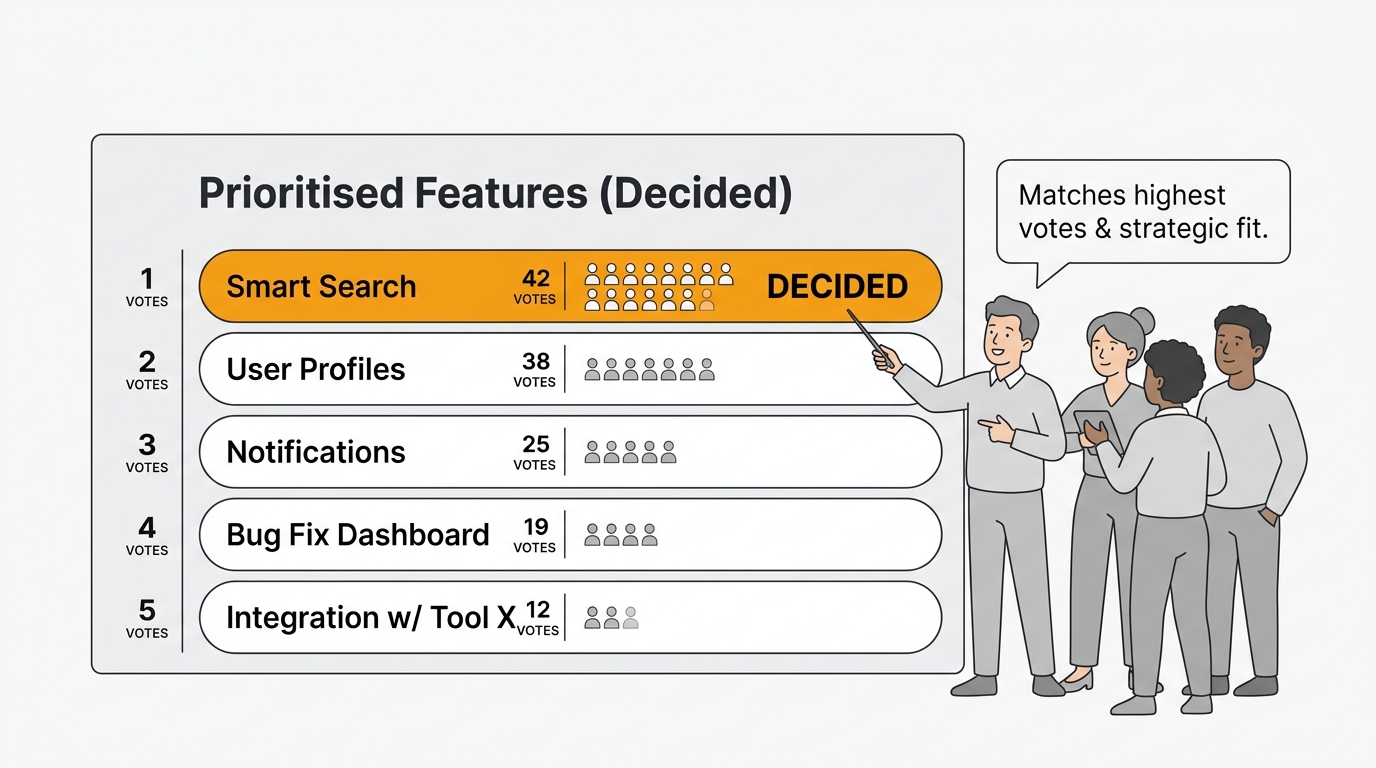
Feature voting is a system that lets users upvote product requests so demand becomes a ranked, quantified signal instead of a pile of anecdotes. It beats raw request counts because one consolidated post with 200 votes is clearer than 200 scattered tickets. To avoid a popularity contest, weight votes by customer value, prevent duplicate fragmentation, and treat votes as input to prioritization rather than a binding poll.
What is feature voting?
Feature voting is a mechanism that lets users upvote feature requests to signal demand, producing a ranked list of what your user base wants most. Instead of reading a hundred support tickets and guessing which need is widespread, you see exactly how many people asked for each capability and who they are.
The mechanics are simple. Users submit ideas to a feedback board, browse what others have posted, and click to upvote the requests they care about. Each post accumulates votes in real time. Sort by votes and the most-wanted features rise to the top. Quackback adds one-click voting for both anonymous and authenticated users, so the friction between wanting a feature and registering that want is a single tap.
Voting is not the same as a poll. A poll asks users to choose from options you defined, which limits you to needs you already anticipated. Voting lets users propose their own ideas and rank each other's, surfacing demand you never thought to ask about. That is the difference between confirming your assumptions and discovering what you missed.
Why votes beat raw request counts
A raw request count tells you how many times something was mentioned. A vote count tells you how many distinct people want it. Those are different numbers, and the gap matters.
Without voting, the same feature shows up as five support tickets, three sales notes, and a Slack thread. You count six mentions and treat it as moderate demand. With a voting board, those signals consolidate into one post that 240 people upvoted. The request did not get more popular. You finally measured it accurately.
Votes also give you defensible prioritization. Product managers are constantly asked to justify why one thing shipped before another. "I think users want this" loses every argument. "247 users voted for this, and here are their comments" wins. Voting converts opinion into evidence your stakeholders can audit. For the framework side of turning that evidence into a sequence, see how to track and prioritize feature requests and the RICE scoring framework.
There is one catch. Raw vote counts favor whatever your largest segment wants, which is usually your free tier. That is where voting tips into a popularity contest, and where the next few sections matter most.
Single voting vs weighted voting
The default everywhere is single voting: every user gets one vote per post, and all votes count equally. It is simple, transparent, and resistant to obvious manipulation. It is also blind to who is voting.
Weighted voting (sometimes called value voting) assigns different weight to votes based on the voter. Ten upvotes from enterprise accounts paying $50,000 a year are not the same business signal as ten from free-trial users who may churn next week. Weighting lets you reflect that.
You can weight along a few axes:
- Revenue or plan tier. Surface what paying customers want above what the free tier wants.
- Company size or segment. See which features matter to the accounts you are trying to land or retain.
- Account health or strategic fit. Give weight to the customers whose renewal you most need to protect.
The trade-off is honesty. Weighting is the right call for most B2B products, where a handful of accounts drive most of the revenue. But it can quietly bury what your broad user base needs, and an opaque weighting scheme erodes trust if users notice that their votes do not move the board. Keep the public board showing real vote counts, and apply weighting in your internal prioritization view rather than rewriting the numbers users see.
In practice, segmentation gets you most of the value without the downsides. Rather than baking weights into the tally, filter and sort the same vote data by plan, revenue, or company. Quackback and Featurebase both let you slice votes by customer attributes, though Featurebase places user segmentation on its Professional plan at $59 per seat per month. Pricing last verified May 2026. Vendors may change plans without notice.
Preventing gaming and vote fragmentation
Two problems quietly corrupt vote data. One is gaming. The other is fragmentation. Fragmentation is the more common and the more damaging.
Vote fragmentation
Vote fragmentation happens when the same underlying request exists as several separate posts, splitting the votes across all of them. "Dark mode," "night theme," and "darker UI option" might each collect 40 votes. Your real top request has 120 votes and looks like three mediocre ones. You build the wrong thing because the data lied to you.
The fix is deduplication and merging. The strongest version catches duplicates at submission time, before they fragment anything. Quackback uses AI duplicate detection to flag when a new post matches an existing one, then suggests a merge that consolidates the votes and the comments into a single thread. The 120 votes stay together where you can see them. Tools without this require you to manually review new posts every week and merge by hand, which works until your board gets busy and then quietly stops working.
Gaming and vote integrity
Gaming is when someone inflates a count, usually by voting repeatedly. The defense is vote integrity: one vote per user per post. Authenticated voting ties each vote to an account, which makes manipulation hard and gives you accurate per-account data. Anonymous voting lowers friction but needs a guard such as browser fingerprinting to stop trivial repeat votes. Quackback enforces one vote per user, supports both anonymous and authenticated voting, and gives admins override tools to clean up bad votes without policing the board manually.
A quieter form of gaming is internal: a single sales rep filing twenty separate requests on behalf of one account to make it look like broad demand. The answer is the same as fragmentation. Consolidate to the account, and let one customer count as one customer.
Voting on behalf of customers
Not everyone who wants a feature will visit your board. Enterprise buyers mention requests on calls. Support agents hear the same ask ten times a day. If those signals never reach the board, your vote data systematically under-counts your most valuable customers, which is exactly backward.
Vote-on-behalf lets your team record a vote for a customer who told you about a need through another channel. The agent on the support call adds the customer's vote to the existing post instead of asking them to go log in and click. The board now reflects real demand, including the demand that arrives through humans rather than the widget.
This is where several tools differ. Featurebase's Fibi AI agent can submit votes on behalf of customers during support conversations. Canny discovers requests inside connected support tools and attributes them, though its tracked-user pricing means every voter you add is a billable user, and revenue-weighted prioritization sits on its Growth plan. Pricing last verified May 2026. Vendors may change plans without notice. Quackback lets your team vote on behalf of a customer and attribute it to their account, so a single agent recording a real customer ask strengthens the signal instead of inflating it. Because votes consolidate through dedup and merge, those on-behalf votes land on the right post rather than spawning a new fragment.
Turning votes into decisions
A voting board is not a vending machine where the top item ships automatically. Votes are an input to prioritization, not a verdict. Treating them as binding is how teams build for their noisiest users and neglect strategy. Here is how to act on votes without surrendering judgment:
- Read the comments, not just the count. Two posts with 100 votes can describe very different urgency. The comments tell you the why. A request with 100 votes and detailed workflow descriptions is a stronger signal than 100 silent upvotes.
- Cross-reference with a framework. Run your top-voted items through RICE or a similar method. Reach is what votes measure well. Impact, confidence, and effort still need your input.
- Segment before you rank. Look at who voted. Filter by plan or revenue so a feature wanted by ten enterprise accounts is not buried under one wanted by a thousand free users who will not pay for it.
- Reserve room for strategy. Some of the most important work has few votes because users cannot vote for what they cannot imagine. Protect roadmap space for bets that move the product forward even when the board is quiet on them.
- Close the loop. When you ship a voted feature, notify the voters. When you decline one, say why. Quackback notifies voters automatically through status changes and the changelog, which keeps people voting because they see that voting leads to action.
The teams that get the most from feature voting treat it as a continuous demand signal feeding a deliberate prioritization process, not as a leaderboard that dictates the sprint. For a deeper comparison of the platforms that support this workflow, see our ranked guide to the best feature voting tools. For the underlying concept of the feedback board that hosts the votes, see the glossary.
Why Quackback handles voting differently
Quackback is built so vote data stays accurate as your board scales. AI duplicate detection and one-click merge keep votes consolidated, so your top request never hides behind three half-counted clones. Vote-on-behalf lets your team capture demand from support and sales calls and attribute it to the right account. Voter segmentation lets you weight by customer value in your internal view without distorting the public count. An MCP server lets AI assistants query and triage vote data directly.
Try Quackback — open source with a managed cloud option. Start free. Get started | View on GitHub
Frequently asked questions
What is the difference between single and weighted feature voting?
Single voting gives every user one equal vote per request, which is simple and transparent. Weighted voting assigns more value to votes from certain users, such as high-revenue accounts. Most B2B teams keep public counts unweighted and apply weighting through segmentation in an internal prioritization view.
How do I stop duplicate posts from splitting my vote counts?
Use a tool with AI duplicate detection that flags matching requests at submission time and suggests a merge. Merging consolidates votes and comments into one post, so your most-requested feature shows its true total. Without it, review new submissions weekly and merge related posts by hand.
Can my team vote on behalf of customers?
Yes, with tools that support vote-on-behalf. When a customer mentions a request on a call or in support, an agent records the vote against the existing post and attributes it to that account. Quackback supports this, so demand arriving through humans still reaches your board accurately.
Does the most-voted feature have to be built next?
No. Votes are an input to prioritization, not a binding poll. Read the comments behind the count, segment by customer value, run items through a framework like RICE, and reserve roadmap space for strategic work that users cannot vote for because they cannot yet imagine it.
Is feature voting better than counting support requests?
Yes. Raw request counts measure how often something is mentioned, often duplicating the same need. Votes measure how many distinct people want it, consolidated into one ranked post. Voting also gives you defensible, auditable demand data that stakeholders can verify rather than scattered anecdotes.

Authored by James Morton
Founder of Quackback. Building open-source feedback tools.
Try Quackback
The open-source feedback platform. Boards, voting, and roadmaps.
Get startedStar on GitHub305