
A go-to-market strategy is not a marketing plan. It is the bridge between building something and getting it into the hands of people who will pay for it.
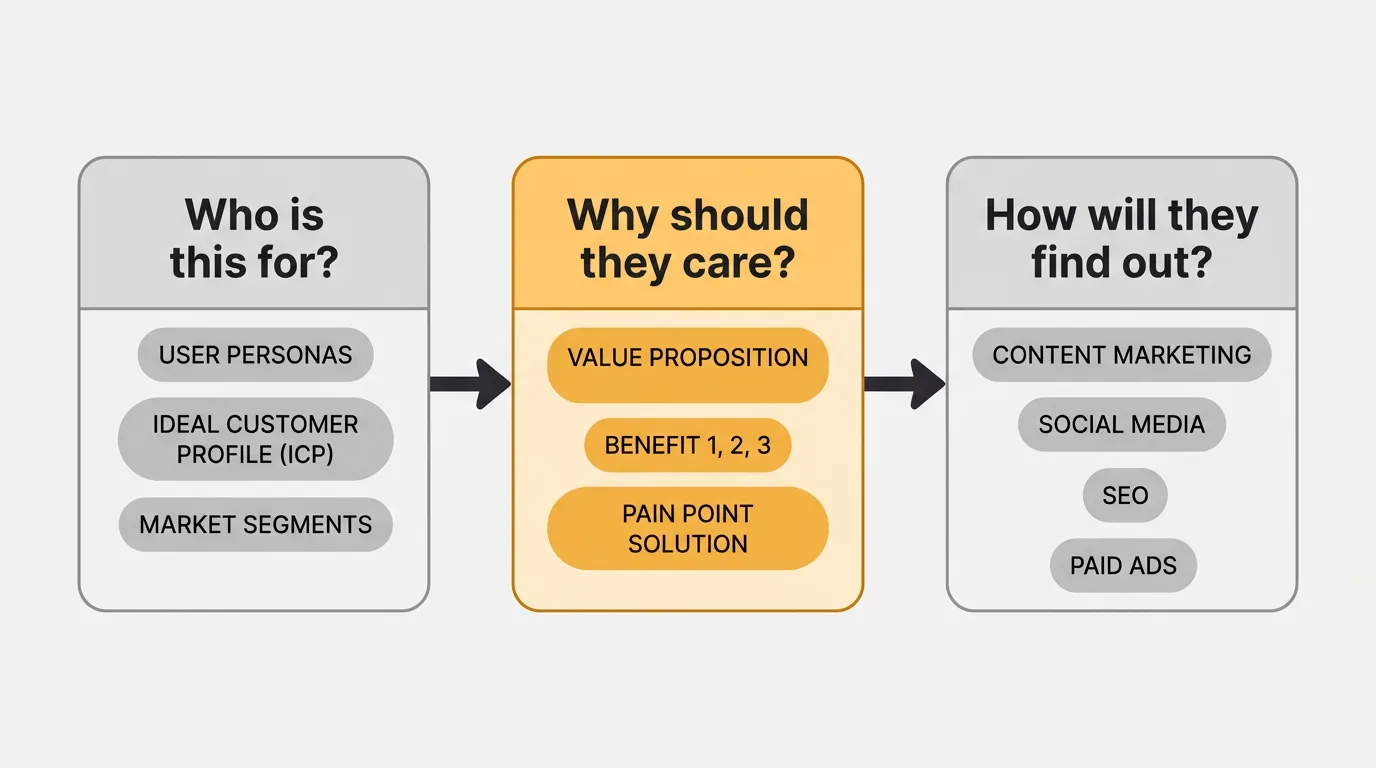
Most SaaS teams build first and figure out distribution later. The result is a good product that nobody knows about, positioned for an audience that does not exist, priced in a way that does not match how customers buy. A GTM strategy forces you to answer the hard questions before you launch — not after.
This template covers the six components of a SaaS GTM strategy with practical guidance for each. It works for new products, new features, new markets, and pricing changes.
The GTM template
1. Target audience
Who is this for? Be specific. "SaaS companies" is not a target audience. "Product managers at B2B SaaS companies with 50-500 employees who currently track feature requests in spreadsheets" is.
Define your Ideal Customer Profile (ICP):
| Dimension | Your answer |
|---|---|
| Company size (employees) | |
| Industry or vertical | |
| Annual revenue range | |
| Tech stack or tool usage | |
| Pain point or trigger event | |
| Decision maker role | |
| Budget authority |
Define your buyer personas (2-3 max):
For each persona, document:
- Job title and reporting structure
- Daily workflow and tools used
- Primary pain point your product solves
- How they currently solve the problem (the alternative you are replacing)
- What success looks like for them
- How they evaluate and buy software (self-serve, sales-assisted, procurement)
2. Value proposition
Why should they care? Your value proposition is the intersection of what your product does, what the customer needs, and what competitors do not offer.
Template:
For [target persona] who [pain point or situation], [product name] is a [category] that [key benefit]. Unlike [primary alternative], we [key differentiator].
Example:
For product managers who lose feature requests across Slack, email, and support tickets, Quackback is an open-source feedback tool that centralizes requests with voting and AI-powered analysis. Unlike Canny or Productboard, you own your data.
Test your value proposition: Can a stranger read it and understand (a) who it is for, (b) what it does, and (c) why it is different? If any of those are unclear, revise.
3. Positioning and messaging
How do you want to be perceived? Positioning is the mental space you occupy in the customer's mind relative to alternatives.
Positioning dimensions:
| Dimension | Your position |
|---|---|
| Category | What type of product are you? (e.g., "feedback management tool") |
| Primary competitor | Who do customers compare you to? |
| Key differentiator | What do you do that they do not? |
| Price position | Are you cheaper, comparable, or premium? |
| Target segment | Enterprise, mid-market, SMB, or developer? |
Messaging hierarchy:
- Headline — one sentence that captures the primary benefit
- Subheadline — one sentence that adds specificity or addresses a common objection
- Three pillars — the three most important capabilities, each with a one-sentence description
- Proof points — customer quotes, metrics, case studies, or social proof
4. Channel strategy
How will they find out? Choose channels based on where your target audience already spends time, not where you want them to be.
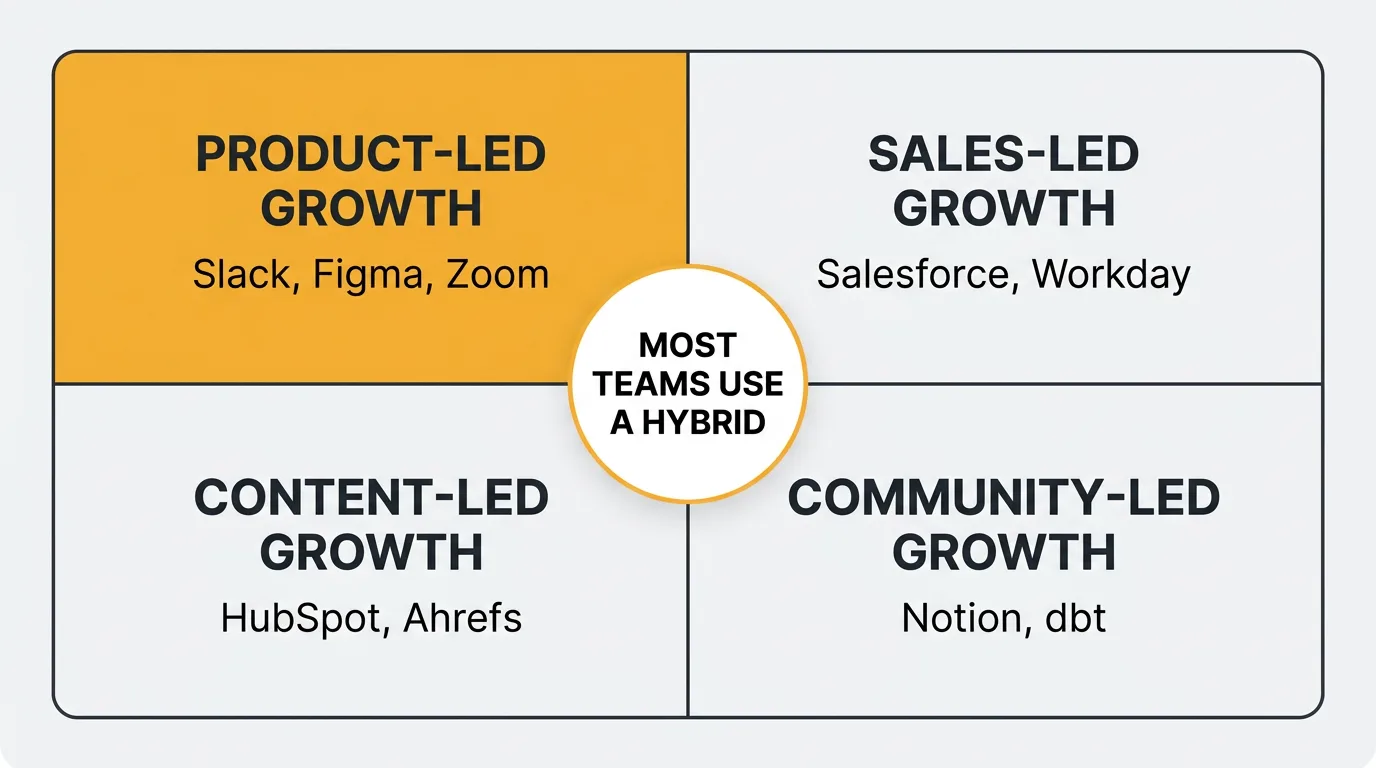
Product-led growth (PLG)
The product is the primary acquisition channel. Users sign up, experience value, and convert to paid without talking to sales.
Works when: The product delivers value quickly (minutes, not months), the price point is low enough for self-serve purchasing, and the user and buyer are the same person.
Tactics: Free tier or trial, in-product onboarding, viral loops (inviting teammates), community and word-of-mouth, content marketing for organic discovery.
Examples: Slack, Notion, Figma, Linear.
Sales-led growth
Sales teams drive acquisition through outbound prospecting, demos, and relationship building.
Works when: The price point justifies sales involvement ($10K+ ACV), the buying process involves multiple decision-makers, and the product requires customization or integration.
Tactics: Outbound email, LinkedIn outreach, conference networking, partner referrals, sales engineering demos.
Examples: Salesforce, Workday, Pendo.
Content-led growth
Educational content drives organic traffic that converts to product signups.
Works when: Your target audience actively searches for solutions to the problems you solve, the sales cycle involves research, and you can produce content at a quality level that ranks.
Tactics: SEO blog content, comparison pages, template resources, webinars, podcasts, changelog as content.
Examples: HubSpot, Ahrefs, Buffer.
Community-led growth
A community of users and advocates drives awareness and adoption through peer recommendations.
Works when: Your product serves a passionate niche, users benefit from connecting with each other, and your category has a strong practitioner community.
Tactics: User forums, Slack or Discord communities, user conferences, ambassador programs, open source contributions.
Examples: Figma, dbt, Notion.
Most SaaS companies use a combination. A PLG company still needs content for organic discovery. A sales-led company still benefits from a free trial that lets prospects experience the product before a demo. Choose your primary motion and supplement with secondary channels.
5. Pricing strategy
How will they pay? Pricing is a GTM decision, not just a finance decision. It determines your acquisition channel (self-serve vs sales-assisted), your customer segment (SMB vs enterprise), and your expansion model (seat-based, usage-based, or feature-gated).
Key pricing decisions:
| Decision | Options |
|---|---|
| Billing model | Per seat, per usage, flat rate, freemium |
| Free tier | Yes / No / Trial only |
| Annual vs monthly | Annual discount incentive or monthly only |
| Self-serve checkout | Yes (PLG) / No (sales-assisted) / Both |
| Pricing page transparency | Published prices / "Contact sales" |
For a deep dive into how SaaS companies price their products, see our feedback tool pricing comparison.
6. Launch timeline
When and how will you go to market? A realistic timeline for a SaaS GTM execution:
| Week | Activity |
|---|---|
| Weeks 1-2 | Finalize ICP, personas, and value proposition. Validate with 5-10 customer interviews. |
| Weeks 3-4 | Build messaging, positioning, and channel plan. Create sales enablement materials. |
| Weeks 5-6 | Prepare launch assets: landing page, blog post, email sequences, demo video. |
| Week 7 | Beta launch to early access group. Collect feedback. |
| Week 8 | Public launch. Execute across all channels. Monitor and iterate. |
For a detailed launch execution plan, see our product launch checklist.
GTM for different scenarios
New product
Full GTM required. All six components above need to be defined from scratch. The highest risk is targeting the wrong audience — validate your ICP with customer interviews before investing in channels.
New feature
Lighter GTM. Your audience, positioning, and channels already exist. Focus on: which customer segment benefits most, how to communicate the value to existing customers (changelog, email, in-app), and whether the feature changes your competitive positioning.
New market
Medium GTM. Your product exists, but your audience and positioning may need to change. A product that sells to startups in the US may need different messaging, pricing, and channels to sell to enterprises in Europe.
Pricing change
Targeted GTM. Focus on: communicating the change to existing customers (transparency matters more than spin), updating all public-facing pricing pages, and retraining sales on the new model.
Validating your GTM with feedback
The riskiest assumption in any GTM strategy is that you understand what your audience wants. Customer feedback validates or invalidates that assumption before you scale.
Before launch: Run your value proposition by 5-10 people in your target audience. Do they understand it? Does it resonate? Do they identify with the pain point? If not, revise before investing in channels.
During beta: Collect feedback from early users through a feedback widget or board. What do they love? What confuses them? What is missing? Beta feedback shapes your launch messaging — if every beta user mentions the same benefit, lead with that.
After launch: Monitor feedback for patterns. If customers describe your product differently than your messaging does, listen to them. Their language is often better than yours because it reflects how they actually think about the problem.
Common GTM mistakes
Targeting everyone. A GTM strategy that targets "all SaaS companies" is a GTM strategy that targets nobody. Narrow your ICP until it feels uncomfortably specific. You can expand later.
Leading with features instead of outcomes. Customers do not buy features. They buy outcomes. "AI-powered feedback analysis" is a feature. "Know what your customers want without reading 500 tickets" is an outcome.
Choosing channels before understanding the audience. "We should be on TikTok" is not a strategy. It is a guess. Choose channels where your audience already spends time, not channels that are trending.
Skipping the pricing conversation. Pricing determines everything downstream — acquisition channel, customer segment, sales motion, and unit economics. Decide pricing early, not after launch.
No feedback loop. A GTM strategy is a hypothesis. It needs to be tested and refined based on what happens when real customers encounter your product. Build feedback collection into your launch plan from day one.
Frequently asked questions
How long does it take to build a GTM strategy?
Four to eight weeks for a new product, including customer validation. Two to four weeks for a new feature or market. One to two weeks for a pricing change. The research and validation phases take longer than the documentation.
Do I need a GTM strategy for a feature launch?
A lightweight one, yes. You need to know which customers benefit, how to communicate the value, and how to measure success. You do not need a full ICP exercise or channel strategy — those already exist. See our product launch checklist for the feature-launch version.
What is the difference between a GTM strategy and a marketing plan?
A GTM strategy defines who your customer is, what your value proposition is, and which channels you will use to reach them. A marketing plan is the tactical execution of the channel strategy — specific campaigns, content calendars, ad budgets, and performance targets. GTM comes first; the marketing plan follows.
How do I choose between PLG and sales-led?
It depends on your average contract value (ACV) and buying complexity. Products under $10K ACV with a single decision-maker work well with PLG. Products over $50K ACV with multiple stakeholders typically need sales-led. Products in between often use a hybrid: PLG for acquisition and sales for expansion.
How do I know if my GTM strategy is working?
Track three metrics: customer acquisition cost (CAC) by channel, time-to-first-value for new users, and conversion rate from free to paid (for PLG) or from demo to close (for sales-led). If CAC is rising, your targeting or channel mix needs adjustment. If time-to-first-value is high, your onboarding or product experience needs work.

Authored by James Morton
Founder of Quackback. Building open-source feedback tools.
Try Quackback
The open-source feedback platform. Boards, voting, and roadmaps.
Get startedStar on GitHub305