
Upvoty covers the basics. Boards, voting, a roadmap, and a changelog — the core feedback workflow in a single hosted tool. For teams that need exactly that and nothing more, it works.
But "simple" also means limited. Upvoty has no AI features. No open-source option. No self-hosting. The integration list is short. And the product has seen minimal development in recent years while competitors have added AI analysis, duplicate detection, MCP servers, and deeper integrations with the tools product teams already use.
Upvoty's pricing is per-board on lower tiers. The Power plan ($15/mo) covers one board. Multi-product teams on the Superpower plan ($39/mo) get unlimited boards. There are no tracked-user limits, which is an advantage over Canny. But there is also no free tier — once the trial ends, you pay.
Teams that outgrow Upvoty typically want one of three things: more features (AI, better integrations, changelog history), a free or open-source option, or a clearer product development roadmap from the vendor. Here are seven alternatives worth considering.
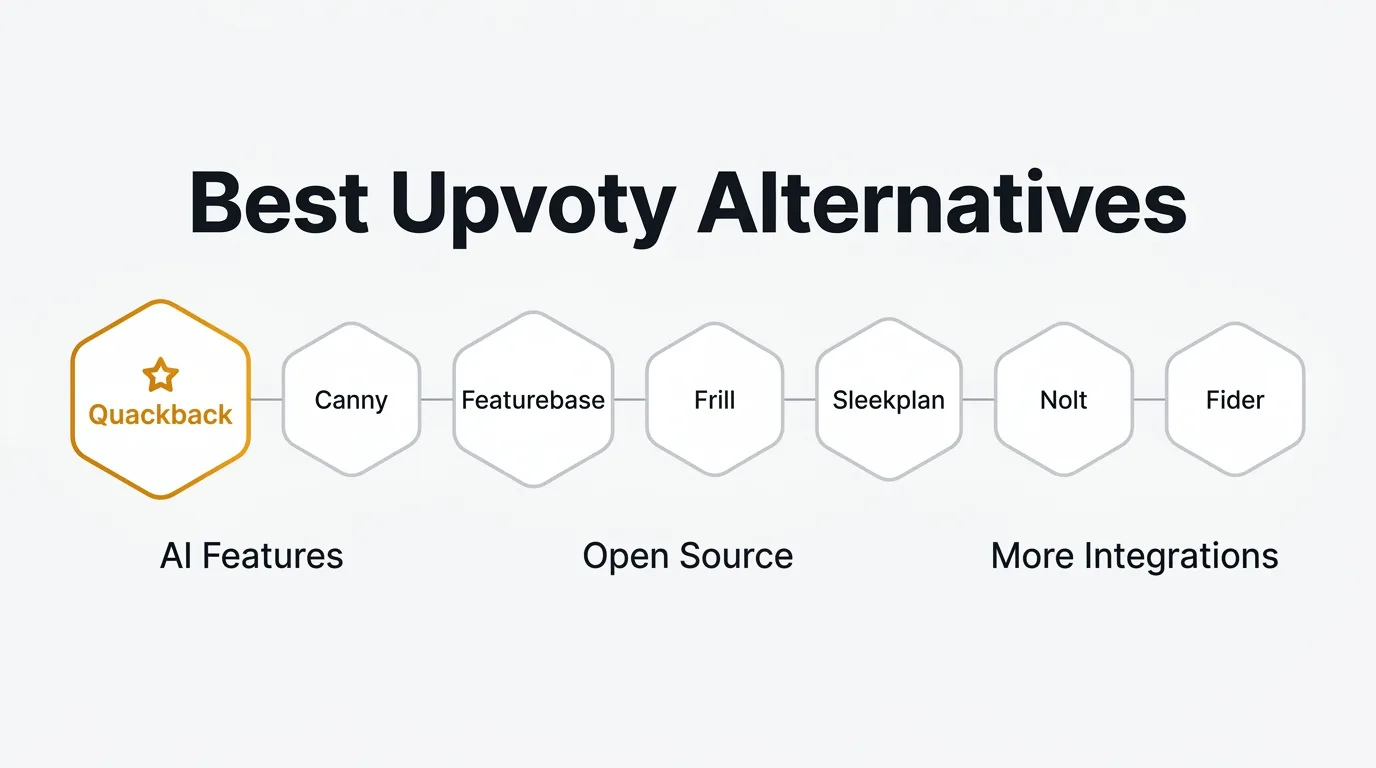
The best Upvoty alternative is Quackback, an open-source feedback tool you can self-host for free or run on Quackback Cloud, with built-in AI and an MCP server. Featurebase and Sleekplan are the strongest hosted options with free tiers, and Canny offers the deepest integrations. The full ranked list:
- Quackback — Open source, self-hosted free or managed cloud. AI + MCP server included.
- Canny — Established feedback tool with strong integrations and AI Autopilot. From $19/mo.
- Featurebase — Free tier with feedback, changelog, roadmap, and a support inbox.
- Frill — Simple and affordable with clean boards and a changelog. From $25/mo.
- Sleekplan — Widget-first with built-in NPS/CSAT surveys. From $13/mo.
- Nolt — Flat-rate pricing, clean feedback boards, no per-user billing. $29/mo.
- Fider — Open source, bare-bones voting board. Free to self-host.
Pricing last verified February 2026. Vendors may change plans and pricing without notice. Check each vendor's pricing page for the latest figures.
Why teams switch from Upvoty
The most common reasons teams look for an Upvoty alternative:
- No AI features. Upvoty has no duplicate detection, no merge suggestions, no sentiment analysis, and no AI-assisted triage. As feedback volumes grow, manual curation becomes the bottleneck. Competitors have invested heavily in AI tooling; Upvoty has not.
- Limited integrations. Upvoty connects to Slack, Jira, and Zapier. There is no native Linear, GitHub, Intercom, Zendesk, or Salesforce integration. Teams with established stacks often hit this ceiling quickly.
- No open-source or self-hosting option. Your data lives on Upvoty's servers with no alternative. Teams with data residency requirements or a preference for infrastructure ownership have no path forward.
- Minimal product development. As of early 2026, Upvoty's public changelog shows few notable feature additions, and long-standing requests — a better API, post merging, user segmentation — remain unbuilt.
- No free tier. Unlike Featurebase and Sleekplan, Upvoty has no free plan. You pay from day one.
- Per-board pricing. Multi-product teams on the Power plan pay per board. Managing feedback across several products or internal tools gets expensive before you reach the flat-rate Superpower plan.
1. Quackback
Quackback is open source (AGPL-3.0), self-hosted, and free. No feature gates.
You get the full feedback workflow in a single product: feedback boards with voting, a public roadmap, a changelog, SSO/OIDC, custom branding, and 25 integrations including Slack, Jira, Linear, GitHub, Intercom, Zendesk, and Salesforce. Everything Upvoty lacks — AI, self-hosting, open source, deep integrations — is included at no cost when you self-host.
The AI features are where Quackback pulls well ahead of Upvoty. Duplicate detection catches redundant posts before they pile up. Merge suggestions identify related requests with reasoning your team can accept or dismiss in one click. Sentiment analysis runs on every post. Summaries pull out key quotes and next steps.
The MCP server is something no other feedback tool in this category offers. It implements the Model Context Protocol, the standard that Claude, Cursor, and Windsurf support. Connect an AI agent and it gets full, structured access to your feedback data: search posts, triage requests, write responses, create changelog entries, and merge duplicates. Every action is attributed and auditable.
Key features:
- Feature request boards with voting, status tracking, and nested comments
- Public roadmap and changelog with automatic voter notifications
- Built-in AI: duplicate detection, merge suggestions, sentiment analysis, post summaries
- MCP server for AI agents (search, triage, respond, create, merge)
- 25 integrations: Slack, Linear, Jira, GitHub, Intercom, Zendesk, Salesforce, and more
- SSO/OIDC, webhooks, full REST API
- Custom branding with themes, custom CSS, and your own domain
Pricing: Free and open source to self-host with Docker, or run it on the managed Quackback Cloud if you would rather not manage infrastructure.
Pros:
- Full-featured feedback, roadmap, and changelog in one product
- AI included at no extra cost when self-hosted (bring your own model key)
- MCP server for AI agent access
- Open source — audit the code, fork it, own your data
- Self-host for free or use the managed cloud
- 25 integrations, SSO, and custom branding included on every self-hosted installation
Cons:
- Self-hosting means you manage your own infrastructure (the managed cloud removes this)
- Newer project with a smaller community than established SaaS tools
Best for: Teams that want open-source, self-hosted feedback with AI and no usage limits.
For a detailed side-by-side breakdown, see the full Quackback vs Upvoty comparison.
Try Quackback — open source with a managed cloud option. Start free. Get started | View on GitHub
2. Canny
Canny is one of the most established feedback tools in the category. It covers boards, voting, a roadmap, and a changelog — the same core workflow as Upvoty — with a stronger integration suite and a more active development pace.
Where Upvoty's integration list tops out at Slack, Jira, and Zapier, Canny connects natively to Linear, GitHub, ClickUp, Intercom, Zendesk, Salesforce, HubSpot, and more. The Autopilot AI feature, included on all paid plans, detects feedback from Intercom and Zendesk conversations and automatically creates posts on your board without manual triage.
The trade-off is pricing structure. Canny moved to tiered tracked-user pricing in May 2025. A tracked user is anyone who posts, votes, or comments. Costs increase as you cross tier thresholds, and auto-upgrades to the next tier can catch teams off guard. The Core plan starts at $19/mo (annual) for 100+ tracked users. Jira, Linear, and ClickUp integrations require the Pro plan ($79/mo).
Key features:
- Feedback boards with voting, status tracking, and custom fields
- Roadmap and changelog with scheduled posts
- Autopilot AI: auto-capture feedback from Intercom and Zendesk
- Integrations: Jira, Linear, GitHub, ClickUp, Intercom, Zendesk, Salesforce, HubSpot, and more
- SSO (Business plan), custom domain, and custom branding
Pricing: Free plan (25 tracked users). Core at $19/mo (annual). Pro at $79/mo. Business is custom.
Pros:
- Established product with a large user base and frequent updates
- Strong integration suite including CRM and support tools
- AI Autopilot included on all paid plans
- Clean, polished interface
Cons:
- Tracked-user pricing can spike unexpectedly
- Free plan limited to 25 tracked users
- PM integrations (Jira, Linear) locked to Pro plan ($79/mo)
- No self-hosting, no open source
Best for: Teams that want a proven hosted feedback tool with strong integrations and are comfortable with usage-based pricing.
See how it compares: Quackback vs Canny.
3. Featurebase
Featurebase bundles feedback boards, a changelog, a roadmap, a help center, and a support inbox into one product. It has a free plan (1 seat, limited features), which makes it one of the most accessible starting points for teams evaluating alternatives to Upvoty.
The AI agent, Fibi, auto-resolves customer questions using context from your help center, feedback posts, and past conversations. It can also submit feature requests on behalf of users. The catch: Fibi charges $0.49 per resolution on top of your plan cost, which adds up at volume. Duplicate detection and post merging are included on paid plans.
Featurebase is closed source and hosted only. Per-seat pricing ($29–99/seat/month on paid plans) means costs grow with your team size. User segmentation and advanced analytics are locked to higher tiers. But for small teams that want a hosted all-in-one tool with a free starting point, it covers significantly more ground than Upvoty.
Key features:
- Feedback boards with voting, status tracking, and user segmentation
- Changelog, public roadmap, and surveys (NPS, CSAT)
- Unified support inbox with live chat and email
- Fibi AI Agent for auto-resolving questions ($0.49/resolution)
- 12 integrations: Linear, Jira, GitHub, Slack, Intercom, Zendesk, and more
Pricing: Free (1 seat, limited). Growth at $29/seat/month. Professional at $59/seat/month. Enterprise at $99/seat/month.
Pros:
- Free tier available with no time limit
- All-in-one: feedback, support inbox, help docs in one product
- Surveys (NPS, CSAT) included
- Growing fast with regular feature updates
Cons:
- Per-seat pricing adds up for larger teams
- AI resolutions are usage-based ($0.49 each)
- No self-hosting, no open source
- Post merging locked to paid tiers
Best for: Small teams wanting a free hosted option that combines feedback with a support inbox.
See how it compares: Quackback vs Featurebase.
4. Frill
Frill is a focused feedback tool that covers boards, a roadmap, and a changelog. It's closer to Upvoty in scope than some other alternatives on this list — no support inbox, no AI, no complex prioritization framework — but it has a cleaner interface and more active product development.
Frill's Startup plan starts at $25/mo and covers 50 ideas, a changelog, and a public roadmap. The Business plan ($49/mo) unlocks unlimited ideas. The Growth plan ($149/mo) adds white labeling and advanced surveys. Unlike Upvoty's per-board model, Frill's plans are not limited by the number of boards.
All plans include unlimited teammates, SSO, webhooks, API access, and custom domains. Frill has fewer integrations than Canny or Featurebase — it connects to Slack, Zapier, and a handful of others, but lacks native Jira, Linear, and GitHub connections on lower tiers.
Key features:
- Feedback boards with voting, status updates, and custom fields
- Public roadmap with status-based categorization
- Changelog with subscriber notifications
- Custom domain and branding (Business plan)
- Integrations: Slack, Zapier, and more via API
Pricing: Startup at $25/mo (50 ideas). Business at $49/mo (unlimited). Growth at $149/mo. Enterprise from $349/mo.
Pros:
- Clean, focused interface
- Active product development with regular updates
- Changelog and roadmap included on the base plan
- No per-board pricing
Cons:
- No AI features
- Startup plan limited to 50 ideas
- Fewer native integrations than Canny or Featurebase
- No self-hosting, no open source
Best for: Teams that like Upvoty's simplicity but want a more actively developed hosted alternative.
See how it compares: Quackback vs Frill.
5. Sleekplan
Sleekplan takes a widget-first approach to feedback. Instead of sending users to a separate portal, Sleekplan embeds directly into your app as an in-app widget. Users can submit feedback, vote on ideas, read your changelog, and respond to satisfaction surveys without leaving your product.
The built-in CSAT and NPS surveys are a genuine differentiator. Most feedback tools treat surveys as a separate concern. Sleekplan includes them natively, so you can measure satisfaction alongside feature requests in the same tool. The AI features ("Sleek Intelligence") on paid plans handle basic categorization and insights.
The free Indie plan is limited: one seat, no roadmap, no surveys, no AI. The Starter plan ($13/mo) unlocks the roadmap, surveys, and AI credits — making it the cheapest hosted option on this list with a meaningful feature set. The Business plan ($38/mo) adds post merging, user segmentation, and conditional surveys.
Key features:
- Feedback board with voting, status updates, and impact scoring
- Changelog with scheduled posting and subscriber notifications
- Roadmap (Starter plan and above)
- Built-in CSAT and NPS surveys
- Embeddable in-app widget, standalone portal, or iframe
- 12 integrations: Jira, Linear, Slack, Intercom, GitHub, Zapier, and more
Pricing: Free Indie plan (1 seat, limited). Starter at $13/mo. Business at $38/mo. Enterprise is custom.
Pros:
- In-app widget reduces friction for feedback submission
- Built-in NPS/CSAT surveys — unique in this category
- Cheapest paid plan with a real feature set ($13/mo)
- Free tier available
Cons:
- Free plan is very limited (no roadmap, no surveys, no AI)
- Widget-first means the standalone portal is less polished
- Post merging requires Business plan ($38/mo)
- No self-hosting, no open source
Best for: Teams prioritizing in-app feedback collection with built-in satisfaction surveys.
See how it compares: Quackback vs Sleekplan.
6. Nolt
Nolt is the most stripped-down hosted option on this list. You get a clean feedback board where users submit and vote on ideas, plus a basic roadmap view and status notifications. There is no changelog, no AI, no support inbox, and no surveys.
The pricing is flat-rate: $29/mo for one board on the Essential plan (billed annually). No tracked-user billing, no per-seat charges. You know exactly what you will pay each month regardless of how many users submit or vote. This predictability is Nolt's primary advantage.
The limitation is scope. Nolt's public changelog has been quiet in recent releases, and core feature requests — a changelog, comment threading, bulk editing — remain unbuilt. Per-board pricing also means costs multiply if you manage feedback across multiple products or internal tools.
Key features:
- Feedback board with voting and custom statuses
- Roadmap view
- SSO, private boards, and password-protected boards
- Integrations: Slack, Discord, Jira, Linear, GitHub, Zapier (Pro plan)
- Custom domain and branding
Pricing: Essential at $29/mo for 1 board (annual). Pro at $69/mo for 5 boards. Enterprise is custom.
Pros:
- Flat-rate pricing — no per-user surprises
- Clean, focused interface with a fast setup
- SSO included on paid plans
- No tracked-user limits
Cons:
- No changelog, no AI features, no surveys
- Quiet recent release history
- Per-board pricing multiplies costs across multiple products
- No self-hosting, no open source
Best for: Small teams wanting a simple, predictably priced feedback board with no moving parts.
See how it compares: Quackback vs Nolt.
7. Fider
Fider is the open-source alternative on this list for teams that want to self-host without the full feature set of Quackback. It's licensed under AGPL-3.0, built with Go and React, and deploys with Docker. Users submit ideas, vote, and comment. Admins manage posts with tags, custom statuses, and filters.
Fider has been around since 2017 and has a stable, lightweight codebase. Go makes it resource-efficient — you can run it on a small VPS. The trade-off is scope. There is no changelog. No roadmap view. No AI features. Integrations are limited to webhook-based connections with Slack, Discord, and Microsoft Teams. No native Jira, Linear, or GitHub integration.
The project also moved to an open-core model in v0.33.0, putting content moderation and SEO indexing behind the paid cloud tier. For self-hosted deployments, those features are absent from the free version.
Key features:
- Feedback boards with voting, comments, and rich text editor
- Tags, filters, and customizable statuses
- REST API and webhooks
- Multi-language support (10+ languages)
- SSO with OAuth providers
- Self-hosted on any cloud or on-premise
Pricing: Free and open source for self-hosting. Cloud free tier limited to 250 feedback items. Cloud Pro at $49/month.
Pros:
- Mature, stable codebase (since 2017)
- Lightweight and resource-efficient
- Truly open source for self-hosting
- Simple to set up and operate
Cons:
- No changelog, no roadmap, no AI features
- Limited integrations (webhooks only, no native Jira or Linear)
- Open-core model means some features are paywalled on cloud
- No duplicate detection or post merging
- Development pace has slowed
Best for: Developers who want a bare-bones open-source voting board with minimal overhead and no SaaS dependency.
See how it compares: Quackback vs Fider.
Comparison table
| Upvoty | Quackback | Canny | Featurebase | Frill | Sleekplan | Nolt | Fider | |
|---|---|---|---|---|---|---|---|---|
| Starting price | $15/mo | Free | Free (25 users) | Free (1 seat) | $25/mo | Free (1 seat) | $29/mo | Free |
| Open source | No | Yes (AGPL-3.0) | No | No | No | No | No | Yes (AGPL-3.0) |
| Self-hosting | No | Yes | No | No | No | No | No | Yes |
| Feedback boards | Yes | Yes | Yes | Yes | Yes | Yes | Yes | Yes |
| Roadmap | Basic | Yes | Yes | Yes | Yes | Yes | Yes | No |
| Changelog | Basic | Yes | Yes | Yes | Yes | Yes | No | No |
| AI features | No | Yes (built in) | Autopilot | Fibi ($0.49/res) | No | Basic | No | No |
| MCP server | No | Yes | No | No | No | No | No | No |
| Integrations | Limited | 23 | 15+ | 10+ | Slack, Zapier | Slack, Zapier | Slack, Jira | Webhooks |
| SSO | No | OIDC | Business plan | Paid plans | All plans | Paid plans | Paid plans | OAuth |
How to choose
Start with what Upvoty is missing for your team. That narrows the list fast.
If you want open source and self-hosting: Quackback is the only option that matches Upvoty's full feature set — boards, roadmap, changelog — and adds AI, an MCP server, and 25 integrations at no cost. Fider is the lighter alternative if you only need voting boards and want a minimal footprint.
If you want a free hosted tier: Featurebase and Sleekplan both offer free plans. Featurebase's free tier is more capable for feedback collection. Sleekplan's free plan is more limited but unlocks quickly at $13/mo.
If you want the simplest possible tool: Nolt is the closest to Upvoty in scope. Flat-rate pricing, no usage surprises, clean UI. It just has no changelog and no AI.
If you want AI features: Quackback (self-hosted, free), Canny (Autopilot on all paid plans), and Featurebase (Fibi AI agent, $0.49/resolution) are the only tools here with meaningful AI. Sleekplan has basic AI categorization on paid plans.
If you want the deepest integrations: Canny and Featurebase connect to the widest range of tools. Canny covers CRM (Salesforce, HubSpot) and PM tools (Jira, Linear, ClickUp). Featurebase covers support (Intercom, Zendesk) and includes a native support inbox.
For a broader look at the feedback tool landscape, see Best Feature Voting Tools, Best Customer Feedback Tools in 2026, and Open Source Feedback Tools.
Frequently asked questions
What is the best free alternative to Upvoty?
Quackback is the most full-featured free alternative. It's open source (AGPL-3.0), self-hosted, and includes feedback boards, voting, a public roadmap, a changelog, 25 integrations, SSO/OIDC, and built-in AI features — all at no cost when self-hosted. Among hosted tools, Featurebase and Sleekplan both offer limited free tiers, though they restrict features until you upgrade to a paid plan.
Is there an open-source alternative to Upvoty?
Yes. Quackback is the closest open-source equivalent, covering boards, voting, roadmap, changelog, integrations, and AI features that Upvoty does not offer. Fider is another open-source option for teams that need only a basic voting board. Both self-host with Docker. For a deeper comparison, see Open Source Feedback Tools.
How does Upvoty pricing compare to its alternatives?
Upvoty starts at $15/mo for one board with no tracked-user limits. Among hosted alternatives, Sleekplan is cheaper at $13/mo. Frill starts at $25/mo and Nolt at $29/mo. Canny starts at $19/mo but uses tracked-user tiering that can increase costs as your user base grows. Featurebase and Sleekplan both have free tiers. Quackback is free to self-host — you pay only for your own infrastructure.

Authored by James Morton
Founder of Quackback. Building open-source feedback tools.
Try Quackback
The open-source feedback platform. Boards, voting, and roadmaps.
Get startedStar on GitHub305