 Quackback
Product-Led Marketing: Your Changelog, Roadmap, and Widget Are Distribution Channels
Your public changelog, roadmap, and feedback widget are distribution channels your product already owns. Here is how to use them as PLM surfaces.
 James Morton11 min read
On this page
- What product-led marketing actually means (and why PLG is not PLM)
- The three distribution surfaces every product already owns
- Your changelog is a content channel
- Your public roadmap is a credibility channel
- Your feedback widget is a retention and referral channel
- Metrics: how to tell if your product is marketing itself
- What breaks when marketing and product do not share these surfaces
- Getting started without a PLM team
- Frequently asked questions
Most posts about product-led marketing repeat the same definition and the same Slack and Dropbox case studies. This post takes a different angle. Every product already owns three public surfaces that function as distribution channels. Most teams treat them as admin. The teams that win treat them as marketing.
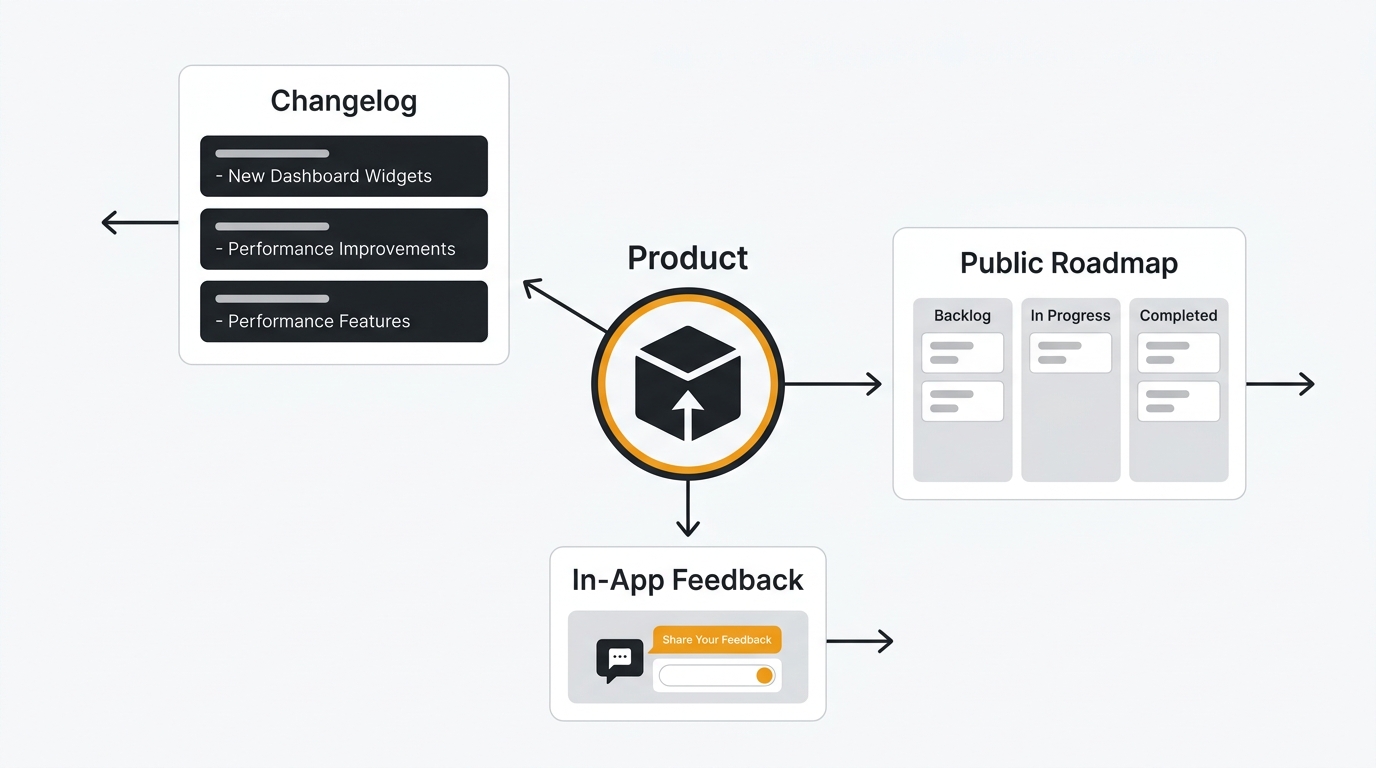
TLDR: Product-led growth is about your product driving adoption. Product-led marketing is about your product's public surfaces driving distribution. Three surfaces every product already owns — the changelog, the public roadmap, and the feedback widget — function as content, credibility, and retention channels when you treat them like channels. Most teams ignore them.
What product-led marketing actually means (and why PLG is not PLM)
Product-led growth is a go-to-market model where the product itself drives acquisition and expansion. A free trial that converts without a sales call is PLG. A viral referral loop baked into the product is PLG. The product is the engine.
Product-led marketing is related but not the same. PLM is the practice of treating your product's public surfaces — the parts prospects and users can see without logging in, or see while using the product — as marketing channels. PLG asks "how does the product acquire users?" PLM asks "what does the product broadcast to the world?"
The two share DNA. A PLG company benefits from strong PLM because its growth depends on the product's legibility. But you do not need to be a PLG company to do PLM. A sales-led B2B tool with a public changelog and roadmap is doing PLM. A freemium app with a locked changelog and private roadmap is doing PLG without PLM, and leaving distribution on the table.
The distinction matters because the playbook is different. PLG is about onboarding, activation, and pricing. PLM is about what your product says when nobody from your team is in the room.
The three distribution surfaces every product already owns
Every product that ships has three public surfaces it can choose to publish:
- The changelog. What you shipped and when.
- The public roadmap. What you are building and what is next.
- The feedback widget. Where users tell you what to build.
Call these the free shipping surface. You are going to ship the work anyway. Publishing what you ship costs nothing extra. Each surface does a different job. Together they replace a surprising amount of the marketing work most teams pay for elsewhere.
Most teams treat these as internal artifacts. The changelog lives in a Notion page updated once a quarter. The roadmap is a private Linear board. The widget is a support email nobody reads. This is the default state, and it leaves the channels unused.
The teams that do PLM well flip this. They make all three public by default, put them on the marketing site, and treat each one as a content channel with its own cadence and audience.
Your changelog is a content channel
A changelog is a running log of what shipped. Treated correctly, each entry is a piece of content. Search engines index it. Existing users subscribe to it. Prospects use it to check whether the product is alive. Every entry is a reason for someone to come back to your site.
The mechanics are simple. Publish a dated entry every time you ship something users can see. Write one or two sentences in plain language. Link to screenshots or a short loop if the change is visual. Tag the entry by area so readers can filter.
The keep a changelog convention is a reasonable starting point for format. It solves the hardest part, which is deciding what goes in and what the categories are. You do not have to follow it exactly, but you do have to pick a format and stick with it.
Changelog entries are also raw material for every other content format. A week of entries becomes a product update announcement email. A month of entries becomes a recap post. A quarter becomes a release note you send to customers. You are writing atoms once and composing them into molecules later.
A tool like the Quackback changelog publishes entries to a clean route, generates an RSS feed, and lets users subscribe by email. The point is not the tool. The point is that the changelog stops being a Notion page and becomes a place on the internet.
Your public roadmap is a credibility channel
A public roadmap does one job no other marketing asset does well. It shows prospects that your product is alive and that you are building toward something.
Evaluation-stage deals die for a specific reason more than any other: the buyer cannot tell if the product will be around in twelve months. A private roadmap gives them nothing to go on. They read the last blog post, see it is from six months ago, and move to the next option. A public roadmap closes that objection without a sales call. The buyer sees items in progress, items shipped last month, and items queued for next quarter. The product is a going concern.
Public roadmaps also reduce support load. Users who want a feature can check the roadmap, upvote it, and see where it is. That is one fewer email to your queue and one more signal to you about what matters.
The objection most teams raise is that a public roadmap forces you to commit to dates. It does not. Use status columns — Exploring, Planned, Building, Shipped — and no dates on individual items. You are publishing direction, not deadlines.
A feature request tracking system feeds directly into this. User-submitted requests become roadmap candidates. Upvotes become prioritization signal. The roadmap becomes a living document that reflects actual demand instead of internal opinion.
Your feedback widget is a retention and referral channel
The third surface is the one most teams miss. A feedback widget embedded in your product turns a silent user into a participating one. Every upvote is a micro-commitment. Every submitted request is a user telling you they care enough to type a sentence. Every fulfilled request is a moment where the user gets something they asked for and attributes it to you.
The feedback widget is a retention channel because it creates a conversation with users who would otherwise bounce. A user who hits a missing feature has two options. Option one: close the tab and forget about you. Option two: click a widget, write a sentence, and move on. The first costs you the user forever. The second buys you a chance to close the loop.
The widget is also a referral channel. Users who get a feature they asked for tell other users, tell their team, and post about it. The customer feedback loop — submit, acknowledge, build, ship, notify — is the mechanism that turns silent usage into advocacy. Each full loop produces at least one user with a story about the product doing something for them.
The widget is the smallest of the three surfaces and the one with the highest leverage. You can add it to a product in a day.
Metrics: how to tell if your product is marketing itself
PLM is measurable if you know where to look. Here are the signals that matter.
| Signal | What it tells you |
|---|---|
Organic traffic to /changelog, /roadmap, /feedback | Your surfaces are ranking and attracting visitors without paid spend |
| Sign-ups with "direct" referral source after visiting those pages | Your surfaces are converting visitors into users |
| Widget opens per session | Your product is inviting conversation rather than ending it |
| Time from first feedback submission to churn | Longer is better — engaged users stick around |
| Upvotes per published roadmap item | Your roadmap reflects demand rather than internal guesses |
| RSS subscribers on the changelog | You are building an owned audience |
| Share of feedback items that ship within 90 days | Your loop is short enough to produce repeat engagement |
None of these require a dedicated analytics pipeline. If you run a product strategy guide review every quarter, these belong in the same dashboard as your usage and revenue metrics.
The signal that matters most is the second one. If visitors to your changelog or roadmap are signing up without being tagged by a paid channel, your product's public surfaces are doing marketing work. That is PLM working.
What breaks when marketing and product do not share these surfaces
Each surface has a specific failure mode when it is ignored.
A stale changelog erodes trust. If the most recent entry is from four months ago, every visitor concludes the product is dying. They are often wrong, but the conclusion has been reached. A stale changelog is worse than no changelog.
A private roadmap kills evaluation-stage deals. Prospects who cannot see what you are building assume you are not building anything. They will not ask. They will quietly move to a competitor whose roadmap they can see. You never learn the deal existed.
A widget without follow-through breeds cynicism. Asking for feedback and ignoring it is worse than not asking. Users who submit a request and hear nothing conclude you do not care. The fix is not a bigger team. The fix is acknowledgment — an automated reply, a status change, a comment from a real person within a week.
All three failures come from treating these surfaces as internal admin rather than public commitments. The moment you commit publicly, the incentive to maintain the surface aligns with the incentive to do the work.
Getting started without a PLM team
You do not need a PLM team to do PLM. You need three weeks and a tool that publishes the surfaces for you.
Week 1: Publish the changelog. Pick a format. Write entries for the last four things you shipped. Put them at /changelog on your marketing site. Add an RSS feed. Commit to one entry per week. A public changelog tool handles this end to end.
Week 2: Make the roadmap public. Move your internal board to a public route or publish a filtered view of it. Use four columns: Exploring, Planned, Building, Shipped. No dates. Seed the columns with whatever is in flight. Link to it from your navigation.
Week 3: Add the widget. Drop a feedback widget into your app. One button, one text field, one submit action. Route submissions into the same tool that manages your roadmap so upvotes feed prioritization automatically.
If you want all three surfaces in one system, Quackback ships them as a single product. It is open source under AGPL-3.0, self-hosted, and free. AI triage is included. It has 25 integrations and an MCP server for agent workflows. The Quackback documentation covers setup. If you are comparing options, the Quackback vs Canny comparison lays out the tradeoffs.
The tool is not the point. The pattern is the point. Three surfaces, published, maintained, treated as channels. That is product-led marketing.
Frequently asked questions
What is the difference between product-led growth and product-led marketing?
Product-led growth is a go-to-market model where the product itself drives acquisition and conversion — free trials, self-serve onboarding, viral loops. Product-led marketing is a practice of treating your product's public surfaces as marketing channels. You can do PLM without being a PLG company, and a PLG company benefits from strong PLM. They share DNA but solve different problems.
Does product-led marketing work for B2B?
Yes, and arguably better than for consumer products. B2B buyers spend weeks in evaluation and look for signals that a product is alive and well-supported. A public changelog and roadmap answer that question directly. They are especially effective for mid-market and enterprise deals where the buyer needs to justify the choice internally.
How do I measure product-led marketing?
Track organic traffic to your /changelog, /roadmap, and /feedback routes. Track sign-ups with a direct referral source from visitors who saw those pages. Track widget opens per session and the share of feedback items that ship within 90 days. The headline metric is sign-ups from visitors to your public surfaces — that number isolates PLM's contribution.
What is the cheapest way to start with product-led marketing?
Publish a changelog on a static page and commit to one entry per week. That is the minimum viable surface. It costs nothing and takes an hour to set up. Add a public roadmap next — a filtered view of your existing board is enough. Add a feedback widget third. An open-source tool like Quackback gives you all three for free if you self-host.
Do I need a dedicated team to run these surfaces?
No. The surfaces work precisely because they piggyback on work you are already doing. The changelog documents shipped work. The roadmap reflects planned work. The widget collects feedback you would receive by email anyway. The overhead is publishing discipline, not new headcount. One person on the product team can own all three surfaces part-time.
Written by James Morton. Founder of Quackback, the open-source platform for customer feedback and support.
Quackback is open-source software for customer feedback and support
Feedback boards, a public roadmap, a changelog and a support inbox in one place. Free to start, no card needed.
Keep reading
Feature Voting: How to Let Users Prioritize Without a Popularity Contest
Feature voting turns user requests into ranked demand data. Learn single vs weighted voting, how to stop gaming and vote fragmentation, and how to act on votes.
How to Prioritize Feature Requests: A Practical Framework (2026)
Learn how to prioritize feature requests with a repeatable framework: gather signal, score with RICE or MoSCoW, weight by customer value, and build a roadmap.
Customer Engagement Tools for Product Teams (Not Marketing)
Most customer engagement tool lists target marketers. Here is the stack product teams actually need — widgets, feedback, changelogs, onboarding, and voting.